
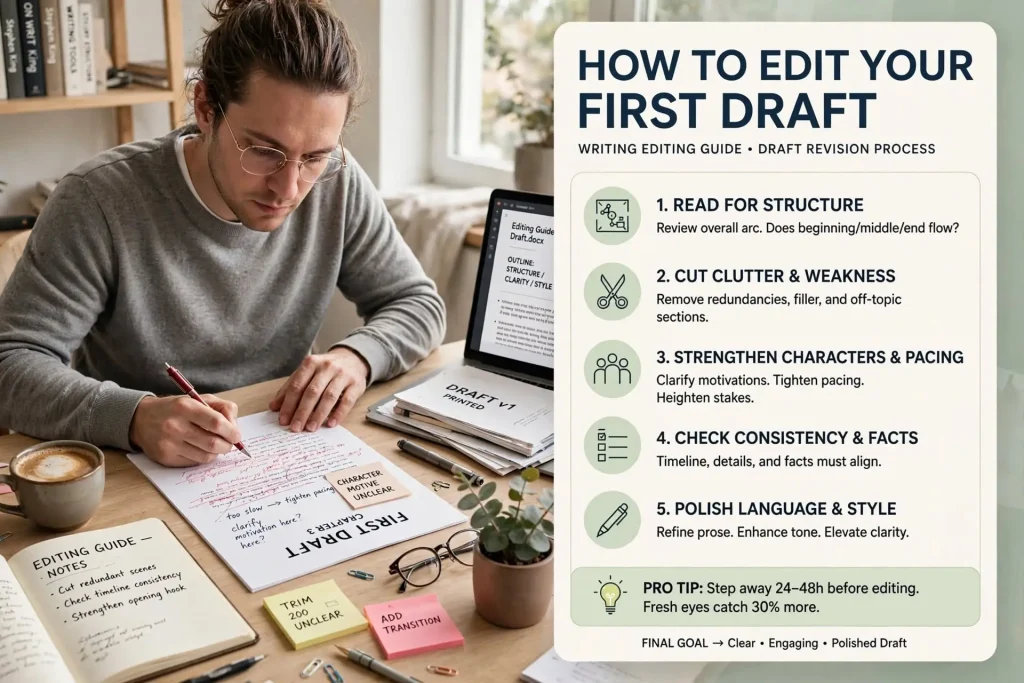
Most authors send first drafts to professional editors and pay for the editor to fix problems the author could have fixed themselves at no cost. The editing bills get higher than necessary. The professional editing focuses on issues the author should have caught rather than on the deeper work editors are uniquely positioned to do. The how to edit first draft skills authors develop pay back across every subsequent book they write. Self-editing isn’t replacement for professional editing but preparation that makes professional editing more effective and less expensive. Authors who develop self-editing skills consistently outperform authors who skip this phase.
This post walks through the specific self-editing techniques that improve first drafts significantly, in the proper sequence, before any professional editing money gets spent.
Why Self Editing Before Professional Edit Matters
Self-editing serves specific purposes that affect professional editing outcomes.
The cost reduction. Professional editing typically charges by word count or by hour. Cleaner manuscripts cost less to edit professionally.
The focus elevation. When obvious surface issues are fixed, professional editors can focus on deeper structural and craft issues that produce more value.
The skill development. Self-editing builds craft skills that improve subsequent writing. Authors who self-edit consistently write cleaner first drafts over time.
The objectivity practice. Self-editing requires distance from your own work. Developing this objectivity supports better creative decisions.
The manuscript clarity. Self-editing identifies what your manuscript is actually doing versus what you think it’s doing. The reality check matters.
The professional respect. Strong manuscripts get better attention from professional editors than weak manuscripts. The work quality affects the professional relationship.
These benefits compound across an author’s career. Self-editing skill becomes one of the most valuable craft skills you develop.
The Distance Step
Distance from your manuscript enables self-editing that doesn’t work otherwise.
The minimum distance period. At least 2 weeks between finishing first draft and beginning revision. Longer if possible.
The complete break. Don’t keep tinkering during the distance period. Actual break, not partial break.
The other reading. Read other books during the distance period. Reset your reading expectations.
The other project work. Some authors start next project during distance period. The new work resets perspective.
The fresh-eyes return. When you return, you should see your manuscript more clearly than you could immediately after finishing. The clarity enables effective revision.
Without the distance step, self-editing tends to produce minor adjustments rather than meaningful improvements. The familiarity with your own work prevents seeing it clearly.
Structural Self Editing
Address the largest issues first.
The overall structure question. Does your story or argument actually work at the structural level? Three-act structure for fiction. Argument structure for nonfiction.
The opening evaluation. Does the opening do what openings need to do? Strong hooks. Establishment of key elements. Reader investment building.
The middle assessment. Does the middle maintain reader engagement? Or sag in ways that lose readers?
The ending review. Does the ending deliver on the opening’s promise? Closure of the right elements?
The structural rebalancing. Sometimes specific sections need significant work. Better to identify at self-editing stage than during professional editing.
The chapter-level review. Does each chapter advance the story or argument? Or include material that should be cut or moved?
The pacing audit. Where does the manuscript drag? Where does it rush? Pacing problems affect everything that follows.
Structural problems should be fixed before line-level editing. Fixing prose in scenes that get cut wastes effort.
Scene Level Self Editing
For fiction, scene-level review identifies problems below the structural level.
The scene purpose question. Each scene should serve specific purposes. Scenes without clear purpose should be cut or rewritten.
The scene-by-scene tension check. Does each scene have specific tension? Scenes without tension typically should be cut.
The scene transitions. Do scenes connect properly? Transitions that feel jarring or unclear damage reading flow.
The scene-level pacing. Are individual scenes paced appropriately? Some need more breathing room. Others need cutting.
The scene character work. Do characters develop appropriately within each scene? Static scenes typically need work.
The scene conflict. Is the conflict in each scene clear? Vague conflict produces vague scenes.
The scene resolution. Does each scene resolve appropriately? Or end in ways that don’t serve subsequent scenes?
For nonfiction, similar review applies to individual sections within chapters. Each section should serve specific purposes within the larger argument.
Paragraph Level Self Editing
Paragraph-level review catches issues that scene-level review misses.
The paragraph length variation. Mix paragraph lengths for reading rhythm. Wall-of-text paragraphs tire readers. All-short paragraphs feel choppy.
The topic sentence clarity. Does each paragraph have clear focus? Wandering paragraphs confuse readers.
The paragraph transitions. Do paragraphs connect smoothly? Transitions that work properly support reading flow.
The redundancy elimination. Does each paragraph add something new? Or repeat what previous paragraphs covered?
The paragraph cuts. Some paragraphs add nothing. Identify them and cut them. The book gets better.
The paragraph repositioning. Some paragraphs work better elsewhere. The right position improves them significantly.
Paragraph-level work tightens manuscripts significantly. The cumulative effect across hundreds of paragraphs makes substantial difference.
Sentence Level Self Editing
Sentence-level work addresses the prose itself.
The sentence variety. Mix sentence lengths. Mix sentence structures. Monotonous sentence patterns tire readers.
The verb strength. Strong verbs carry sentences. Weak verbs (forms of “to be,” “to have”) often signal opportunity for improvement.
The adjective and adverb reduction. Excessive modifiers usually signal weak nouns and verbs. Strengthen the nouns and verbs. The modifiers become unnecessary.
The passive voice review. Passive voice has appropriate uses but often signals weak writing. Convert most passive to active.
The unnecessary words. Many sentences contain words that add nothing. Cut them. The sentences become stronger.
The clunky phrasing. Awkward phrasing slows reading. Rewrite for smoother flow.
The repeated sentence structures. Avoid starting consecutive sentences the same way. Vary structures.
The sentence rhythm. Read aloud. Sentences that feel awkward when spoken usually have problems on the page too.
Sentence-level work produces the polish that distinguishes professional from amateur prose.
Word Level Self Editing
Word-level work catches the smallest issues.
The word choice precision. The specific right word usually exists. Find it.
The repeated word search. Same words used repeatedly in close proximity tire readers. Search for your overused words and vary them.
The clich avoidance. Cliches signal lazy writing. Replace with fresh phrasing.
The filler word removal. “Just,” “really,” “very,” “actually,” and similar words often add nothing. Cut them.
The character tic review. Specific phrases or expressions you overuse without noticing. Search and reduce.
The spelling and grammar issues. Catch what you can. Professional editing handles the rest but obvious errors should be fixed.
The dialect and accent consistency. If characters speak distinctively, the dialects should remain consistent.
Word-level work seems minor but cumulative effects across an entire manuscript significantly affect reading experience.
Reading Aloud Technique
Reading your manuscript aloud reveals issues silent reading misses.
The natural rhythm test. Sentences that work in writing should work when spoken. Sentences that don’t usually have problems.
The dialogue authenticity check. Dialogue read aloud reveals if characters sound natural or stilted.
The pacing identification. Where does the reading drag? Where does it rush? Pacing problems become obvious when read aloud.
The repeated word detection. Repeated words and phrases stand out when read aloud in ways they don’t when read silently.
The transition smoothness. Scene and paragraph transitions either work or feel awkward when read aloud.
The sentence length issues. Long sentences that work in writing may feel unwieldy when read aloud. The aloud test reveals when sentences need shortening.
The text-to-speech alternative. Some authors use text-to-speech rather than reading aloud themselves. The TTS catches similar issues with less throat fatigue.
Reading aloud is among the most powerful self-editing techniques available. The discomfort of the practice is worth the issues it reveals.
Backwards Reading Technique
Reading the manuscript backwards catches different issues.
The fresh perspective. Reading in reverse breaks the narrative flow that hides issues. Each sentence gets evaluated independently.
The line-level focus. Backwards reading focuses attention on individual sentences rather than story.
The error catching. Typos, grammatical errors, and word choice issues become more visible when story momentum doesn’t distract.
The repetition detection. Repeated words and phrases stand out without narrative flow masking them.
The sentence structure variation check. Pattern monotony becomes obvious without narrative context.
The application stages. Backwards reading works particularly well for late-stage self-editing focused on prose polish.
The pace consideration. Reading backwards is slow. Plan time accordingly.
Backwards reading complements forward reading rather than replacing it. Both techniques catch different issues.
Self Editing Tools That Help
Several tools support self-editing.
Word processors with editorial features. Word, Google Docs, and others have basic spelling and grammar checking.
Grammarly. Subscription tool that catches more issues than basic word processor tools. Useful but limited.
ProWritingAid. Strong tool with reports for various style issues. Useful for catching patterns.
AutoCrit. Tool focused on fiction craft issues. Identifies overused words, repeated phrases, sentence variety issues.
Hemingway App. Identifies wordy sentences and reading-level issues. Useful for prose tightening.
Read-aloud software. Text-to-speech tools that read manuscripts aloud. Useful for the reading-aloud technique without throat fatigue.
Standard search-and-replace. Built into all word processors. Useful for finding overused words and patterns.
Tools assist but don’t replace careful reading. The tools find issues for you to consider. You make the decisions.
Knowing When to Stop Self Editing
Self-editing can become procrastination if pushed too far.
The diminishing returns point. After several revision passes, additional self-editing produces less improvement.
The fresh eyes limitation. Eventually you can’t see your own manuscript clearly regardless of distance.
The professional editor value. Some issues require external perspective to address. Self-editing forever doesn’t solve these.
The schedule consideration. Books need to get published eventually. Endless self-editing prevents that.
The signal recognition. When revision passes produce mostly minor word changes rather than substantial improvements, self-editing has done its work.
The handoff readiness. Manuscript ready for professional editing should be substantially improved from first draft but doesn’t need to be flawless.
Stop self-editing when you’ve exhausted what you can identify yourself. Professional editors handle what remains.
Self Editing Skills That Pay Across Every Book
The self-editing skills you develop early in your writing career pay back across every subsequent book you write. The skills transfer. The discipline transfers. The eye for craft develops over time and supports better writing as well as better self-editing. Authors who treat self-editing as serious craft skill rather than as obstacles to publication tend to produce books that get progressively stronger across their careers.
The investment in self-editing skills isn’t extreme. A few months of focused practice on self-editing techniques applied to one manuscript produces skills that support every subsequent manuscript. The improvement compounds across years. The author who self-edits seriously across their first ten books typically produces dramatically stronger work by book ten than the author who skipped self-editing development. The skill compounds without specific additional effort once developed. Strong first drafts produce strong final books with reasonable professional editing investment. Weak first drafts require expensive professional editing to produce acceptable final books. The choice between these patterns affects publishing economics significantly across an author’s career. Self-editing might be the most leveraged craft skill available to writers given how the skill development supports every book you’ll write across your entire career.


