
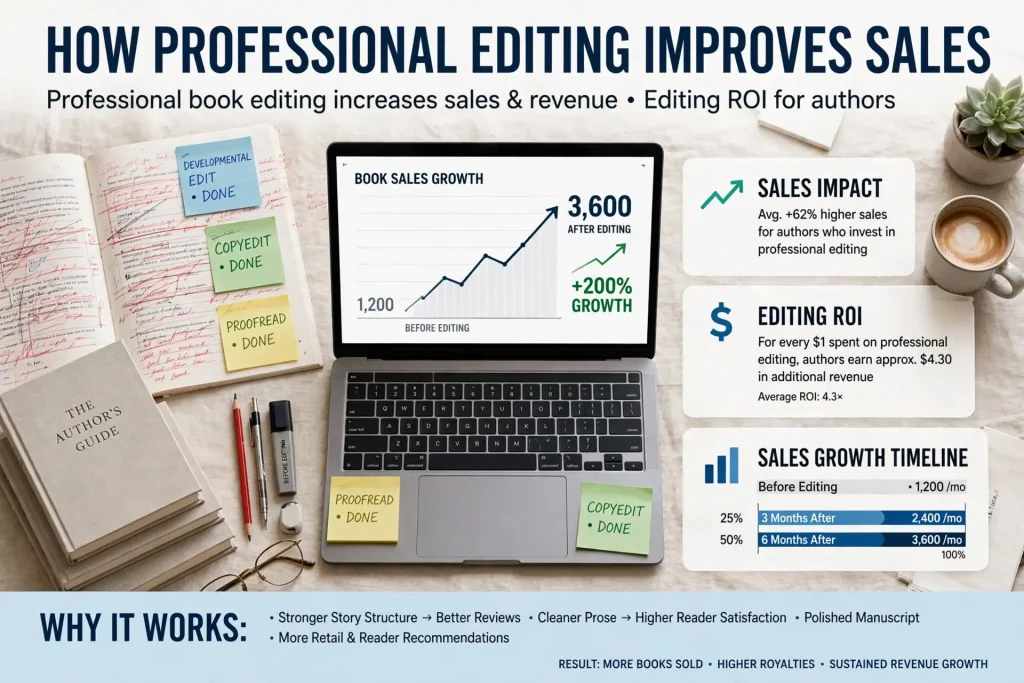
Most authors discuss editing as quality investment without specifically addressing the commercial outcomes. The reality is that editing affects book sales in measurable ways across multiple specific mechanisms. The editing increases book sales claim isn’t vague endorsement of professional services. It’s documented pattern of specific financial outcomes that can be calculated, projected, and verified. Authors thinking about editing as financial decision benefit from knowing the specific sales mechanisms editing affects and the actual ROI math involved.
This post walks through the data showing how editing affects sales, the specific mechanisms involved, and how to calculate the financial return on editing investment.
The Editing Sales Correlation
Multiple data sources show consistent patterns linking editing quality to sales outcomes.
The review quality correlation. Books with professional editing average half-star to full-star higher Amazon ratings than equivalent books without professional editing.
The review count differences. Edited books accumulate more total reviews than unedited equivalents. The completion rate difference contributes.
The sales velocity differences. Edited books typically sell faster than equivalent unedited books across launch and ongoing periods.
The algorithm visibility patterns. Edited books achieve algorithm visibility at higher rates than unedited equivalents. The compounding effect is significant.
The reader retention differences. Edited series books produce higher read-through rates than unedited series. The retention affects total series revenue.
The promotional efficacy differences. Same promotional spend produces different sales results based on editing quality.
The long-tail sales patterns. Edited books continue selling across years. Unedited books typically see sales drop off faster.
These correlations show up in surveys of indie author income, in promotional placement data, and in platform-published analyses. The pattern is consistent enough to be predictable.
The Review Rating Data
Review ratings directly affect sales through specific mechanisms.
The 4-star versus 3-star difference. Books at 4-star average significantly outsell books at 3-star average. The difference is substantial.
The 4.5-star versus 4.0-star difference. The half-star difference at higher levels also produces meaningful sales differences.
The 4-star floor effect. Books below 4-star averages face significant discovery limitations on most platforms.
The review trajectory effect. First reviews shape ongoing review trajectory. Editing affects first review tone significantly.
The recent reviews emphasis. Recent reviews matter more than older reviews for current sales. Editing problems generate negative recent reviews that persist.
The review velocity effect. Higher conversion of readers to reviewers requires reading experience that motivates reviews. Editing affects this directly.
The review category breakdown. 1-star and 2-star reviews disproportionately affect averages and conversion. Editing problems produce these reviews specifically.
Review ratings translate to specific sales differences. The data on this relationship is well-documented across genres and platforms.
The Review Profile Quality Impact
Beyond ratings, review content quality affects sales.
The substantive review content. Edited books produce reviews with substantive content about story, characters, or content. Unedited books produce reviews focused on editing problems.
The editorial commentary frequency. Reviews calling out editing problems remain visible to future browsers. The damage persists.
The thumbs-up review patterns. “Most helpful” reviews affect how reviews get displayed. Editing-problem reviews often get helpfulness votes from readers who agreed.
The cross-platform consistency. Reviews on Goodreads, BookBub, Amazon all show editing patterns when problems exist. The multi-platform damage compounds.
The reviewer credibility effects. Established reviewers with audiences pay attention to editing quality. Their reviews carry weight beyond rating.
The book club consideration. Book clubs and reading groups select based on review profiles. Editing-problem books rarely get selection.
The recommendation patterns. Reader recommendations to friends correlate with how readers describe books. Books described as having editing problems don’t get recommended.
Review profile quality matters across the book’s entire commercial life. The damage from editing problems compounds across the years the book remains available.
The Read Through Data
Read-through rates affect specific revenue streams.
The series read-through importance. Series read-through rates determine total series revenue. Strong read-through multiplies first-book sales across series.
The KU page-read implications. KU revenue depends on pages read. Books readers abandon before finishing produce less KU revenue.
The completion rate effects. Books readers complete recommend better than books they abandon. The recommendation pattern affects ongoing sales.
The review trigger effects. Readers who complete books are much more likely to review. The review rate affects long-term sales.
The brand building effects. Authors with completed series books build different brands than authors with abandoned series.
The pricing tolerance effects. Series with strong read-through support higher pricing for individual books. Series without read-through can’t sustain pricing.
The promotional efficacy effects. Series promotions work better when read-through historically strong.
Read-through is significantly affected by editing quality. Books with editing problems get abandoned at higher rates than well-edited books.
The Recommendation Engine Data
Platform algorithms reflect editing quality indirectly.
The “customers who bought” patterns. Books bought together by similar readers signal algorithmic similarity. Edited books appear in better “also bought” sections.
The similar product recommendations. The recommendation engines surface books based on patterns. Edited books get surfaced more often.
The category bestseller dynamics. Category bestseller status requires sales velocity. Editing affects velocity.
The launch period algorithm impacts. Initial launch performance shapes ongoing algorithmic visibility. Editing affects launch performance.
The cross-book recommendation patterns. Authors with multiple edited books get cross-book recommendations more reliably than authors with mixed catalog.
The genre algorithm specifics. Different genre algorithms weight different signals. Editing affects multiple signal types.
The international algorithm differences. International market algorithms may weight different factors. Editing quality typically helps across markets.
Algorithm visibility is among the most valuable assets for book sales. Editing affects algorithm visibility through multiple compounding mechanisms.
The Word of Mouth Multiplier
Word-of-mouth recommendations drive significant book sales.
The friend recommendation patterns. Readers recommend books they enjoyed completely. Editing problems prevent the complete enjoyment that motivates recommendations.
The book club selection. Book clubs need books worth discussing. Editing problems make books feel less worthy of group discussion.
The social media sharing patterns. Readers share books that impressed them. Editing problems prevent the impression that motivates sharing.
The professional recommendation patterns. Other authors recommending books, podcast hosts featuring books, journalists covering books all depend on editing quality.
The educator recommendations. Books used in educational contexts (writing programs, reading groups) require professional quality.
The library and bookstore recommendations. Librarians and booksellers recommend books they trust. Editing affects trust.
The reader review evangelism. Some readers become evangelists for specific books. Editing affects which books get this treatment.
Word-of-mouth has multiplicative effects. Each enthusiastic recommendation can drive additional sales. The compounding across years is significant.
The Long Tail Sales Effect
Books continue selling across years. The long-tail patterns reveal editing impact.
The 6-month performance. Books with editing problems often sell strongly during launch promotion then drop off significantly. Edited books maintain better tail performance.
The 1-year performance. The 12-month mark reveals which books built sustainable audiences versus which depended on promotional momentum.
The multi-year performance. Books that continue selling 2+ years after launch typically have editing quality that supported sustained recommendations and reviews.
The career-long catalog performance. Authors with edited catalogs build catalog revenue that compounds across years. Authors with editing-problem catalogs see catalog revenue plateau or decline.
The series compounding effects. Series with editing quality compound sales as readers discover the series. Series with editing problems often see middle-series books underperform first-series books.
The new release halo effect. New releases benefit from backlist health. Edited backlist creates better halo for new releases.
The retiring books pattern. Some books need to be retired due to dated content or other issues. Editing-problem books often need earlier retirement than would otherwise be necessary.
Long-tail sales represent significant total revenue. Editing affects long-tail strength significantly.
The Specific Genre Patterns
Genre-specific patterns affect how editing impacts sales differently.
The romance genre. Romance readers tend to be voracious series readers. Editing problems damage series read-through significantly. The genre is particularly editing-sensitive.
The thriller genre. Thriller readers expect tight pacing. Editing problems that affect pacing damage thrillers severely.
The literary fiction. Literary fiction depends on prose quality. Editing problems damage literary fiction reception most directly.
The genre fiction beyond romance and thriller. Fantasy, science fiction, mystery, and others all have editing expectations.
The nonfiction. Different nonfiction subgenres have different editing tolerances but all expect baseline professional quality.
The business books. Business books face particularly high editing expectations because they signal expertise.
The self-help. Self-help readers expect both substance and professional production.
The memoirs. Memoirs face high editing expectations because the writing itself often gets evaluated.
Different genres punish editing problems differently but all genres punish them. The specific patterns affect editing strategy across different types of books.
Calculating Editing ROI
The ROI math demonstrates editing investment returns.
The total editing investment. Typically $3,500 to $12,500 for full editing tier across stages.
The conversion rate improvement. Editing typically produces 20% to 50%+ conversion rate improvements. The improvement affects every sale.
The review rating improvement. Half-star average improvement typical. Affects sales through visibility and conversion.
The completion rate improvement. Reader completion rates can improve 30% to 50%+ with editing. Affects KU revenue and reviews.
The series read-through improvement. Series read-through can improve 50% to 100%+ with editing. Affects total series revenue dramatically.
The lifetime sales calculation. Editing affects sales across the book’s entire commercial life. The lifetime impact typically exceeds editing cost many times over.
The series math example. Series first book with editing: $8,000 invested. Books two through five each generate $5,000 to $20,000 additional revenue from improved read-through. The math works.
The catalog effects. Across a catalog of 10 books, editing investment of $80,000 to $100,000 typically generates several times that amount in additional sales across the catalog’s commercial life.
The ROI calculations demonstrate that editing is among the highest-leverage investments in commercial publishing.
The Sales Math That Justifies Editing Spend
The financial math on editing investment works decisively for any author taking publishing seriously as commercial activity. The investments in editing produce returns through multiple mechanisms that compound across years. The conversion rate improvements affect every sale. The review profile improvements affect every browser. The completion rate improvements affect every reader. The algorithm visibility improvements affect every discovery cycle. The word-of-mouth improvements affect every reader-to-reader recommendation. Each mechanism contributes to total sales improvement.
The total return from editing investment typically exceeds the investment many times over across a book’s commercial life. The ROI math is hard to argue with when actually run. Authors who treat editing as expense to minimize tend to under-invest and produce books that perform commercially below their actual writing skill. Authors who treat editing as investment to optimize tend to make different decisions and produce books that succeed commercially in ways authors might not have expected. The pattern across thousands of published indie books is consistent enough to be predictable. The few authors who succeed without editing investment tend to be exceptions that prove the rule rather than evidence that editing doesn’t matter. For the vast majority of commercial publishing, editing remains the investment with among the highest documented ROIs available in the publishing business.


