
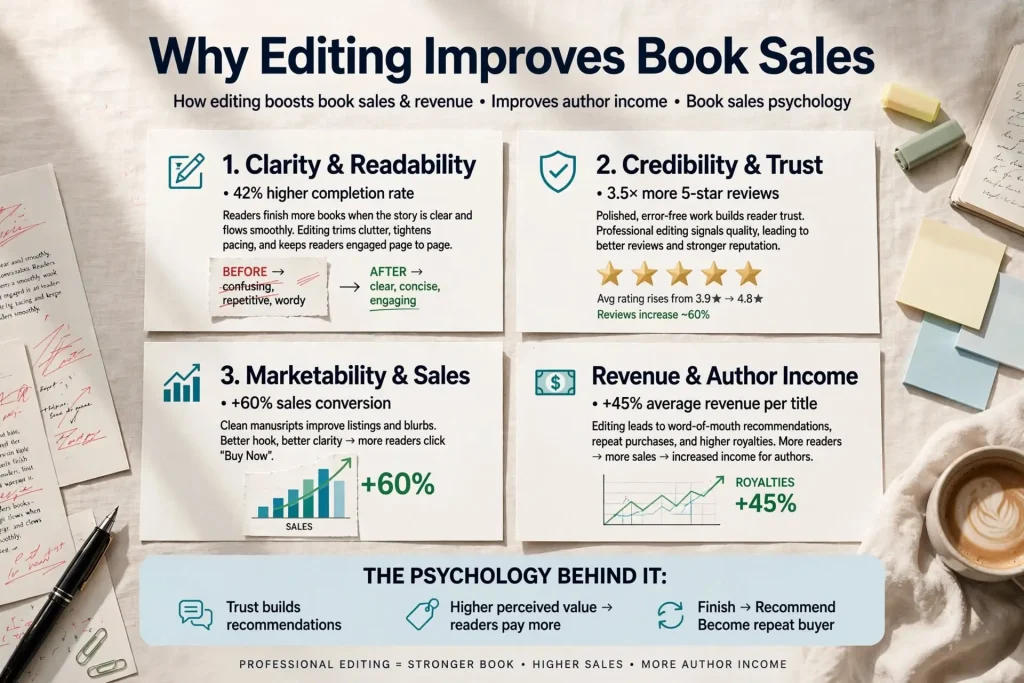
Most discussions of editing focus on the decision to edit at all. The more important question is why editing produces commercial outcomes. Authors who know the mechanisms by which editing improves sales tend to make better investment decisions than authors who hear vague claims about editing being important without specific reasoning. The editing improves sales claim deserves specific framework explanation rather than blanket assertion. Quality genuinely drives sales in the book marketplace through specific mechanisms that operate consistently across genres and platforms. Authors who recognize these mechanisms can think about editing strategically rather than as expense to minimize.
This post walks through the specific market mechanisms by which editing quality drives sales, why the quality-sells thesis works in book publishing specifically, and how editing investment functions as competitive advantage in crowded markets.
Why Quality Drives Sales in the Marketplace
The book marketplace has specific characteristics that make quality matter commercially.
The supply oversaturation reality. New books arrive at platforms daily by the thousands. Readers face more options than they can possibly examine. Quality differentiation matters when supply exceeds attention.
The reader risk calculation. Readers take risk on new authors. The risk calculation includes expected quality. Books that disappoint reduce future risk-taking on the same author.
The recommendation infrastructure dependence. Most book discovery flows through recommendations (algorithms, reviews, word-of-mouth). All these mechanisms favor quality books.
The trust building dynamics. Author-reader relationships build on trust accumulated across books. Each quality book builds trust. Each quality problem damages trust.
The compound interest reality. Quality books generate ongoing returns. Reviews accumulate. Reader recommendations multiply. Algorithm visibility persists. Quality decisions compound across years.
The opportunity cost reality. Time spent reading a specific book is time not spent on alternatives. Quality affects if readers feel that time was well spent.
These market characteristics make quality investment commercially rational rather than just aesthetically preferable. The market specifically rewards quality through measurable mechanisms.
The Competitive Quality Threshold
Every genre has effective quality threshold for competing commercially.
The genre-specific threshold. Different genres have different quality expectations. Literary fiction has different standards than airport thrillers. Each genre has effective threshold.
The threshold compliance requirement. Books below the genre threshold typically fail commercially regardless of marketing investment. The threshold isn’t negotiable through promotional spending.
The threshold movement. Genre quality thresholds typically rise over time as more competition emerges. Yesterday’s acceptable quality may not meet today’s expectations.
The threshold awareness. Authors who study their genre carefully tend to know the threshold. Authors who don’t study often produce work that doesn’t meet contemporary standards.
The above-threshold competition. Once above threshold, books compete on other dimensions (cover, marketing, positioning). Below threshold, those dimensions can’t compensate.
The threshold-determined investment. Editing investment should be sufficient to clear the genre threshold reliably. Inadequate investment produces sub-threshold work that fails commercially.
Threshold thinking helps authors think about editing as competitive positioning rather than as quality concern in abstract.
The Reader Experience Quality Mechanism
The reading experience itself determines commercial outcomes through specific dynamics.
The immersion dependence. Strong books support reader immersion. Editing problems break immersion repeatedly. Broken immersion damages reading experience.
The cognitive load reality. Reading requires cognitive effort. Editing problems increase that effort. Higher cognitive load reduces enjoyment.
The friction frustration. Reading should feel effortless when working well. Editing problems produce friction. Friction frustrates readers across hundreds of small moments.
The completion likelihood. Readers complete books that feel good to read. They abandon books that feel like work. Editing affects completion rates significantly.
The recommendation motivation. Readers recommend books they enjoyed. Editing affects enjoyment. Editing affects recommendation rates.
The review motivation. Readers review books that affected them. Editing affects emotional impact. Editing affects review rates.
The repeat purchase decisions. Readers buy subsequent books from authors whose previous books they enjoyed. Editing affects enjoyment. Editing affects repeat purchases.
The reader experience mechanism connects editing quality to specific commercial outcomes through measurable pathways. The mechanism operates reliably across genres and reader demographics.
Quality Signaling Effects on Discovery
Beyond the reading experience itself, quality signals affect discovery through specific mechanisms.
The cover-as-quality-signal effect. Strong covers signal probable content quality. Readers reasonably infer that books with quality covers probably have quality content.
The description-as-quality-signal effect. Well-written descriptions signal probable writing quality. Poorly written descriptions signal otherwise.
The reviews-as-quality-signal effect. Strong review profiles signal probable reading quality. Weak review profiles signal weak books.
The price-as-quality-signal effect. Pricing can signal positioning. Books priced too low may signal quality problems. Books priced appropriately signal serious positioning.
The author-as-quality-signal effect. Authors with quality reputations get benefit of doubt on new releases. Authors without quality reputations don’t.
The metadata-as-quality-signal effect. Strong metadata (titles, keywords, categories) signals attention to detail that suggests content quality.
The sample-as-quality-signal effect. The free sample readers can access reveals editing quality immediately. Editing problems in samples prevent purchase.
Quality signals operate before readers even read the books. The signals affect which books get discovered, examined, and purchased.
Quality & the Subscription Economy
Subscription services like Kindle Unlimited operate with specific quality dynamics.
The pages-read revenue model. KU revenue depends on actual pages read. Books readers abandon produce less revenue. Editing affects abandonment rates.
The completion rate as direct revenue. The percentage of subscribers who finish the book directly affects revenue. Editing affects completion.
The recommendation flywheel within KU. KU algorithms favor books KU subscribers actually finish. Editing affects completion. Completion affects recommendations.
The series binge dynamics. KU subscribers often binge series quickly. Strong editing supports binge reading. Editing problems interrupt binges.
The author momentum within KU. Authors with strong KU performance get more KU visibility. Quality builds momentum that’s hard to achieve without quality.
The KU enrollment value question. KU enrollment makes most economic sense for authors who can deliver consistent quality. The enrollment becomes increasingly valuable as quality improves.
Subscription economics specifically reward quality through their revenue mechanics. Authors who produce quality books for subscription services often generate substantially more revenue than authors who don’t.
Quality & Word of Mouth Velocity
Word-of-mouth recommendations multiply book sales when they happen.
The recommendation barrier height. Readers don’t recommend books they didn’t love. The bar for recommendation exceeds the bar for completion.
The recommendation cost calculation. Recommending requires reputation investment from the recommender. Bad recommendations damage the recommender’s reputation. Quality matters significantly for if readers risk recommendations.
The friend network propagation. Strong books propagate through reader networks. Each enthusiastic reader recommends to multiple others. The multiplier effects are significant.
The book club velocity. Book clubs accelerate word-of-mouth significantly when they select books. Selection requires quality.
The social media share patterns. Books that get social media buzz typically have quality that justifies the buzz. Books without quality don’t get organic social media presence.
The celebrity recommendation patterns. When books reach broader audiences through celebrity recommendations, quality matters significantly. Celebrity recommendations of poor books damage celebrity credibility.
The professional recommendation patterns. Other authors, podcast hosts, journalists recommending books all require quality books to recommend. Without quality, these channels stay closed.
Word-of-mouth velocity multiplies book sales beyond what any individual marketing can achieve. The multiplication depends on quality that motivates recommendation.
Quality & Cross Book Effects
Books in an author’s catalog interact in ways that quality affects.
The series read-through dependence. Series success depends on readers continuing through series books. Quality affects continuation.
The author brand catalog effects. Authors with consistent quality across catalogs build brands that support all books. Inconsistent quality damages the brand.
The backlist activation patterns. New releases drive readers into backlist. The backlist needs quality to convert these reader visits.
The cross-genre author considerations. Authors writing across genres face quality expectations in each. Weakness in one genre can affect perception across genres.
The series spin-off effects. Strong series enable spin-off works. Weak series prevent expansion opportunities.
The audiobook conversion patterns. Strong text books support audiobook adaptations. Weak text books rarely support audiobook investment.
The translation opportunities. Strong books in source language support translation investments. Weak books don’t.
Cross-book effects mean that individual book quality affects catalog-wide commercial outcomes. Investment in quality on one book benefits others.
Quality as Pricing Power
Quality affects what books can charge through specific dynamics.
The premium pricing justification. Books that justify premium pricing usually have quality that supports the positioning. Quality enables pricing power.
The bargain pricing avoidance. Books that must compete on price typically have quality limitations. Quality lets you avoid the bargain bin.
The promotional pricing leverage. Promotional discounts work better on quality books. Same discount on quality book versus weak book produces different results.
The series pricing strategies. Strong series can sustain pricing strategies that weak series can’t. The strategic flexibility benefits revenue.
The international pricing opportunities. Quality books can sustain international pricing strategies. Weak books often need market-specific discounting.
The bundle pricing flexibility. Bundles of quality books support higher pricing than bundles of weak books.
The special edition pricing. Hardcover special editions require quality that justifies the production investment.
Pricing power matters significantly for total author revenue. Quality enables pricing power that authors without quality can’t access.
The Quality Investment Multiplier
Editing investment functions as multiplier on other publishing investments.
The cover design multiplier. Strong covers work better on quality content. Cover investment produces returns that depend on content quality.
The marketing multiplier. Marketing investment produces different returns based on book quality. Same marketing spend produces different results.
The promotional placement multiplier. Promotional placements work better on quality books. The placement effectiveness depends on quality.
The advertising ROI multiplier. Paid advertising ROI depends on conversion rates. Quality affects conversion. Quality affects ad ROI.
The platform algorithm multiplier. Algorithmic visibility depends on signals that quality affects. Quality multiplies algorithm value.
The audience growth multiplier. Email list growth, social following, audience development all benefit from quality. Quality multiplies audience investment returns.
The catalog effect multiplier. Quality books support catalog effects that weak books don’t. Quality multiplies catalog development value.
The multiplier function means editing investment isn’t just about that specific book. It multiplies the returns on every other investment associated with that book and surrounding books.
Quality Compounds Across Time
The compound effects across time make quality particularly valuable for sustainable publishing.
The first-year sales pattern. Quality books often sell more in year one than weak books. The launch advantage matters.
The multi-year sales pattern. Quality books continue selling across years while weak books fade. The tail revenue matters.
The decade-long catalog value. Quality catalogs maintain value across decades. Weak catalogs lose value as they age.
The audience growth pattern. Quality books build audience that supports subsequent releases. Weak books don’t build audience effectively.
The career trajectory pattern. Authors who invest in quality early in their careers tend to develop trajectory advantages that compound. Authors who don’t invest fall behind progressively.
The intergenerational reader pattern. Quality books sometimes find new generations of readers years after release. Weak books typically don’t.
The legacy value. Authors with quality catalogs leave intellectual property that has actual value. Authors with weak catalogs typically don’t.
Compound effects across decades make quality investment particularly compelling for authors thinking about sustainable careers rather than just current book performance.
Quality as Sustainable Sales Driver
The quality-sells thesis isn’t sentiment about books deserving care. It’s specific commercial framework that operates through identifiable mechanisms in the actual book marketplace. Authors who recognize these mechanisms can think about editing strategically rather than viewing it as expense to minimize. The quality threshold for commercial competitiveness rises over time. The investment required to clear that threshold isn’t shrinking either. Authors who underfund editing typically produce work that doesn’t compete effectively in their chosen genres regardless of writing skill.
The frame change matters. Authors thinking about editing as expense tend to spend differently than authors thinking about editing as investment with measurable commercial return. The same financial outlay produces different decisions when framed differently. The investment framework typically leads to higher editing investment and significantly higher commercial returns than the expense framework. Quality genuinely drives sales in the book marketplace through the specific mechanisms covered in this post. Authors who internalize this framework tend to build sustainable publishing careers that authors operating without the framework can’t match through writing skill alone. The market rewards quality with sustained sales, ongoing audience growth, and career trajectory that compounds across years. The market punishes quality problems through review damage, sales limitation, and career trajectory that plateaus below where authors’ actual writing skill would otherwise support. Authors get to choose which pattern their careers follow. The choice typically gets made through investment decisions about editing.


