
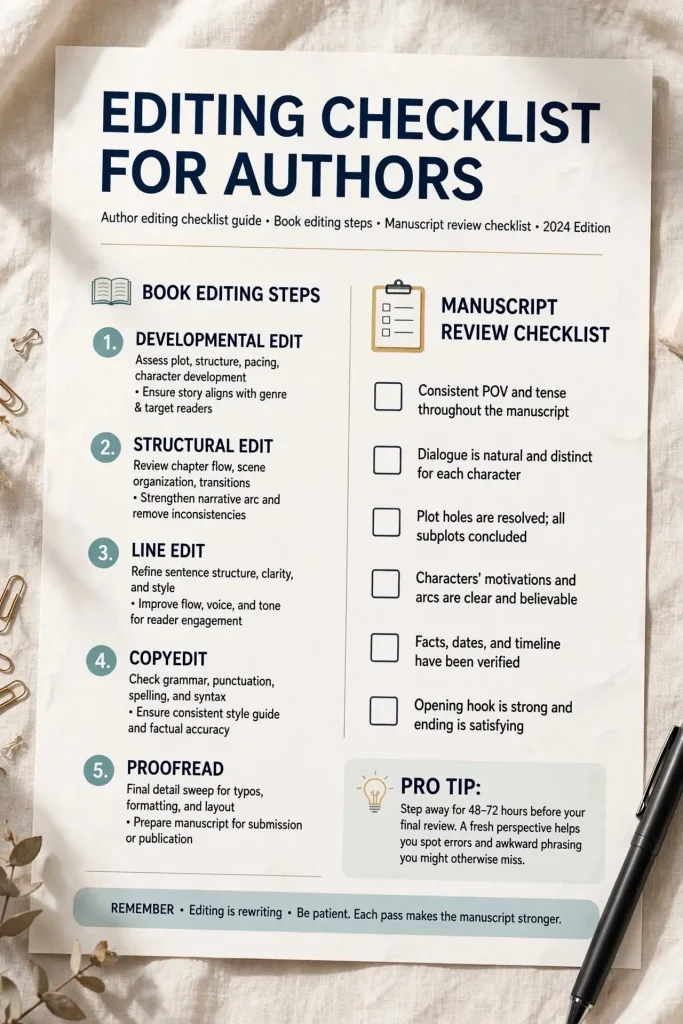
Most authors approach editing without systematic process. They edit their manuscripts when they think to, addressing whatever issues catch their attention, without working through a consistent checklist of items to verify at each editing stage. The book editing checklist that actually helps authors provides specific items to check at each editing pass, organized in the order that supports productive workflow. Authors who work from checklists produce more thoroughly edited manuscripts than authors who edit by intuition.
This post provides specific actionable checklists for each editing stage, organized to support systematic editing workflow.
Why Editing Checklists Help Authors
Checklists support specific aspects of editing work.
The completeness assurance. Checklists prevent overlooking items that should be addressed. Without checklists, authors miss issues they would have caught with systematic review.
The consistency maintenance. Checklists support consistent treatment across books. Editing approaches developed once apply to subsequent books.
The skill building. Checklists make implicit editorial knowledge explicit. Working through checklists teaches editorial thinking.
The fatigue mitigation. Editing involves significant cognitive load. Checklists reduce the load by handling sequence and completeness systematically.
The collaboration support. When working with professional editors, checklists support clear communication about what’s been addressed and what hasn’t.
The progress tracking. Checklists provide visible progress markers. Authors can see what’s been done and what remains.
These benefits compound across many books. Authors developing checklist habits early in their careers benefit across decades of subsequent editing work.
The Developmental Editing Checklist
Developmental editing addresses the largest manuscript issues. The checklist covers big-picture elements.
The premise verification. Does the book’s central premise actually work? Strong premise. Clear premise. Reader-accessible premise.
The audience targeting. Is the audience clear? Genre appropriate. Audience expectations met.
The structural framework. Does the manuscript structure actually work? Three-act for fiction or appropriate alternative. Clear argumentative structure for nonfiction.
The opening hook strength. Does the opening do its job? Engaging from first page. Establishes key elements. Reader investment building.
The plot/argument throughline. Does the central plot or argument hold together? Clear cause and effect. Consistent logical development.
The middle development. Does the middle build properly? Pacing maintained. Tension developing. Character or argument deepening.
The climax setup. Is the climax earned? Setup adequate. Stakes clear. Resolution implied but not given away.
The ending satisfaction. Does the ending satisfy? Closure of right elements. Door open for series if applicable. Reader expectation managed.
The subplot integration. Do subplots support the main story? Or distract from it.
The character arc completion. Do main characters develop appropriately across the manuscript span? Static main characters typically need work.
Each developmental check identifies possible structural issues. Issues found should be addressed before proceeding to line editing.
Story Structure Checks
Specific structural items to verify.
The inciting incident placement. Is the inciting incident properly placed? Often too late in early drafts.
The first plot point timing. The major plot shift around 25% mark. Check timing.
The midpoint placement. The middle event that often shifts story direction. Check placement and impact.
The second plot point. The shift toward climax around 75% mark.
The climax pacing. Climax pacing should build appropriately. Not too rushed. Not too dragged out.
The denouement length. After climax, appropriate resolution length. Too long damages ending. Too short feels abrupt.
The structural rhythm overall. Does the structural rhythm support reader engagement throughout?
The chapter break placement. Where chapters break. Hooks at chapter endings. Appropriate chapter lengths.
These structural checks form the foundation of developmental editing review. Other elements depend on these working.
Character Development Checks
Specific character items to verify.
The main character motivation. Clear motivation. Consistent motivation. Believable motivation.
The main character flaw or limitation. Adequate flaw. Flaw that creates story problems. Flaw that allows growth.
The character growth arc. Clear starting state. Clear ending state. Meaningful change between.
The antagonist development. Adequate antagonist depth. Believable antagonist motivation. Effective antagonist threat.
The supporting character roles. Each supporting character serving specific story purposes. No unnecessary characters.
The character voice differentiation. Different characters speaking differently. Different thinking patterns. Different vocabularies.
The character relationship development. Relationships changing appropriately across the story. Believable relationship dynamics.
The backstory integration. Backstory serving current story. Not overwhelming current action.
Character checks ensure characters feel dimensional and serve the story. Flat characters typically signal developmental editing opportunity.
Pacing & Tension Checks
Specific pacing items to verify.
The chapter-to-chapter pacing. Variation in chapter length. Variation in chapter intensity.
The scene-to-scene pacing within chapters. Variation in scene intensity. Strategic placement of breathing room.
The information delivery pacing. Information arriving when needed. Not too early. Not too late.
The tension cycle management. Tension rising and falling in cycles. Not constant high intensity. Not constant low intensity.
The reflection moments. Adequate reflection time for characters and readers. Not all action without breathing.
The action sequences. Appropriate action pacing. Not so fast readers lose track. Not so slow tension dies.
The dialogue density variation. Some sections heavier in dialogue. Others heavier in narration.
The transition smoothness. Pacing through transitions. Some quick. Some slower for emphasis.
Pacing affects reader experience continuously. Specific pacing problems usually have specific structural causes worth investigating.
The Line Editing Checklist
Line editing addresses sentence-level prose. The checklist covers craft elements.
The opening sentence per chapter. Does each chapter open compellingly? Reader investment supported.
The closing sentence per chapter. Does each chapter close in ways that motivate reading next chapter?
The transition sentences. Smooth transitions between paragraphs, scenes, and chapters.
The voice consistency. Author voice consistent throughout. Character voices consistent within author voice.
The point of view consistency. POV maintained consistently. Head-hopping caught and addressed.
The tense consistency. Past tense or present tense maintained. Switches catch attention if not intentional.
The sensory detail integration. Strong scenes engage multiple senses. Weak scenes overrely on visual.
The action choreography. Physical action clear. Reader can visualize what’s happening.
The emotional resonance. Important emotional moments hit with appropriate weight.
The pacing through prose. Sentence length and rhythm support pacing intentions.
Line editing focuses on craft. The checklist catches craft issues that affect reading experience.
Voice & Tone Checks
Specific voice items.
The author voice strength. Distinctive voice maintained. Not generic prose.
The author voice consistency. Voice doesn’t drift across sections.
The character voice differentiation. Different characters sound different in dialogue and (for multi-POV) narration.
The genre tone alignment. Tone appropriate to genre. Mystery feels like mystery. Romance feels like romance.
The mood maintenance. Mood serving story. Light when appropriate. Heavy when appropriate.
The humor placement. If humor present, appropriately placed. Not undermining serious moments.
The emotional register variation. Different scenes hitting different emotional registers appropriately.
The dialogue authenticity. Dialogue sounding natural without being literally realistic.
Voice work distinguishes professional from amateur prose. The checklist supports voice consistency.
Sentence Level Checks
Specific sentence items.
The sentence length variation. Mix of short and long sentences. Not monotonous.
The sentence opening variation. Avoiding consecutive sentences with same openings.
The sentence rhythm. Read aloud test. Sentences flowing when spoken.
The strong verbs. Verbs carrying weight. Avoiding excessive forms of “to be.”
The adjective and adverb reduction. Modifiers earning their place. Not piling up unnecessarily.
The passive voice review. Active voice preferred. Passive where appropriate.
The clarity priority. Clear meaning. Not requiring re-reading.
The economy. Words earning their place. No filler.
Sentence-level work tightens prose throughout. The cumulative effect significantly affects reading experience.
The Copy Editing Checklist
Copy editing addresses mechanics and surface-level issues.
The grammar verification. Standard grammar throughout. Intentional variations marked as intentional.
The punctuation consistency. Punctuation rules applied consistently. Em dashes, semicolons, commas, etc.
The capitalization consistency. Proper nouns, titles, technical terms.
The spelling verification. All spelling correct in chosen variant (US English, UK English, etc.)
The number formatting. Numbers spelled out or in digits per consistent rules.
The date formatting. Dates handled consistently throughout.
The dialogue formatting. Quotation marks, attribution, paragraphing consistent.
The italics usage. Italics used consistently for emphasis, titles, foreign words.
The bold usage. Bold used consistently if at all.
The acronym usage. Acronyms spelled out at first use. Used consistently afterward.
Copy editing catches surface issues that signal amateur production when present.
Grammar & Mechanics Checks
Specific grammar items.
The subject-verb agreement. Verbs agreeing with subjects.
The tense consistency. Tenses maintained or shifted intentionally.
The pronoun reference clarity. Pronouns referring clearly to specific antecedents.
The modifier placement. Modifiers next to what they modify. No misplaced or dangling modifiers.
The parallel structure. Lists and series in parallel grammatical form.
The comma usage. Commas applied per chosen style (Oxford or not, etc.)
The apostrophe usage. Possessives and contractions handled correctly.
The hyphen and dash usage. Hyphens for compound words. Em dashes or en dashes per style choice. (If avoiding em dashes for stylistic reasons, this constraint applies consistently.)
The semicolon usage. Semicolons where appropriate. Not overused.
Grammar mechanics affect perceived production quality. Errors here signal amateur production immediately.
Style Consistency Checks
Specific style items.
The style sheet creation. Compile style decisions for consistent application.
The character name spelling. Names spelled identically throughout.
The location name consistency. Place names consistent throughout.
The technical term consistency. Specialized terminology used consistently.
The treatment of dialect. Dialect or accent treatment consistent across all instances.
The formatting of letters, texts, emails. Consistent presentation of correspondence elements.
The formatting of thoughts. Italics, no italics, quotation marks, etc., consistently applied.
The treatment of foreign words. Italics, accents, definitions consistent.
The chapter title style. Consistent treatment of chapter titles.
The section break style. Consistent visual breaks between sections.
Style consistency catches the small inconsistencies that accumulate into looking unprofessional.
The Proofreading Checklist
Proofreading is the final pass catching remaining issues.
The typo verification. Last-pass typo catching. Fresh eyes find what previous passes missed.
The spacing verification. Single spaces between sentences (modern standard). Consistent paragraph spacing.
The widow and orphan check. Last lines of paragraphs alone at tops of pages. First lines of paragraphs alone at bottoms.
The page numbering verification. Page numbers correct and consistent.
The header and footer verification. Running heads correct on every page.
The table of contents verification. TOC matches actual content. Links working.
The cross-reference verification. Internal references pointing to correct locations.
The image placement verification. Images appearing where intended. Captions associated correctly.
The footnote verification. Footnotes numbered correctly. Notes appearing on correct pages.
Proofreading is the safety net for surface issues. It catches what slipped through previous passes.
Final Polish Items
Final polish items before publication.
The opening paragraph polish. The first 100 words get more reader attention than any other section. Polish thoroughly.
The closing paragraph polish. Last impressions matter. Strong closing matters.
The first chapter polish. Sample on Amazon includes first chapter. Polish for sample effectiveness.
The chapter ending polish. Each chapter ending should motivate next chapter reading.
The dialogue polish review. Final pass focused only on dialogue. Catches issues other passes missed.
The character introduction polish. How characters get introduced affects reader investment significantly.
The setting establishment polish. How settings get established affects immersion.
The pivotal scene polish. Identify the most important scenes. Final pass on these specifically.
Final polish work brings the manuscript to publication readiness.
Pre Publication Final Check
The last check before publication.
The complete read-through. One full read-through of the final manuscript.
The format generation test. Generate ebook and print files. Test on multiple devices.
The cover-to-content alignment. Cover and content actually fit each other.
The metadata final verification. Title, description, keywords all final.
The pricing final verification. Pricing across markets correct.
The category final verification. Categories selected and additional category requests prepared.
The launch preparation status. Marketing materials, ARC distribution, promotional placements all in place.
The professional verification. If using professional editor, final signoff received.
The author final approval. The author’s final approval as last step before publication.
Final check prevents launching with issues that simple review would catch.
Working Through Editing Stage by Stage
The editing checklists provide systematic framework for working through manuscript improvement. Authors who use checklists tend to produce more thoroughly edited manuscripts than authors editing by intuition. The discipline of checking specific items rather than relying on intuition catches issues that would otherwise slip through. The checklists also support efficient collaboration with professional editors. Clear communication about which checks have been completed by author versus which need editor attention saves time and money.
The checklists themselves get refined across books. Authors discover items to add based on issues they discover in published books. Items get removed when they become automatic and no longer require explicit checking. The checklists evolve with author skill and experience. Authors who maintain editing checklists across years tend to develop checklists customized to their specific writing tendencies and the specific issues their work tends to develop. The personalization makes the checklists more valuable across years of subsequent editing work. The investment in developing editing checklists pays back across every manuscript subsequently edited. The pattern works for authors at every career stage from first book through hundredth book.


