
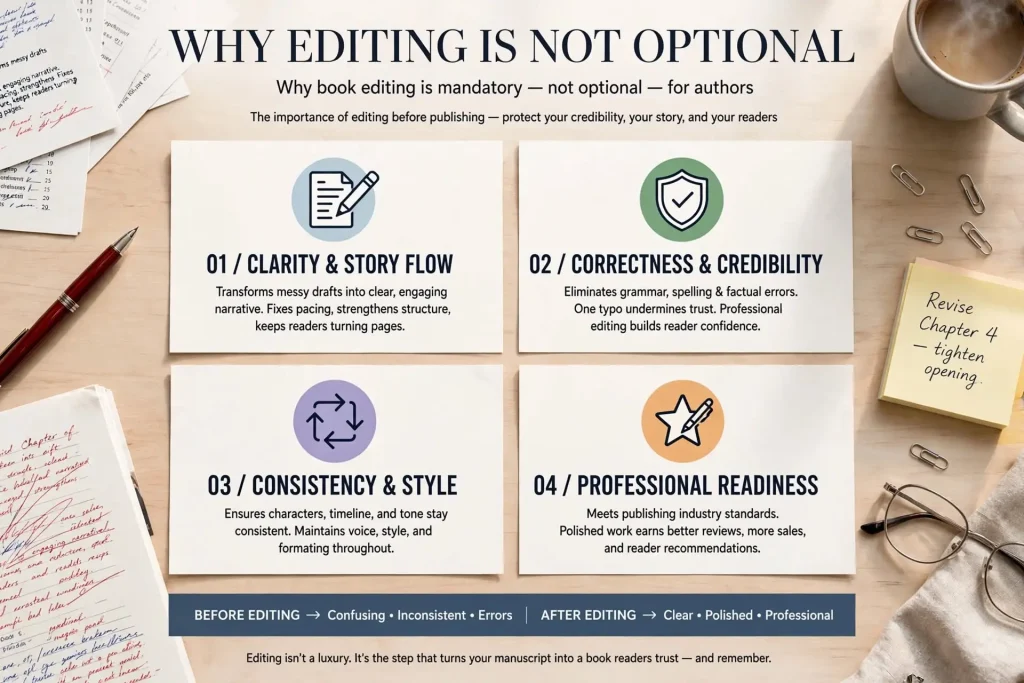
Most authors who consider skipping editing focus on what they’ll save in money. The framework deserves the opposite focus. What will be lost by skipping editing matters significantly more than what gets saved. The why editing matters books question gets answered most clearly by looking at what actually happens to books published without proper editing. The damage isn’t theoretical. It’s documented patterns of specific consequences that affect career trajectories for years rather than just individual book performance. Authors who see the actual consequences tend to make different decisions about editing than authors who think only about the upfront cost.
This post walks through what specifically happens when authors skip editing, why those consequences are so damaging, and why recovery from these mistakes is significantly harder than preventing them.
What Actually Happens When You Skip Editing
The consequences of skipping editing manifest in specific identifiable ways.
The review damage pattern. Unedited books accumulate one-star and two-star reviews specifically calling out editing problems. The reviews remain visible to future browsers indefinitely.
The completion rate damage. Readers abandon unedited books at higher rates than edited books. The abandonment affects KU revenue and review accumulation.
The recommendation rate damage. Readers don’t recommend books with editing problems even when they finish them. Word-of-mouth disappears.
The algorithm visibility damage. Platforms surface books with strong performance signals. Editing problems produce weak signals. The visibility suffers.
The trust damage. Author-reader relationships suffer when readers feel they paid for unfinished work. Subsequent book purchases get affected.
The career trajectory damage. Career-long patterns develop. Authors with editing-problem histories typically have careers that plateau below their actual writing skill would otherwise support.
The opportunity cost compound. Time and money spent producing unedited books amounts to time and money not spent on quality books that would have built career.
These patterns aren’t random or unlucky. They’re documented predictable outcomes of skipping editing in commercial publishing.
The Review Damage Scenario
Reviews become the most visible consequence of editing problems.
The launch period reviews. First reviews shape ongoing review trajectory. Books with editing problems get negative first reviews that damage trajectory.
The verified purchase reviews. Verified purchase reviews carry weight. Disappointed verified purchasers leave negative reviews that affect future browsers.
The Goodreads damage. Goodreads reviews have their own audience. Editing-problem reviews on Goodreads damage book reception across literary community.
The reviewer audience reach. Some reviewers have substantial followings. Negative reviews from these reviewers can damage sales significantly.
The review content specificity. Reviews don’t just give star ratings. They explain the ratings. Editing-focused negative reviews remain detailed and visible.
The review search visibility. Future browsers see negative reviews when researching books. The reviews persist in search results for years.
The cross-platform review consistency. Negative reviews appear across Amazon, Goodreads, BookBub, and other platforms. The criticism multiplies.
The review-driven category ranking. Negative reviews damage average ratings. Damaged ratings affect category rankings. Lower rankings reduce sales.
Review damage from editing problems persists across the book’s entire commercial life. The damage doesn’t fade. It compounds.
The Algorithm Visibility Loss
Platform algorithms reflect editing quality through specific mechanisms.
The conversion rate signals. Books with editing problems convert browsers less effectively. Lower conversion produces less algorithmic visibility.
The completion rate signals. KU completion rates affect algorithm placement. Editing problems reduce completion. Reduced completion reduces visibility.
The review velocity signals. Books that produce reviews quickly signal positive engagement. Editing problems slow review accumulation. Slower accumulation signals less engagement.
The repeat purchase signals. Readers who buy multiple books from same author signal strong engagement. Editing problems prevent repeat purchases. Reduced repeat purchases reduce author-level algorithmic visibility.
The cross-promotional algorithm effects. Books mentioned together in “also bought” sections get algorithmic boosts. Editing problems prevent appearance in these sections.
The recommendation engine sidelining. The algorithm-driven recommendation engines stop surfacing books with weak performance signals.
The category bestseller exclusion. Category bestseller status requires sustained sales velocity. Editing problems prevent the velocity needed.
The new release window underperformance. Initial launch performance shapes ongoing visibility. Editing-problem launches underperform and produce ongoing visibility limitations.
Algorithm visibility produces most of the book discovery on major platforms. Books invisible to algorithms struggle regardless of writing quality.
The Long Term Reputation Cost
Author reputation builds across books and across years.
The cumulative author profile. Authors are known by their catalogs collectively. Several editing-problem books damage reputation more than single book.
The Google search results. Author names produce Google search results that include reviews and discussions. Editing-problem reviews appear in these searches.
The author community awareness. Other authors notice editing quality. Cross-promotion opportunities, panel invitations, podcast appearances depend on professional reputation.
The reader-to-reader discussions. Reader communities discuss authors. Editing-problem authors get discussed accordingly.
The book recommendation discussions. When readers ask “what should I read?” editing-problem authors don’t get recommended.
The industry recognition pathways. Awards, recognition lists, industry attention require sustained quality. Editing problems exclude authors from these pathways.
The library and bookstore relationships. Libraries and bookstores curate selections based on quality. Editing-problem books rarely get carried.
The traditional publishing or rights-sale pathways. Authors hoping to traditionally publish or sell rights face significantly worse outcomes with editing-problem catalogs.
The reputational damage may be the most permanent of all the consequences. Once established, reputation persists.
The Series Trust Damage
For series authors, editing problems damage series economics specifically.
The first-book trust establishment. First books in series establish trust readers extend to subsequent books. Editing problems prevent this trust establishment.
The read-through rate damage. Series read-through rates depend on quality of each book. Editing problems in book one damage book two read-through. Damage in book two damages book three. The cascade is significant.
The series abandonment patterns. Readers who started series sometimes abandon them when later books have editing problems. The abandonment loses significant cumulative revenue per reader.
The series brand damage. Series develop their own brands beyond author brand. Editing problems damage series brands.
The pre-order rate damage. Series readers preorder subsequent books when trust is strong. Editing problems prevent preorders. Lower preorders affect launch performance.
The series boxed set damage. Series boxed sets sell when individual books sold well. Editing problems prevent boxed set viability.
The series spin-off opportunity loss. Strong series enable spin-off works. Editing problems prevent spin-off opportunities.
The series translation opportunity loss. Strong series support translation investments. Editing problems prevent international expansion.
Series economics multiply consequences. The damage to series from editing problems exceeds the damage to standalone books.
The Career Trajectory Effect
Editing patterns affect career trajectories over years.
The progressive quality expectation. Reader expectations of authors increase over time. Authors who don’t meet rising expectations get left behind.
The competitive advantage loss. Quality-focused competitors widen their lead over editing-problem authors over time.
The audience growth limitation. Authors with editing problems struggle to grow audiences. Existing readers don’t recommend. New readers face the negative review profile.
The brand calcification. Authors known for editing problems get locked into that reputation. Changing reputation requires sustained quality across multiple books.
The opportunity exclusion expansion. Opportunities open to quality authors stay closed to editing-problem authors. The exclusion compounds.
The career income limitation. Income limitations from editing problems compound across years. The difference between editing-problem and edited careers can be six-figure across decades.
The retirement asset limitation. Strong author catalogs have actual financial value. Editing-problem catalogs have minimal value.
The legacy consideration. Authors build legacies through their work. Editing-problem catalogs don’t support meaningful legacy.
Career trajectory effects accumulate the consequences of individual decisions. Decisions about editing matter across this career span rather than just individual book performance.
The Recovery Difficulty
Recovering from editing-problem reputation is significantly harder than maintaining quality reputation.
The review persistence. Negative reviews don’t disappear. They remain visible indefinitely affecting future browsers.
The Google search persistence. Negative discussions in Google search results persist for years.
The reader memory persistence. Readers who had bad experiences remember those experiences. They warn others.
The publication republishing limitations. Republishing edited versions of previously published books has limited effect. Original reviews persist.
The new release approach limitation. New releases by authors with editing-problem histories face skepticism from readers who remember previous problems.
The catalog refresh costs. Refreshing existing catalog to fix editing problems costs significantly. Many authors can’t afford complete catalog refresh.
The brand reconstruction time. Rebuilding reputation requires multiple subsequent quality books. The process takes years.
The trust rebuilding challenge. Trust once damaged rebuilds slowly. Readers who had bad experiences extend trust grudgingly to subsequent works.
Prevention is significantly easier than recovery. The cost of editing each book exceeds the cost of catalog-wide recovery later.
The Comparison Disadvantage
Editing-problem books face quality comparison disadvantages constantly.
The genre competition reality. Your books sit on same shelves as edited competitors. Comparison is unfavorable when editing differs.
The reader cross-shopping. Readers comparing options choose edited books over editing-problem alternatives.
The traditional publisher competition. Traditional publishers maintain editing standards. Your unedited books compete with their edited books.
The successful indie author competition. Successful indie authors typically invest in editing. Their books compete with yours.
The sample comparison. The free sample on Amazon shows editing immediately. Browsers compare your sample to alternatives.
The cover-content disconnect. Strong covers paired with weak editing create disappointment that affects subsequent decisions about your books.
The pricing comparison. Editing-problem books face pricing pressure. Can’t sustain pricing other books support.
The promotional comparison. Promotional placements work better for edited books. Same promotional investment produces different results.
Comparison disadvantages affect performance across every metric. The disadvantage compounds across multiple books.
The Opportunity Cost Calculation
The full cost of skipping editing includes opportunity costs.
The lost sales calculation. Sales that would have happened with editing minus sales actually achieved without editing.
The lost review profile calculation. Better review profile would have driven additional sales. Editing-problem reviews prevented those sales.
The lost recommendation calculation. Recommendations that would have driven additional sales but didn’t happen due to editing problems.
The lost algorithm visibility calculation. Sales that would have happened through algorithmic surfacing that didn’t happen due to weak performance.
The lost catalog effect calculation. Sales of other books in catalog that would have benefited from strong reputation but didn’t.
The lost long-term sales calculation. Years of sales that would have continued for quality books but ended early for editing-problem books.
The lost career opportunity calculation. Opportunities that would have been available with quality reputation but weren’t available with editing-problem reputation.
The full opportunity cost typically exceeds editing investment by significant multiples. The economics work decisively in favor of editing investment.
Specific Damage Examples
Specific scenarios illustrate the damage patterns.
The first-book author scenario. New author skips editing on debut. Negative reviews accumulate. Future books by same author face skepticism even if subsequently edited.
The series author scenario. Series author edits first book but skips editing on book two. Series readers abandon at book two. Subsequent series books underperform dramatically.
The genre-shift author scenario. Author moves to new genre. Skips editing because they think they know the new genre. Genre readers reject the work. Author loses opportunity in new genre.
The hybrid author scenario. Author with traditional publishing history self-publishes. Skips editing because they trust their own editing. Self-published work damages traditionally-built reputation.
The translation scenario. Author translates English book to other languages without proper editing in target languages. Translated work fails. Damages author reputation in those markets.
The audiobook adaptation scenario. Author adapts text book to audio without proper editing in audio format. Audio version performs poorly. Damages author audiobook market positioning.
The catalog refresh scenario. Author tries to refresh catalog quality after years of editing problems. Discovers reputation has calcified. New edited books struggle to overcome reputation.
Each scenario shows specific patterns of how editing-skipping damage compounds.
The Reverse Path Impossibility
Some consequences of skipping editing can’t be reversed.
The original reviews persistence. Original negative reviews stay published regardless of subsequent edits.
The reader memory persistence. Readers who had bad first experiences remember those experiences regardless of subsequent improvements.
The Google search history persistence. Negative discussions in Google search results persist indefinitely.
The algorithm history considerations. Platform algorithms have memories. Initial poor performance affects ongoing visibility.
The reputation calcification. Established reputations are hard to change. Authors known for editing problems stay known for editing problems.
The publication republishing limitations. Existing readers don’t necessarily rebuy republished editions.
The brand momentum considerations. Brand momentum, once lost, rebuilds slowly. The lost momentum costs years.
The catalog-wide effects. Editing problems in some books damage perception of entire catalog.
The path forward requires producing many quality books to overcome past editing problems. The investment significantly exceeds what editing would have cost originally.
The Editing Choice That Defines Your Career
The editing investment isn’t just about specific book performance. It’s about which kind of career trajectory you’re building across years. Authors who consistently invest in editing build trajectories that compound positively. Authors who consistently skip editing build trajectories that plateau below their writing skill would otherwise support.
The choice between these patterns affects publishing career outcomes more than most authors recognize. The cost of editing one book versus the cost of editing-problem reputation across an entire career produces decisive math. Authors taking publishing seriously as commercial activity invest in editing because the alternative produces measurable damage across decades. Authors treating publishing as casual hobby may reasonably skip editing for hobby books. But authors with serious commercial ambitions face decisive math favoring editing investment. The choice you make about editing your books today shapes your publishing career trajectory for years to come. The investment in editing isn’t optional cost to minimize. It’s foundational investment in the career you’re trying to build. Authors recognizing this framework typically make different decisions than authors viewing editing as expense to skip when budgets feel tight.


