
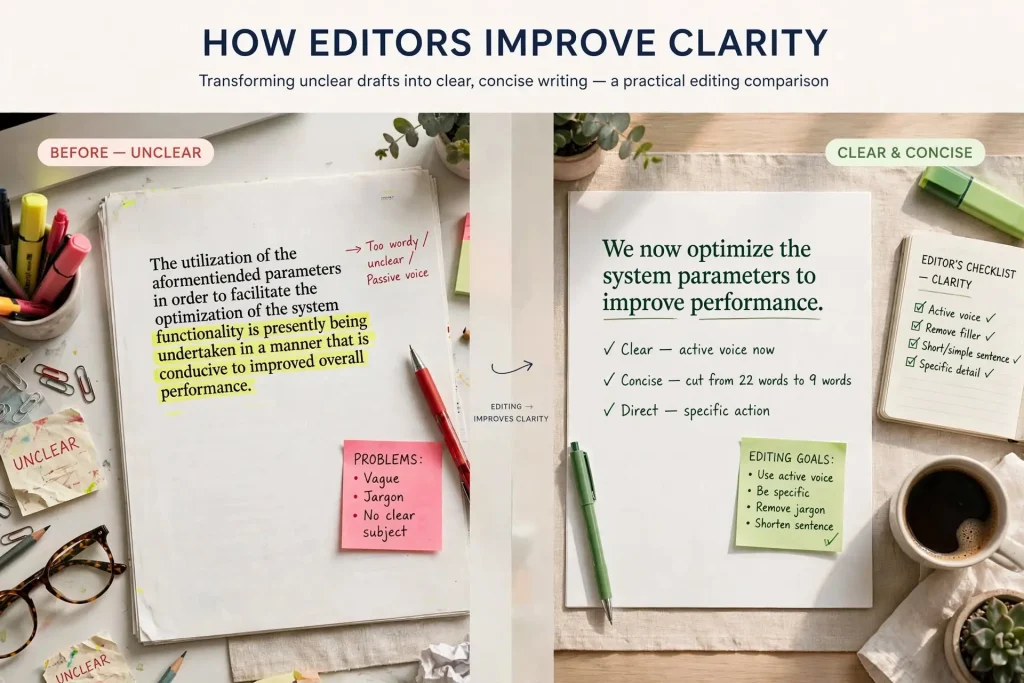
Most editing focuses on grammar, voice, structure, or other specific concerns. Clarity editing is its own focus that cuts across these areas to address one fundamental question. Does the reader actually understand what the author meant? Strong clarity editing identifies passages where readers will get lost, where intended meaning gets blurred, where good thinking gets undermined by unclear expression. The clarity editing books that produce strong reader experiences treat clarity as a specific editorial priority rather than something that happens as a byproduct of other editing work.
This post walks through what clarity editing specifically involves, the techniques editors use to strengthen clarity, and how authors can apply clarity thinking to their own work.
What Clarity Editing Specifically Addresses
Clarity editing focuses on the gap between what authors mean and what readers actually understand.
Authors know their material thoroughly. They’ve thought through the ideas, characters, plots, or arguments for months or years. The deep knowledge can blind authors to places where their writing makes sense to them but won’t make sense to readers encountering the material for the first time.
The clarity editor reads the work fresh, like a typical reader would. They flag passages where meaning blurs, where ideas appear before their context, where pronouns reference unclear antecedents, where logic gaps assume knowledge readers don’t have.
The work cuts across other editing concerns. A passage might have correct grammar, strong voice, and good structure but still fail at clarity. Clarity editing addresses what other editing rounds may miss.
The output. Cleaner prose where reader meaning matches author meaning. Sentences that communicate intended ideas without reader effort. Paragraphs that flow logically. Sections that build on each other coherently.
Sentence Level Clarity Issues
At the sentence level, clarity editing addresses several specific patterns.
Overly long sentences. Sentences that contain multiple clauses, qualifications, and digressions often lose readers before reaching the period. Editors break these into shorter clearer sentences.
Buried meanings. Sentences where the main point sits inside subordinate clauses while less important content takes the main clause. Editors restructure to put main ideas in main clauses.
Pronoun confusion. “It,” “this,” “that,” “they” without clear antecedents. Readers spending mental effort figuring out what pronouns refer to lose focus on actual content.
Passive constructions that obscure. “Mistakes were made” hides who made the mistakes. Active constructions with clear subjects usually communicate more clearly.
Nominalization. Turning verbs into nouns (“the creation of confusion” instead of “creating confusion”). Verb forms usually read more clearly than noun forms.
Negative constructions. “Not unlike” instead of “similar to.” Multiple negatives in sentences require readers to track them carefully.
Modifier placement. Modifiers placed in ambiguous positions in sentences. “I only read books written in English” versus “I read only books written in English.”
Each pattern adds reader effort. Sentences with multiple patterns become exhausting to read even when individually clear.
Word Choice for Clarity
Word selection significantly affects clarity.
Specific over general. Specific words usually communicate more clearly than general ones. “Honda Civic” beats “vehicle.” “Three days” beats “soon.”
Concrete over abstract. Concrete language readers can picture beats abstract language they have to interpret. “Built a treehouse” beats “engaged in construction activities.”
Common over uncommon. Common words usually clearer than rare ones. Editors flag jargon, academic vocabulary, or showy word choices where simpler alternatives would work better.
Active verbs over weak verbs. Strong active verbs (“she ran”) read more clearly than weak verb constructions (“she was running”).
Removing filler. Phrases like “in order to,” “the fact that,” “due to the fact that” add words without adding meaning. Editors cut these for clarity.
Consistent terminology. Calling the same thing by different names confuses readers. Editors flag inconsistent terminology and suggest standardization.
Reading-level appropriate. Vocabulary that exceeds the target audience’s comfort reduces clarity. Editors calibrate word choice to the appropriate reading level.
Paragraph Level Clarity
Beyond sentences and words, clarity editing addresses paragraph organization.
One main idea per paragraph. Paragraphs covering multiple ideas confuse readers about what to focus on. Editors flag paragraphs that try to do too much and suggest breaking them apart.
Clear topic sentences. The first sentence of each paragraph should establish what the paragraph addresses. Paragraphs that bury their topic confuse readers.
Logical sequence within paragraphs. The sentences within a paragraph should build on each other. Random ordering of related ideas reduces clarity.
Appropriate transitions. Movement from one paragraph to the next should feel logical. Editors flag transitions that feel jarring and suggest connecting language.
Length appropriate to content. Very long paragraphs become tiring. Very short paragraphs feel choppy. Editors flag paragraph length issues.
The combined effect of strong paragraph-level work is prose that flows clearly through ideas rather than asking readers to do reconstruction work between paragraphs.
Argument Clarity in Nonfiction
For nonfiction specifically, clarity editing addresses argument structure.
The central claim should be visible. Readers should know what the book argues. Books that obscure their central claims through indirect presentation lose readers.
Supporting evidence should connect clearly to claims. The connection between evidence and the points it supports needs to be visible. Evidence that floats without clear connection to claims reduces argument strength.
Logical progression. Each major point should build on previous ones. Random ordering of major points confuses readers about how the argument develops.
Counterarguments addressed clearly. Strong nonfiction acknowledges counterarguments. The handling of counterarguments needs to be clear about what’s being acknowledged and how the author responds.
Conclusions earned by evidence. The conclusions a book reaches should follow from the evidence presented. Conclusions that exceed what the evidence supports damage credibility.
Strong clarity editing in nonfiction often involves restructuring sections to make arguments more visible and easier to follow.
Story Clarity in Fiction
For fiction, clarity editing addresses specific story-level concerns.
POV clarity. Readers should always know whose perspective they’re in. Confused POV shifts within scenes damage story experience.
Time and location clarity. Readers should know when and where each scene happens. Disorientation about time or location reduces engagement.
Character action clarity. Readers should be able to picture what characters are doing. Vague action descriptions undermine immersion.
Dialogue attribution. Readers should know who’s speaking. Long dialogue sequences without clear attribution become confusing.
Cause and effect. The causal logic of story events should be visible. Confused causality reduces story coherence.
Information delivery. Readers need information at the right times. Information delivered too early loses impact. Information delivered too late confuses earlier scenes retroactively.
Story clarity editing often involves significant restructuring of how information appears across the manuscript.
Tools & Techniques
Clarity editors use specific techniques to identify issues.
Reading aloud. Sentences that don’t sound clear when spoken often aren’t clear when read either. Editors mentally or actually read passages aloud to catch problems.
Fresh-reader perspective. Editors approach the work without prior knowledge. The fresh perspective reveals what readers without context would experience.
Specific question testing. Editors ask specific questions about each passage. What is this sentence trying to communicate? Does the reader have the context needed? Are there ambiguities?
Reverse outline analysis. For nonfiction particularly, creating reverse outlines from the existing manuscript reveals organizational issues that linear reading misses.
Software analysis tools. Tools like Hemingway, ProWritingAid, and Grammarly catch some clarity issues automatically. They’re useful supplements but not replacements for human editorial judgment.
Reading-level analysis. Software that measures reading difficulty helps calibrate prose to target audience. Useful for nonfiction and children’s books particularly.
Common Clarity Editing Mistakes
Several patterns reduce clarity editing effectiveness.
Editor overcorrection. Editors who simplify everything strip out voice and personality. Strong clarity editing preserves voice while improving comprehension.
Author resistance. Authors who reject every clarity suggestion miss the gap between their meaning and what readers actually understand.
Skipping the fresh read. Authors editing their own work for clarity struggle because they can’t read fresh. Outside editing perspective matters significantly for clarity.
Treating clarity as a single pass. Clarity issues exist at sentence, paragraph, section, and chapter levels. Strong clarity editing addresses all of these rather than just one level.
Conflating clarity with simplicity. Clear prose isn’t necessarily simple prose. Layered ideas can be expressed clearly. The goal is comprehension, not reduction.
Genre mismatch. Different genres have different clarity expectations. Literary fiction tolerates more ambiguity than business nonfiction. Editors should work within genre conventions.
Generic editing without clarity focus. Editors who treat all suggestions equally may miss the specific clarity issues that affect reader experience most.
The Clarity Edit That Carries Your Voice
The best clarity editing makes prose clearer without making it sound like the editor wrote it. The author’s voice, perspective, and characteristic patterns remain visible. The reader just absorbs the writing more easily than they would without the clarity work.
Authors who treat clarity editing as essential rather than optional tend to produce books where their thinking, characters, or stories reach readers as intended. Authors who skip clarity editing often produce books where strong underlying content fails to communicate because the prose creates friction for readers. The investment in clarity editing pays back across every reader who encounters the finished book without the friction that uncertain prose would have produced. The work is detailed and specific, but the cumulative effect across hundreds of pages produces reading experiences that engage rather than frustrate. Clarity is the invisible quality that makes the rest of the writing work, and the editing that supports it deserves the attention it requires.


