
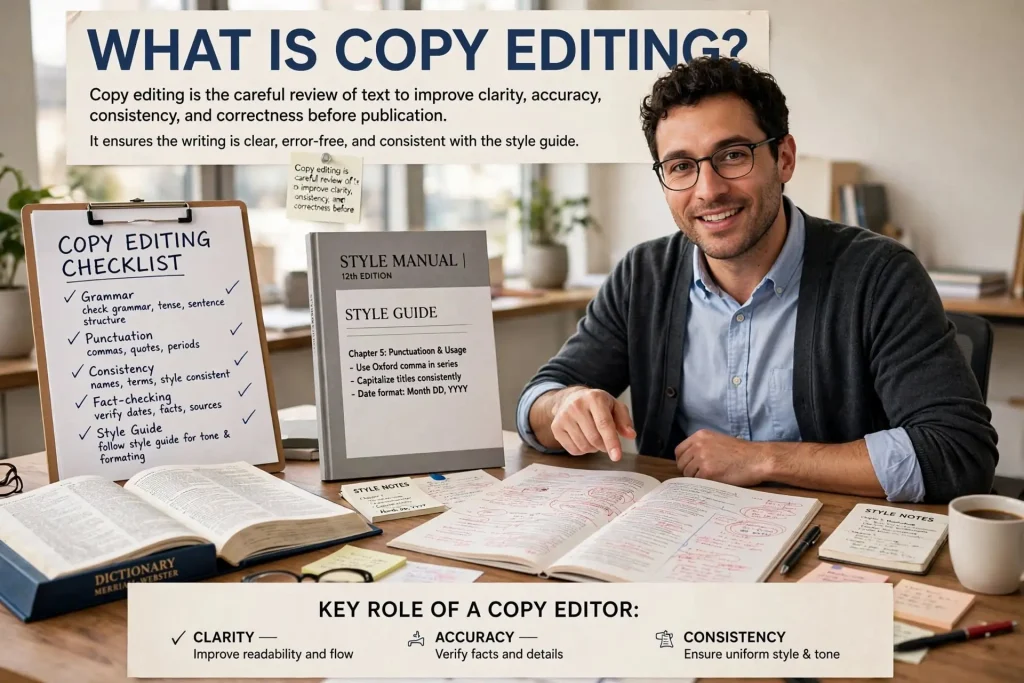
Most authors approach copy editing as a vague necessity. They know they need it but don’t have clear answers to specific questions. How long does it actually take? What does it cost? When in the process should it happen? How do you find a good copyeditor? What’s included versus what costs extra? The copy editing guide that actually helps authors covers the practical process of getting copy editing done rather than just describing what copy editing involves.
This post walks through the practical realities of hiring copy editing services, the typical costs and timelines, how to evaluate copyeditors, and how to work productively with them once hired.
The Copy Editing Stage in the Publishing Process
Copy editing happens at a specific point in the publishing process. Knowing the position helps timing decisions.
After developmental editing. Copy editing comes after the bigger-picture editorial work. Story structure for fiction, argument organization for nonfiction, character arcs, all should be substantially addressed before copy editing starts.
After major author revisions. The manuscript copyedited should be the manuscript close to publication. Major changes after copy editing waste the editing investment.
Before layout. Copy editing happens before the manuscript gets formatted into final layout. The copyedited manuscript becomes the source for layout work.
Before proofreading. Proofreading comes after layout. The copyedited and laid-out manuscript gets one final pass before publication.
The full editorial sequence runs developmental editing → author revisions → copy editing → author review of copyedits → layout → proofreading → final corrections → publication.
Authors who try to skip stages or do them in wrong order typically produce books with editing problems that the right sequence would have caught.
What’s Typically Included in Copy Editing Services
Standard copy editing includes specific categories of work. Knowing what to expect prevents disappointment.
Grammar and mechanics. Standard sentence-level editorial work.
Consistency editing. Following one chosen pattern throughout the manuscript on spelling, capitalization, hyphenation, and similar choices.
Style guide application. Following Chicago, AP, or other chosen style guides.
Word choice and clarity issues. Identifying awkward phrasing, repetition, unclear references.
Basic fact-checking. Verifying obvious factual claims that are easy to check.
Production preparation. Marking the manuscript for the typesetter.
Style sheet development. Documenting the consistency choices made during editing.
What’s often NOT included in standard copy editing. Substantial fact-checking for research-heavy nonfiction (often a separate service). Heavy line-level rewriting (line editing is a separate service). Developmental concerns (developmental editing is a separate service). Index creation. Permissions clearing for quoted material.
Getting clarity on the specific scope of work before hiring prevents disagreements later. Some copyeditors offer expanded services. Some stick to narrow scope. Either approach can work but expectations need to match.
How Long Copy Editing Takes
Copy editing timelines depend on several factors.
Editor working time. Most professional copyeditors work at 3 to 8 pages per hour for first pass editing. A 300-page manuscript might take 40 to 100 hours of editor time depending on complexity and condition.
Calendar time. Beyond actual working hours, copyeditors need calendar time. Most freelance copyeditors block 2 to 6 weeks for a typical novel-length manuscript.
Booking lead time. Established copyeditors book 2 to 6 months ahead. Authors trying to hire copyeditors with immediate availability often end up with less experienced editors.
Total elapsed time. From hiring to receiving the edited manuscript typically runs 6 to 16 weeks for most projects. The booking lead time plus the working time plus author review time adds up.
Rush rates. Some copyeditors accept rush projects at premium rates (typically 25% to 100% higher). Rush work is available but reduces quality compared to comfortable timelines.
Plan your schedule with proper copyediting time included. Compressing the timeline produces inferior work or expensive rush rates.
What Copy Editing Costs
Costs vary significantly based on manuscript characteristics and editor experience.
Per-word rates. Most copyeditors charge $0.015 to $0.04 per word for fiction. Higher for specialized nonfiction or particularly complicated manuscripts.
Per-hour rates. Some copyeditors charge hourly. Typical rates run $30 to $80 per hour for fiction. Higher for specialized work.
Flat project rates. Some copyeditors quote flat rates for specific projects. Often based on word count with adjustments for complexity.
For a typical 80,000-word novel. Copy editing typically costs $1,200 to $3,200 at standard rates.
For a typical 60,000-word nonfiction book. Copy editing typically costs $900 to $2,400 at standard rates, often more if heavy fact-checking is needed.
For specialized or technical content. Costs run higher due to subject-matter expertise required.
Going significantly below market rates usually produces inferior work. Editors charging $0.005 per word probably can’t sustain a business at those rates and are likely doing speed-edits that miss issues. Significantly above-market rates should come with verifiable credentials.
Finding Qualified Copyeditors
Several sources connect authors with professional copyeditors.
Reedsy. Largest platform for finding editors. All editors vetted before approval. Profile information helps evaluation.
Editorial Freelancers Association. Professional membership organization with searchable directory.
ACES: The Society for Editing. Professional organization with member directory focused on copyediting specifically.
Direct referrals from other authors. Often the most reliable source. Authors who’ve worked with strong copyeditors can recommend them.
Acknowledgments research. Books you admire often credit their copyeditors in acknowledgments. The named editors may be available for hire.
Avoid generic freelance platforms (Upwork, Fiverr) for serious copyediting work. The quality range is too wide and vetting too minimal for high-stakes work.
When evaluating copyeditors, look for genre expertise, professional credentials, sample editing of your work, references from previous clients, and clear communication during the evaluation phase.
When You Need Copy Editing
Several signs indicate copy editing is essential rather than optional.
You’re publishing the book. Any book intended for public publication needs copy editing. The exception is purely personal or family-distributed material.
The book will be sold commercially. Books with commercial intent need professional editing to compete in their markets.
You write in English as a second language. ESL authors benefit particularly from professional copy editing that addresses subtle native-speaker conventions.
You’re writing in a genre with strong conventions. Romance, mystery, and other genres with specific conventions benefit from copyeditors who know the conventions.
You’re producing nonfiction with citations. Citation handling alone often justifies the copy editing investment for nonfiction.
You want the book to last. Professional copy editing affects how the book ages. Books with errors get harder to recommend over time.
Authors who try to self-edit instead of hiring copyeditors typically miss errors that copyeditors catch easily. The author who wrote the manuscript knows what they meant and reads what they meant rather than what they actually wrote.
Working With Your Copyeditor
After hiring, several practices produce better working relationships.
Send a clean manuscript. The cleaner the input, the more value the copyeditor adds. Sending unpolished work wastes their time on issues you should have addressed.
Provide context. Goal of the book, target audience, voice preferences, specific concerns. The context informs editing decisions.
Identify any special considerations. Style guide preferences, character details that need protection, technical content the editor should verify carefully.
Respond promptly to questions. Copyeditors often have questions during the work. Quick responses keep the project moving.
Trust the editor’s judgment on most matters. Strong copyeditors deserve trust on consistency decisions, formatting matters, and similar technical issues.
Push back where appropriate. Sometimes editor suggestions don’t fit your specific intent. Pushing back is fine when done thoughtfully.
Provide complete materials. Include any front matter, back matter, footnotes, captions, or other elements that need editing.
Reviewing Copyedits
After the copyeditor delivers, the review process matters significantly.
Take time before reviewing. The first reaction to substantive editorial changes is often defensive. Wait a few days before reviewing carefully.
Review systematically. Work through the manuscript section by section rather than randomly. Track which changes you accept, reject, or want to discuss.
Use track changes appropriately. Most copyeditors deliver via Microsoft Word with track changes. Knowing how to use track changes makes the review process manageable.
Communicate about substantive issues. When you disagree with significant suggestions, discuss them with the editor rather than just rejecting them. The conversation often produces better outcomes than either initial position.
Don’t litigate every comma. Trust the editor on small consistency matters. Save your editing energy for substantive concerns.
Plan adequate time. Reviewing copyedits on a novel typically takes 20 to 40 hours of focused work. Don’t try to compress this into a few evenings.
Common Process Mistakes
Several patterns regularly weaken the copy editing process.
Skipping the developmental edit. Going from manuscript to copy editing misses structural issues that copy editing can’t address.
Hiring too cheaply. Bargain rates usually produce bargain work. Strong copy editing is worth paying for.
Wrong editor for the genre. Hiring editors without genre expertise often produces work that misses genre-specific concerns.
Rushing the timeline. Compressed schedules produce inferior work. Plan adequate time.
Skipping the sample edit. Most professional copyeditors will sample edit free. Skipping this evaluation step often produces hiring mistakes.
Author resistance to feedback. Some authors push back on every suggestion. The pattern wastes the editing investment.
Not providing context. Editors work better with context about the book’s goals, audience, and special considerations.
Mixing editing stages. Doing copy editing and developmental editing simultaneously usually produces inferior work compared to doing them in proper sequence.
Treating copyeditors as interchangeable. Building long-term relationships with editors who learn your voice produces better results over multiple books than constantly switching editors.
Treating Copy Editing as Essential Infrastructure
Copy editing isn’t an optional polish added to finished work. It’s essential infrastructure that determines if a manuscript becomes a professional book or remains amateur output regardless of writing quality. Authors who treat copy editing as essential and budget for it appropriately tend to produce work that competes effectively in their markets. Authors who skip or shortchange copy editing typically produce work that signals amateur production to readers who can’t articulate exactly why.
The investment is real. Copy editing costs $1,000 to $4,000 for typical books. The time involves planning, hiring, and review work. But the impact on the finished book and its commercial reception justifies the investment many times over. Authors building careers tend to develop ongoing relationships with copyeditors who learn their work across multiple books. The accumulated learning makes each book’s copy editing more efficient than the last. Authors who skip copy editing or use it inconsistently across their catalog often see specific books in their catalog stand out as weaker than the rest, and the books that skipped editing typically underperform the books that received proper editorial attention. The infrastructure pays back across every reader who encounters the finished books for as long as those books stay in catalog.


