
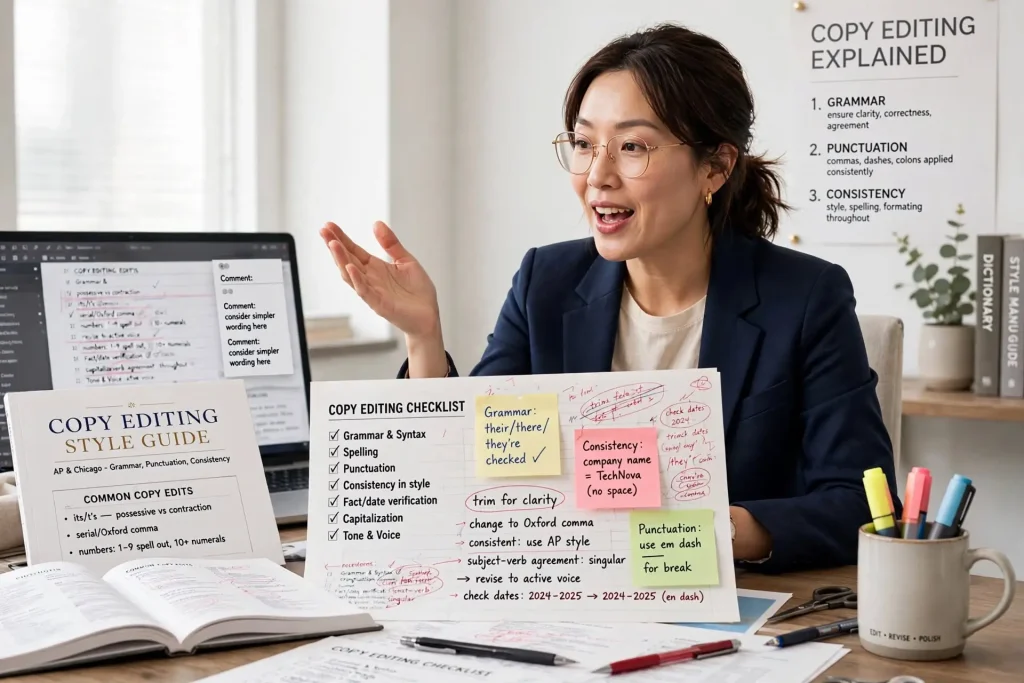
Most authors think they know what copy editing involves until they actually work with a strong copyeditor for the first time. The work goes deeper than simple grammar checking. It catches consistency problems readers wouldn’t have noticed but felt anyway. It identifies style choices that need to be applied consistently. It verifies facts authors thought were accurate. It prepares manuscripts for the production process in ways authors couldn’t have done themselves. The copy editing books actually need addresses craft issues across multiple specific dimensions rather than just sentence-level grammar.
This post walks through what copy editing actually involves at the level of specific editorial work, the categories of issues copyeditors address, and why the work matters more than authors typically realize before experiencing it.
What Copy Editing Actually Addresses
Copy editing covers multiple categories of editorial work that operate at and below the sentence level.
Grammar and mechanics. Subject-verb agreement, pronoun reference, tense consistency, comma usage, sentence structure issues, and other technical correctness questions.
Consistency editing. Spelling variations, capitalization decisions, number style, hyphenation patterns, and dozens of other choices that need to apply consistently throughout the manuscript.
Style application. Following established style guides (Chicago Manual of Style, AP Style, house style guides) consistently throughout the work.
Word choice issues. Wrong word usage, awkward phrasing, unnecessary repetition, jargon problems, and other word-level concerns that affect readability.
Fact-checking. Verifying that cited facts, dates, names, quotations, and other verifiable content are accurate.
Continuity checking. For fiction, tracking character details, timeline consistency, world-building rules, and other elements that need to stay consistent across the manuscript.
Reference and citation checking. For nonfiction, verifying that citations are accurate and formatted correctly.
Production preparation. Marking the manuscript so the typesetter or layout designer can produce the final book.
Each category catches different problems. The cumulative effect of strong copyediting across all categories produces manuscripts dramatically cleaner than what authors can self-edit alone.
Grammar & Mechanics Work
The most visible category of copy editing addresses grammar and sentence-level mechanics.
Sentence structure issues. Run-on sentences, sentence fragments where they don’t serve stylistic purpose, awkward subordinate clause placement, dangling modifiers, and other structural problems.
Comma usage. Comma rules are surprisingly involved. Serial commas (Oxford comma) decisions, commas with conjunctions, restrictive versus nonrestrictive clauses, and many other situations require specific knowledge.
Apostrophe usage. Possessive apostrophes, contraction apostrophes, apostrophes in unusual constructions. The differences between “its” and “it’s” alone catch many authors.
Quotation mark handling. Single versus double quotes, quotes within quotes, punctuation placement with quotes, dialogue conventions in fiction.
Hyphen and dash usage. Hyphens for compound modifiers, en dashes for ranges, em dashes for interruptions. The distinctions matter for professional appearance.
Number conventions. When to spell out numbers versus use numerals. Different rules for different contexts. Date and time formatting conventions.
Capitalization rules. Title capitalization, proper nouns, capitalization in dialogue and other specific contexts. Conventions vary by style guide.
Common confusion points. Affect versus effect, less versus fewer, who versus whom, lie versus lay. Native speakers regularly confuse these and copyeditors catch the errors.
Subject-verb agreement. Particularly with collective nouns, compound subjects, and other tricky constructions where agreement issues hide.
Pronoun reference. Pronouns whose antecedents are unclear or whose number doesn’t match the antecedent. These cause reader confusion even when individual sentences look acceptable.
Consistency Editing
Many copy editing decisions are about consistency rather than correctness. There are often multiple acceptable choices but one must be applied consistently throughout the manuscript.
Spelling variations. American versus British spelling. Some words have multiple accepted spellings (“acknowledgment” versus “acknowledgement”). The chosen spelling should apply throughout.
Capitalization choices. Some terms can be capitalized or lowercase. The choice should be consistent. Internet versus internet. Heavens versus heavens.
Hyphenation patterns. Compound words can sometimes be hyphenated, spaced, or solid. The pattern should apply consistently. Email versus e-mail. Workplace versus work-place versus work place.
Number style. When small numbers are spelled out and large numbers use numerals. The threshold (typically nine, ninety-nine, or a hundred) should apply consistently.
Italicization conventions. Italics for book titles, foreign words, thoughts in fiction, emphasis. The rules for when to italicize should apply consistently.
Quotation conventions. Single versus double quotes. The choice should apply throughout the manuscript.
Style sheet development. Skilled copyeditors develop style sheets documenting all the consistency choices made for a specific manuscript. The style sheet supports current editing and future books from the same author.
The consistency work is invisible when done well. Readers don’t notice that hyphenation is consistent. They notice when it isn’t. The work matters for the unconsciously absorbed sense of professional production.
Style & Voice Considerations
Strong copy editing preserves the author’s voice while improving clarity and craft.
Voice preservation. The author’s distinctive phrasing, sentence rhythms, and word choices should survive copyediting. Heavy-handed copyediting strips out voice and produces homogenized prose.
Sentence flow improvement. Awkward sentences can be smoothed without changing their substance. The copyeditor improves flow while preserving meaning.
Word repetition addressing. Words repeated in close proximity often go unnoticed by authors. Copyeditors catch these and suggest variations.
Pacing observations. While more substantive editing addresses pacing, copyeditors can note specific passages where pacing falters.
Tone consistency. The tone of voice should stay consistent throughout the work. Copyeditors flag shifts that might be unintentional.
Genre voice considerations. Different genres have different voice expectations. Strong copyeditors understand genre conventions and edit accordingly.
The balance between fixing issues and preserving voice is one of the most important skills of strong copyeditors. The best ones improve manuscripts while leaving the author’s distinctive qualities intact.
Fact-Checking Work
For nonfiction particularly, fact-checking is a significant copy editing category.
Statistics and data verification. Numbers cited in the text should match their actual sources. Misquoted statistics damage credibility permanently.
Date verification. Historical dates, publication dates, event dates all need accuracy. Wrong dates show up in reviews and damage author reputation.
Name accuracy. Personal names, company names, place names all need correct spelling and accurate identification. Misspelled names of cited people are particularly visible errors.
Quotation accuracy. Quoted material should match the original source. Misquoted material creates legal and credibility problems.
Source verification. Citations should match the actual sources. Wrong page numbers, wrong publication years, wrong publishers all need fixing.
Geographic accuracy. Distances, locations, geographic relationships all need verification when mentioned specifically.
Technical accuracy. For nonfiction in specialized fields, technical claims should be verified. Copyeditors with subject expertise catch errors that general copyeditors miss.
Fact-checking is often the most time-consuming part of nonfiction copyediting. Books heavy on research may need separate fact-checking passes beyond standard copyediting.
Reference & Citation Editing
For nonfiction with citations, the reference work has its own specifications.
Citation style consistency. Using Chicago, APA, MLA, or another style, the citations should follow the chosen style consistently throughout.
Bibliography accuracy. Author names, publication years, titles, publishers, page numbers all need verification.
Internal citation accuracy. References within the text matching the bibliography entries. Discrepancies between in-text citations and bibliographic entries appear regularly and damage credibility.
URL and DOI verification. Web sources need URLs that actually work. DOIs should resolve to actual papers. Dead links should be addressed.
Cross-reference checking. References to other parts of the book (“see Chapter 3”) should point to the correct locations. Page number references need updating during layout if page numbers change.
Footnote and endnote formatting. The chosen note style should be applied consistently. Formatting differences create amateur appearance.
This work is tedious but essential for credibility-dependent nonfiction. Books with sloppy citations get dismissed by serious readers and reviewers.
Continuity Checking in Fiction
For fiction, copyediting includes specific continuity work.
Character continuity. Physical descriptions, ages, family relationships, backstories, all need consistency across the manuscript. Eye color changes between chapters are common errors copyeditors catch.
Timeline consistency. Events should happen in plausible time relationships. Days of the week should match calendar progression. Time elapsed should match what characters experience.
World-building consistency. For genres with constructed worlds, the rules of that world should apply consistently. Magic systems shouldn’t change without justification. Technology levels should stay consistent.
Series continuity. For series, details established in earlier books should match in later books. Character details, world details, plot elements that span the series.
Location consistency. Geographic details, building layouts, relative positions of places. Characters who arrive somewhere should be able to leave in plausible ways.
Strong fiction copyeditors track these elements explicitly during their reading. Spreadsheets or notes documenting each element catch continuity errors that whole-manuscript reading might miss.
Production Preparation
Copy editing also prepares the manuscript for the production process.
Final markup. Various marks indicate to the typesetter how specific elements should be handled. Italics, bold, hyphenation breaks, special characters.
Chapter and section identification. Clear marking of chapter starts, scene breaks, and other structural elements that affect layout.
Special elements identification. Block quotes, footnotes, sidebars, captions all need clear marking so the typesetter handles them correctly.
Front and back matter preparation. Title page, copyright page, dedication, acknowledgments. The copyeditor often handles formatting and editing of these elements.
Style sheet handoff. The style sheet developed during copyediting passes to the proofreader and typesetter so consistency carries through to the final book.
The production preparation is what distinguishes professional copyediting from amateur proofreading. Strong copyeditors leave manuscripts ready for the next production stage rather than just cleaned up.
What Copy Editing Doesn’t Address
Several editing concerns sit outside the copy editing scope.
Story structure issues. Developmental editing addresses these earlier in the process. Copyeditors don’t restructure stories.
Character arc weaknesses. Substantive character work happens in developmental editing.
Plot problems. Copyeditors might note plot holes they encounter but don’t address them substantively.
Major argument problems in nonfiction. Developmental editing addresses these.
Voice transformation. Copyeditors preserve voice rather than changing it.
Major rewriting. Copyeditors clean up prose but don’t rewrite passages substantially.
Authors who expect copyediting to address developmental issues are usually disappointed. The wrong stage of editing can’t fix problems it’s not designed to address.
The Polish That Distinguishes Professional Work
Copy editing is the work that distinguishes professionally polished books from amateur ones in ways readers feel without consciously naming. The book that reads smoothly across hundreds of pages, where consistency goes unnoticed because nothing breaks the rhythm, where facts check out, where the reader trusts the author’s craft, is the book that benefited from strong copy editing. The book that reads with constant small friction, where consistency varies, where doubts about accuracy arise, where the reader works to understand the author rather than the other way around, is usually the book that skipped or shortchanged copy editing.
The investment in proper copy editing pays back across every reader who encounters the finished book. Authors who treat copy editing as essential rather than optional tend to produce work that competes effectively against traditionally published competitors. Authors who skip it often produce work that signals amateur production even when the underlying writing is strong. The craft of copy editing has developed over centuries of book publishing and the conventions exist because they work. Honoring those conventions through professional copy editing makes everything else about your publishing investment more likely to produce the results you wanted.


