
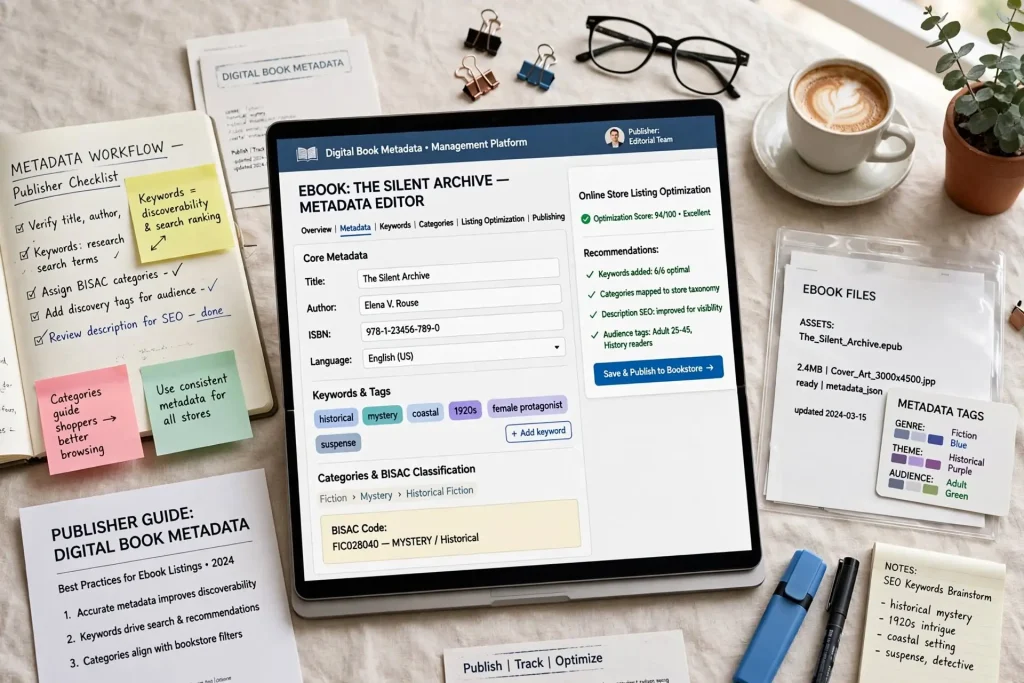
Most authors fill out metadata fields at upload almost as afterthoughts. They type a title, paste a description, pick the first categories that look right, throw in some keywords, and click publish. The decisions accumulate into significant cumulative effect on if books get discovered or stay buried. The digital book metadata that drives discovery isn’t an afterthought to publishing. It’s strategic infrastructure that determines if your books get found by readers actively looking for what you wrote.
This post walks through the specific metadata fields that affect digital book discovery, the platform-specific considerations that matter, and how to optimize metadata systematically rather than randomly.
What Digital Book Metadata Includes
Digital book metadata covers all the information about your book that platforms use to organize, display, and recommend it.
The title and subtitle fields. The most prominent metadata. Affects how books appear in search results and on listing pages.
The description field. Long-form text describing the book. Affects conversion and platform algorithm recognition of the book.
Keyword fields. Specific search terms you want your book to rank for. Platforms vary in how many keywords they accept and how they use them.
Category fields. Where your book gets placed within platform hierarchies. Affects browse discovery and ranking competition.
BISAC codes. Industry-standard subject codes that affect bookstore and library categorization.
Author and contributor information. Author names, formats of names, and any contributing roles (editor, translator, illustrator).
Series information. Series name, number in series, total books in series.
Publication date. The official publication date. Affects new release placement and various promotional eligibility windows.
Language settings. The primary language of the book. Affects which language-specific marketplaces surface the book.
Age range and audience targeting. For children’s and YA particularly. Affects appropriate placement.
Price information. The retail price across formats and markets. Affects pricing strategy and category placement.
ISBN assignments. The identifier that connects the book to broader publishing infrastructure.
Each field affects discovery and reader response differently. Optimization requires attention to all of them rather than focus on just the most visible ones.
Title & Subtitle Optimization
Titles and subtitles drive significant discovery and conversion outcomes.
Title keyword inclusion for nonfiction. Nonfiction titles often include keywords that affect search visibility. “Marketing Strategy” in the title makes the book findable for marketing strategy searches.
Title clarity for fiction. Fiction titles should be evocative and memorable rather than keyword-stuffed. Different optimization approach than nonfiction.
Subtitle as keyword opportunity for nonfiction. Subtitles support multiple keyword targets. Strong nonfiction subtitles include relevant keywords while remaining readable.
Subtitle as positioning opportunity for fiction. Series identifiers (“A Sarah Cross Mystery”), genre signaling, or other positioning information.
Length considerations. Some platforms have title length limits. Going over limits can produce truncation that damages presentation.
Character considerations. Special characters, punctuation, and formatting can affect search and display differently on different platforms.
Title testing approaches. Some authors test titles before committing. A/B testing through ads or audience polls can inform decisions.
The title decision affects discovery for the book’s entire lifetime. The investment in strong title selection pays back across years of subsequent sales.
Description Optimization
The description does work both for human readers and for platform algorithms.
The opening hook. The first paragraph above the “read more” fold on Amazon does the most work. Strong opening hooks convert browsers to readers.
The keyword integration. Descriptions can include keywords that affect search ranking. The integration should be natural rather than stuffed.
The benefit articulation for nonfiction. Nonfiction descriptions should clearly articulate what readers gain from the book.
The story preview for fiction. Fiction descriptions should evoke the story experience without spoiling.
Length considerations. Different platforms support different description lengths. Amazon allows substantial descriptions. Some platforms truncate at lower lengths.
HTML formatting. Some platforms support basic HTML formatting (bold, italics, line breaks). Strategic formatting improves readability.
Editorial review integration. Many descriptions include quoted editorial reviews or testimonials that support credibility.
The description should be reviewed and refined periodically rather than written once and forgotten. Performance data can inform improvements.
Keyword Optimization
Keywords directly affect which searches surface your book.
Amazon’s seven keyword fields. KDP allows seven keyword fields at upload. Each can hold multiple search terms separated appropriately.
Keyword research before selection. Tools like Publisher Rocket, Helium 10, and KDSPY identify high-value keywords. Random keyword selection misses opportunities.
Long-tail keyword opportunities. Specific multi-word phrases that get searched but have less competition. Often easier to rank for than single-word keywords.
Keyword phrase versus single words. Multi-word phrases often perform better than individual words. “Cozy mystery cat sleuth” outperforms “mystery” for many books.
Search volume balancing. The right keywords have enough search volume to matter but not so much that competition is impossible.
Category-supplementing keywords. Some keywords function as additional category placements. Specific recognized terms produce category placement effects.
International keyword variations. Different language markets need different keywords. International distribution requires market-specific keyword research.
Keywords can be updated at any time. Authors who treat keywords as ongoing optimization rather than one-time decision tend to discover better keyword approaches over time.
Category Selection Strategy
Categories affect both discovery and ranking competition.
The two main category placements. Amazon allows selecting two categories at upload. The selection significantly affects where the book gets discovered.
Additional category requests. Amazon support will add additional categories beyond the two upload limits. Strategic authors request 6 to 8 additional categories.
Category competition analysis. Narrower categories often offer better ranking opportunities than broader ones. Tools reveal competition levels in different categories.
Category fit verification. Categories must genuinely fit the book content. Mismatched placement produces conversion problems and possible algorithm response.
BISAC code selection. The industry-standard codes affect bookstore and library categorization. Different from Amazon-specific categories but related.
Category strategy across catalog. Authors with multiple books can develop category strategies that compound across the catalog.
The category decision is reversible but the initial placement affects launch dynamics significantly. Thoughtful initial placement followed by adjustment based on data produces best results.
Platform Specific Metadata Fields
Different platforms have specific metadata requirements beyond shared fundamentals.
Amazon KDP specifics. Seven keyword fields, two main categories at upload, additional categories via support. Description supports HTML. Series information has dedicated fields.
Apple Books specifics. Different category structure. Different keyword treatment. Author bio fields work differently.
Kobo specifics. Category structure similar to Amazon but with differences. Strong international presence affects metadata approach.
Google Play Books specifics. Strong integration with Google’s broader search infrastructure. Metadata affects how books appear in Google searches beyond the book platform.
Library platforms (OverDrive, Hoopla). Specific metadata requirements for library distribution. Different from retail platforms.
International platforms. Tolino, regional platforms have specific metadata expectations that may differ from US standards.
Authors distributing wide should consider platform-specific metadata optimization rather than treating all platforms identically. The platform-specific work produces better results than one-size-fits-all approaches.
Series Metadata Treatment
Books in series have specific metadata considerations.
Series name consistency. The series name should appear identically across all books. Variations fragment series identity.
Book number clarity. The number within the series should be clearly identified. Confused numbering causes reader confusion.
Total books in series. Some platforms show series completion. Indicating planned series length affects reader interest.
Series-related keywords. Series-specific terms can drive cross-series discovery.
Boxed set metadata. Boxed sets need their own metadata that connects to individual book metadata.
Reading order indicators. For series with specific reading orders, metadata should support correct order discovery.
Series metadata treatment significantly affects series read-through. Authors writing series should pay particular attention to these fields.
Common Metadata Mistakes
Several patterns regularly weaken metadata effectiveness.
Generic categories. Picking only broad categories misses narrower opportunities with better ranking chances.
Random keyword selection. Keywords picked without research often miss high-value opportunities.
Title-stuffed keywords. Keywords obviously stuffed into titles for SEO purposes damage reader response without producing search benefits.
Description neglect. Weak descriptions that haven’t been optimized for both conversion and algorithm recognition.
Missing additional category requests. Sticking with only two upload categories leaves significant ranking opportunity unclaimed.
Inconsistent series metadata. Series identification that varies across books in the series.
No metadata review after launch. Metadata set at launch and never revisited misses optimization opportunities.
Platform-specific metadata ignored. Treating all platforms identically when platform-specific optimization would produce better results.
International metadata neglected. Authors distributing internationally who don’t adjust metadata for international markets.
Image metadata ignored. Cover images have metadata too. Proper image metadata affects how images get indexed.
Metadata Optimization as Quiet Sales Driver
Metadata optimization works quietly in the background to drive book discovery across years. The hours spent thinking carefully about title decisions, researching keywords thoroughly, requesting additional categories systematically, and refining descriptions based on performance data produce returns that authors who handle metadata casually rarely see. The cumulative impact across an entire catalog can be significant. Books with optimized metadata get found by readers actively looking for what those books offer. Books with weak metadata struggle to be discovered even when their content is strong.
Authors who treat metadata as serious strategic work rather than upload formality tend to produce books that find their audiences efficiently. Authors who handle metadata casually often produce books that deserve readers but never quite reach them because the discovery infrastructure was weak. The work to optimize metadata isn’t extreme. A few hours of careful thinking, research, and writing during the upload process plus periodic review afterward produces better results than the casual approach most authors default to. The metadata you set up well becomes the discovery infrastructure that quietly supports your book’s sales for as long as it stays in catalog. The investment of careful attention pays back across every reader who finds the book through search and category browsing rather than through marketing you have to actively maintain.


