
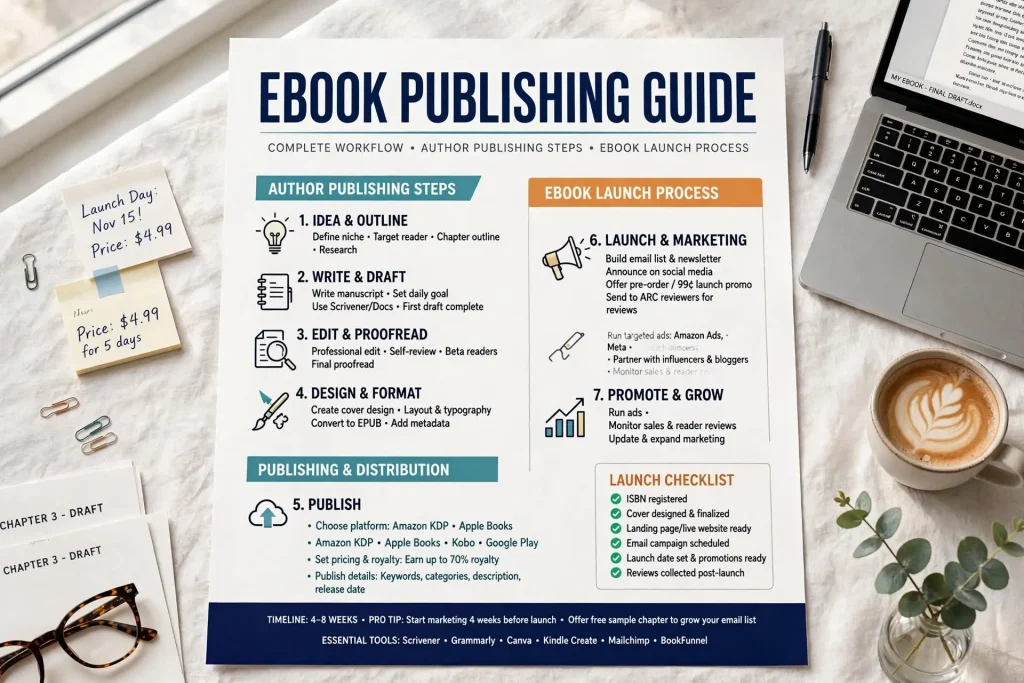
Most authors approaching ebook publishing for the first time get lost in the sequence of decisions. They know they need to publish but don’t know what order to handle the various tasks. They skip steps. They handle steps in wrong order. They miss preparation work that would have made later steps easier. The ebook publishing guide that actually helps new authors walks through the process in proper sequence rather than dropping topical information without showing how the pieces fit together. Authors who follow systematic process tend to produce better launches than authors winging it.
This post walks through the ebook publishing process from manuscript-ready through ongoing catalog management, showing the proper sequence and what each step involves.
Where Your Ebook Publishing Process Should Start
The starting point isn’t the upload page. It’s much earlier than most authors realize.
The completed manuscript. Strong publishing starts with manuscript that’s actually ready for editing. Half-finished manuscripts produce half-finished books.
The financial planning. Publishing costs money. Plan budget before starting rather than discovering costs at each step.
The strategic positioning. Know what you’re publishing and why. Series? Standalone? Genre positioning? Brand building?
The career stage awareness. First book differs from fifteenth book. The process scales with experience.
The realistic timeline planning. Publishing takes longer than most authors expect. Plan timeline accordingly.
These foundational decisions affect everything that follows. Starting without them produces the chaos that catches unprepared authors throughout the process.
Manuscript Preparation Phase
Before any external work begins, the manuscript needs preparation.
Self-editing pass. Multiple revision rounds where you address what you can identify yourself. Saves money on subsequent professional editing.
Style consistency review. Consistent voice, tense, and stylistic choices throughout. Makes professional editing more effective.
Structural review. Does the story or argument work at the structural level? Address big problems before paying for line-level edits.
File organization. Clean source file ready for professional handling. Properly organized chapters, consistent formatting basics.
Backup systems. Multiple backup copies of all manuscript versions. Loss of work between revisions is catastrophic.
Reader feedback gathering. Beta reader input before professional editing identifies issues that professional editors might also catch (at higher cost).
The preparation phase typically takes 4 to 12 weeks for serious work. Authors who skip it often pay more for editing services and produce weaker final books.
Editing Phase
Professional editing comes next, in specific order.
Developmental editing first. The big-picture editor addresses structure, pacing, character, and other large-scale issues. $1,500 to $6,000 typical investment.
Line editing second. Addresses sentence-level prose, voice consistency, and reading flow. $1,000 to $3,500 typical.
Copy editing third. Grammar, mechanics, style consistency, and surface-level issues. $750 to $2,000 typical.
Proofreading last. Final pass catching remaining errors. $300 to $1,000 typical.
The total editing investment for serious books typically runs $3,500 to $12,500. Some authors combine stages or skip some, but the full sequence produces best results.
The timeline for editing typically runs 8 to 16 weeks depending on book length and editor schedules.
Cover Design Phase
Cover design can run parallel to later editing stages.
Designer selection. Find designer who fits your genre, budget, and timeline. $500 to $3,000+ depending on tier.
Brief preparation. Strong design starts with clear creative brief. Reference covers, genre conventions, specific preferences.
Design iteration. Most professional design includes 2 to 3 revisions. Plan timeline accordingly.
Format-specific files. Ebook cover (RGB, specific dimensions), print cover (CMYK, with bleed and spine), promotional graphics.
Cover testing. Before finalizing, test at thumbnail sizes and against competitor covers.
The timeline typically runs 3 to 8 weeks from brief to final files.
Interior Formatting Phase
Interior formatting happens after editing finalizes.
Tool selection. Vellum, Atticus, or InDesign for serious work. Choose based on your platform and skill level.
Source file preparation. Clean edited file with consistent styles. Proper chapter breaks. Working table of contents structure.
Format generation. Generate ebook formats (EPUB primarily). Generate print files if doing print.
Cross-format consistency. Print and ebook editions should feel related visually.
File testing. Test on multiple devices before considering files finished.
Front and back matter. Proper title page, copyright page, about-the-author, also-by listings, review request.
The timeline typically runs 1 to 3 weeks for tool-assisted formatting. Longer for professional formatting service.
Metadata Setup Phase
Metadata configuration deserves careful attention before upload.
Title finalization. The title should be ready, including subtitle if applicable.
Description writing. Strong descriptions that convert browsers. Multiple revisions usually required.
Keyword research. Use Publisher Rocket or similar tools to identify high-value keywords for your specific book.
Category selection. Research categories carefully. Plan for additional category requests beyond initial upload limits.
Series information. Series name, book number, total books planned (or “ongoing”).
Author bio updating. Author bio should reflect current positioning and credits.
Pricing decisions. Initial price set with awareness of strategy across markets.
ISBN assignment. If using free Amazon ISBN or your own purchased ISBNs.
The metadata phase typically takes 1 to 2 weeks of focused work. Done well, this phase pays back across the book’s entire commercial life.
Distribution Selection Phase
Distribution decisions affect everything that follows.
Amazon-exclusive or wide. The fundamental choice affecting subsequent strategy.
KU enrollment consideration. KDP Select enrollment for KU access requires Amazon exclusivity.
Platform selection if wide. Apple Books, Kobo, Google Play Books, Barnes and Noble Press, library platforms.
Aggregator versus direct upload. Draft2Digital or PublishDrive for simplified wide distribution, or direct uploads for control.
International market decisions. Which international markets to engage.
Audiobook timing. Audio production may happen later but planning starts now.
Print edition timing. KDP Print, IngramSpark, or both. Timeline affects launch coordination.
The distribution decisions shape long-term strategy. Initial choices persist unless explicitly changed later.
Pricing Decisions
Pricing involves strategic decisions for launch and ongoing.
Launch pricing. Promotional launch pricing or full launch pricing. Each has strategic implications.
Standard pricing. The price you’ll maintain when not running promotions.
Promotional pricing strategy. The pricing levels you’ll use during promotional cycles.
International pricing. Local pricing decisions for each market.
Format pricing relationships. How ebook, print, and audiobook prices relate.
Series pricing strategy. How series books price relative to each other.
Pricing should be informed by genre benchmarks and competitive analysis rather than guess.
Launch Preparation Phase
Launch preparation in the weeks before publication date.
ARC distribution. Advance reader copies to early reviewers. Builds initial review base.
Launch team coordination. Newsletter, social media, and other launch communication.
Promotional booking. Newsletter promotional placements booked for launch week.
Advertising preparation. Amazon and other platform ads prepared for launch.
Pre-order setup. Pre-orders accumulate sales before launch which affects launch rankings.
Launch day marketing. Specific communications scheduled for publication day.
Launch week sequence. Coordinated activity through launch week supports algorithm visibility.
The launch preparation phase typically runs 4 to 8 weeks before publication.
Post Launch Marketing Phase
Marketing continues after launch.
Initial review response. Engage with early reviews professionally.
Algorithm support. Sustained sales velocity supports continued algorithmic visibility.
Email list growth. New readers from launch added to email list infrastructure.
Promotional cycle planning. First post-launch promotional cycle typically 60 to 90 days after launch.
Performance analysis. What worked? What didn’t? Apply learnings to next book.
Series support. If this is a series book, continued promotion of the series.
Backlist integration. New book promotes backlist. Backlist promotes new book.
Post-launch marketing continues for years rather than weeks. The work compounds across catalog.
Ongoing Catalog Management
Beyond launch, ongoing work maintains catalog health.
Quarterly performance reviews. Each book’s performance analyzed and optimization opportunities identified.
Promotional cycle execution. Regular promotional cycles across the catalog.
Metadata refreshes. Keywords, categories, and descriptions periodically updated.
Cover refresh consideration. Older books may benefit from cover updates.
Series expansion. New books in established series.
New series development. Strategic decisions about new directions.
Platform strategy evolution. Distribution strategy adjusted as conditions change.
Audience development. Ongoing email list growth and reader engagement.
The catalog management work continues across the entire publishing career. The work compounds across years.
Publishing Process Habits That Support Long Careers
The ebook publishing process gets easier with experience but the underlying sequence remains similar across many books. Authors who develop systematic process habits early in their careers tend to handle subsequent books more efficiently than authors who reinvent the process for each book. The habits that support long careers involve treating publishing as serious business operation rather than as art-and-hope.
The first book typically takes longest to publish well. Authors invest significant time in learning each phase, finding professionals to work with, and developing workflows. The investment pays back across every subsequent book. By the fifth book, the process should feel routine rather than chaotic. By the tenth book, optimization opportunities become visible that weren’t visible at the first book stage. By the twentieth book, the systematic approach should be supporting publishing rates that authors operating chaotically can’t match. The process discipline becomes one of the most valuable career assets you build. Authors who treat publishing process as serious skill rather than as obstacles between writing and getting paid tend to develop the kind of operational competence that supports sustainable publishing careers across years. The investment in process learning is worth treating seriously from the first book because every subsequent book benefits from the foundation laid early.


