
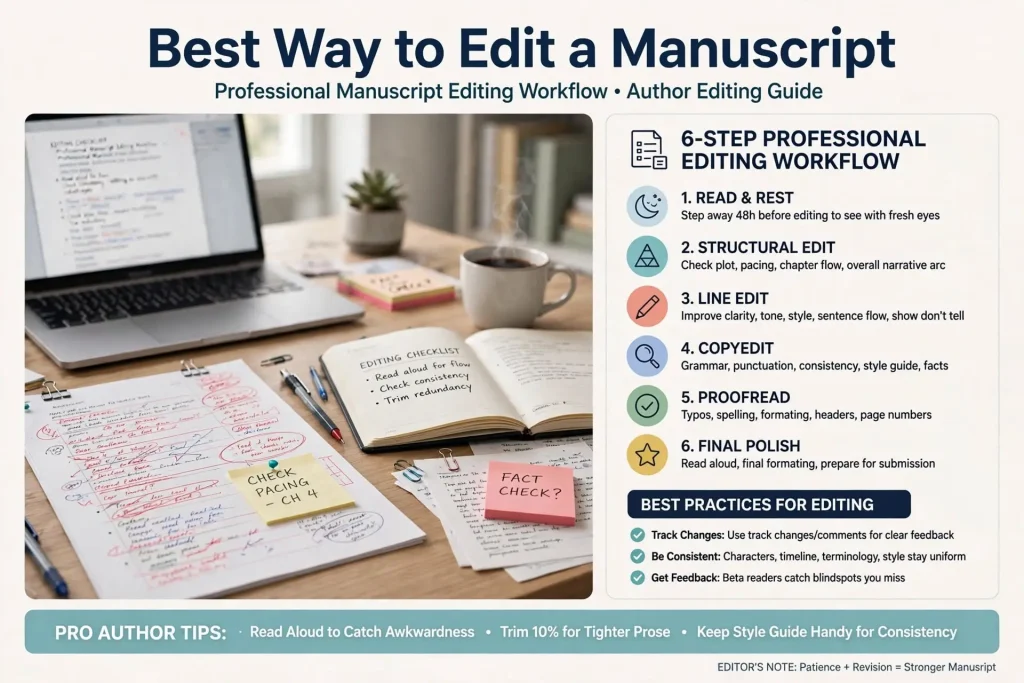
Most authors approaching their manuscripts attempt editing without specific methodology. They read through their work and fix issues that catch their attention. The approach produces some improvement but misses much of what systematic editing addresses. The how to edit manuscript skill at professional level involves specific multi-pass methodology that addresses different issue categories at different stages. Professional editors use this layered approach because it works. Authors who learn the professional methodology tend to produce significantly better edited manuscripts than authors editing intuitively.
This post walks through the professional manuscript editing process, the specific passes that produce thorough editing, and how to apply the methodology to your own work or to working with professional editors.
The Professional Manuscript Editing Approach
Professional editing uses specific methodology that differs from intuitive editing.
The layered approach. Different editing stages address different issue categories. Mixing concerns produces inferior results.
The hierarchical sequence. Big issues addressed first. Smaller issues addressed later. The sequence matters.
The focused attention. Each pass focuses on specific issue categories. Trying to address everything simultaneously produces shallow attention to each.
The fresh perspective per pass. Each pass should bring fresh perspective. Multiple passes produce different findings than single review.
The completion criteria. Each pass has specific completion criteria. Pass not complete until criteria met.
The collaboration consideration. Professional editing typically involves author-editor collaboration. The methodology supports collaboration.
The time discipline. Each pass takes a specific time. Rushing damages outcomes.
This professional methodology produces results intuitive editing can’t match. The work is more systematic and the results more thorough.
The Multiple Pass Methodology
Professional editing involves multiple specific passes addressing different concerns.
The big picture pass first. Structure, premise, audience targeting, overall direction.
The structural pass. Story or argument structure. Chapter and scene organization. Pacing rhythm.
The scene-level pass. Individual scene effectiveness. Scene transitions. Scene-level pacing.
The line-level pass. Sentence-level prose craft. Voice consistency. Reading flow.
The copy editing pass. Grammar mechanics. Style consistency. Surface-level issues.
The proofreading pass. Final typo catching. Mechanical verification.
The publication preparation pass. Final readiness verification before submission.
Each pass focuses on specific concerns. The cumulative effect across all passes produces editing depth single-pass review can’t match.
The Big Picture Pass First
The first pass establishes if the manuscript fundamentally works.
The premise verification. Does the central premise actually work? Strong premise. Reader-accessible premise. Genre-appropriate premise.
The audience targeting. Is the target audience clear? Genre signaling appropriate. Audience expectations met.
The structural framework. Three-act structure for fiction (or appropriate alternative). Clear argumentative structure for nonfiction. Does the framework actually support the content?
The voice and tone. Strong distinctive voice. Consistent tone throughout. Voice appropriate to content.
The opening assessment. Does the opening work? Hooks readers. Establishes key elements. Builds reader investment quickly.
The ending assessment. Does the ending work? Closes appropriate elements. Satisfies reader expectations established by opening.
The overall direction. Does the manuscript move in clear direction? Or wander without clear focus?
The big picture pass identifies if substantial structural work is needed before line-level work makes sense. Substantial structural problems mean line-level editing would be wasted on scenes that should be cut or rewritten.
The Structural Pass
The structural pass addresses big structural elements.
The chapter-level structure. Are chapters appropriately sized? Variation in chapter length serving rhythm. Chapter breaks at strong points.
The scene-level structure within chapters. Are scenes well-formed? Clear scene purposes. Scene transitions working.
The plot or argument arc. The arc from opening through climax to resolution. Or argument structure for nonfiction. Does the arc actually work?
The subplot integration. Subplots supporting main plot. Or subplots distracting from main plot.
The character arc structure. Character development arcs across the story. Clear starting state. Clear ending state. Meaningful change between.
The pacing structure overall. Pacing variation supporting reader engagement. Tension cycles. Breathing room.
The information delivery structure. Information arriving when needed. Setups before payoffs.
The structural pass typically requires significant revision when issues found. Better to address at this stage than to attempt fixing through line-level work later.
The Scene Level Pass
The scene-level pass addresses individual scene effectiveness.
The scene purpose verification. Does each scene serve specific story purposes? Scenes without clear purposes typically need cutting or rewriting.
The scene-level tension. Each scene having specific tension. Scenes without tension typically problematic.
The scene transitions. How scenes connect. Transitions either working or feeling abrupt.
The scene character work. Characters developing or revealing themselves within scenes. Static scenes typically need work.
The scene-level pacing. Individual scene pacing. Some needing more breathing. Others needing cutting.
The scene conflict clarity. Conflict within each scene clear. Vague conflict producing vague scenes.
The scene resolution. How each scene ends. Affecting subsequent scenes appropriately.
The scene sensory engagement. Strong scenes engaging multiple senses. Weak scenes overrelying on single sense.
For nonfiction, similar review applies to individual sections within chapters. Each section should serve specific purposes within larger argument structure.
The Line Level Pass
The line-level pass addresses prose craft.
The sentence-level work. Sentence variety. Strong verbs. Word economy. Active voice preference.
The paragraph-level work. Paragraph length variation. Topic sentence clarity. Paragraph transitions.
The voice consistency. Author voice maintained. Character voices distinct.
The reading flow. Smooth reading without friction. No awkward constructions.
The dialogue craft. Natural dialogue. Subtext where appropriate. Character voice differentiation.
The description craft. Sensory details. Specific imagery. Avoiding generic description.
The exposition smoothing. Exposition feeling natural rather than forced. Information delivery integrated into action and character.
The pacing through prose. Sentence length and rhythm supporting pacing intentions.
Line-level work distinguishes professional prose from amateur prose. The cumulative effect across hundreds of pages significantly affects reading experience.
The Copy Edit Pass
The copy edit pass addresses mechanics and consistency.
The grammar verification. Standard grammar throughout. Intentional variations marked.
The punctuation consistency. Punctuation conventions applied consistently.
The spelling verification. All spelling correct in chosen variant.
The capitalization consistency. Proper nouns, titles, technical terms handled consistently.
The number formatting. Consistent rules for spelling out or using digits.
The date and time formatting. Dates and times handled consistently.
The dialogue formatting. Quotation marks, attribution, paragraph breaks consistent.
The character name consistency. Character names spelled identically throughout.
The location name consistency. Place names consistent throughout.
The technical term consistency. Specialized terminology used consistently.
Copy editing catches the surface issues that accumulate into looking unprofessional.
The Proofreading Pass
The proofreading pass is the final safety net.
The fresh-eyes review. Different eyes from previous passes. Catches what familiarity hides.
The typo verification. Last-pass typo catching. Years of practice still finds new issues.
The spacing verification. Consistent spacing throughout.
The widow and orphan checks. Last lines of paragraphs alone at tops of pages. First lines alone at bottoms.
The page numbering verification. Page numbers correct throughout.
The header and footer verification. Running heads correct on every page.
The table of contents verification. TOC accurate and functional.
The cross-reference verification. Internal references pointing to correct locations.
The image and caption verification. Images and captions properly associated.
Proofreading catches what slipped through previous passes. The safety net function matters.
Working in Collaboration with Authors
Professional editor-author collaboration follows specific patterns.
The editorial letter format. Developmental edits typically arrive as editorial letters addressing structural concerns. Authors respond with revision plans.
The track-changes format. Line and copy edits arrive as track-changes documents. Authors accept or reject specific changes.
The questions documentation. Editors ask questions about ambiguous passages. Authors clarify intentions.
The revision discussions. Authors and editors discuss substantial revisions before authors execute them. Communication prevents wrong directions.
The schedule coordination. Editing involves specific timelines. Communication keeps schedules realistic.
The scope agreements. Clear scope agreements prevent scope creep. Both parties know what’s included and what’s not.
The follow-up clarifications. Authors often need clarification on editor feedback. Strong editors remain available for clarifications.
The collaboration tone. Professional tone supports productive collaboration. Defensiveness damages outcomes.
Strong collaboration produces better edited manuscripts than the same editing without collaboration.
Time Management for Editing Work
Professional editing requires specific time management.
The realistic timeline planning. Developmental editing typically 4-6 weeks. Line editing 3-4 weeks. Copy editing 2-3 weeks. Proofreading 1-2 weeks. Plus author revision time between stages.
The author revision time between stages. Significant time needed between editing stages for author revision. 2-4 weeks per revision typically.
The cumulative editing timeline. Full editing process for a novel can take 4-8 months from start to finish.
The buffer time inclusion. Building in buffer time for unexpected delays. Editors get sick. Life happens.
The launch date coordination. Launch dates should accommodate editing timelines rather than driving them.
The next-book planning. Next book writing can happen in parallel with editing process. Authors don’t need to wait.
The series scheduling. Series authors often have multiple books in editing pipeline simultaneously. Requires sophisticated scheduling.
The portfolio time management. Across many books and editing cycles, sophisticated time management supports sustainable production.
Time management for editing affects both editing quality and overall publishing operations efficiency.
Preparing the Final Manuscript for Publication
The final preparation before publication involves specific work.
The final read-through. One complete read-through of edited manuscript catching any remaining issues.
The format generation. Generating ebook and print files. Multiple format testing.
The cover-content alignment check. Ensuring cover and content actually fit each other.
The metadata final preparation. Final titles, descriptions, keywords ready for upload.
The pricing final decisions. Final pricing across markets.
The category final selection. Categories selected. Additional category requests prepared.
The launch preparation status. Marketing materials, ARC distribution, promotional placements all in place.
The professional final signoff. If using professional editor, getting final signoff from editor that manuscript is ready.
The author final approval. Author’s final approval as last step before publication.
Final preparation prevents launching with issues simple checks would catch.
Manuscript Editing as Layered Process Discipline
The manuscript editing process at professional level isn’t intuitive freeform work. It’s specific multi-pass methodology that produces thorough editing through systematic attention to different issue categories at different stages. Authors who learn the methodology and apply it (either to their own work or in collaboration with professional editors) tend to produce significantly better edited manuscripts than authors editing intuitively.
The discipline of working through passes in proper sequence rather than addressing whatever catches attention produces depth of editing single-pass review can’t match. The work takes longer than intuitive editing but produces results justifying the additional time. Authors building publishing careers benefit from developing professional editing methodology early. The methodology applies across all subsequent books. The skill development supports both self-editing and productive collaboration with professional editors. The investment in learning professional methodology pays back across every manuscript subsequently edited. The pattern applies equally to authors editing their own work for self-publishing and authors working with professional editors. The methodology improves outcomes either way. Authors who treat manuscript editing as serious professional discipline rather than as quick task between writing and publishing typically produce books that compete effectively with traditionally published work in production quality. The investment in editing methodology becomes one of the more valuable craft investments available in indie publishing today.


