
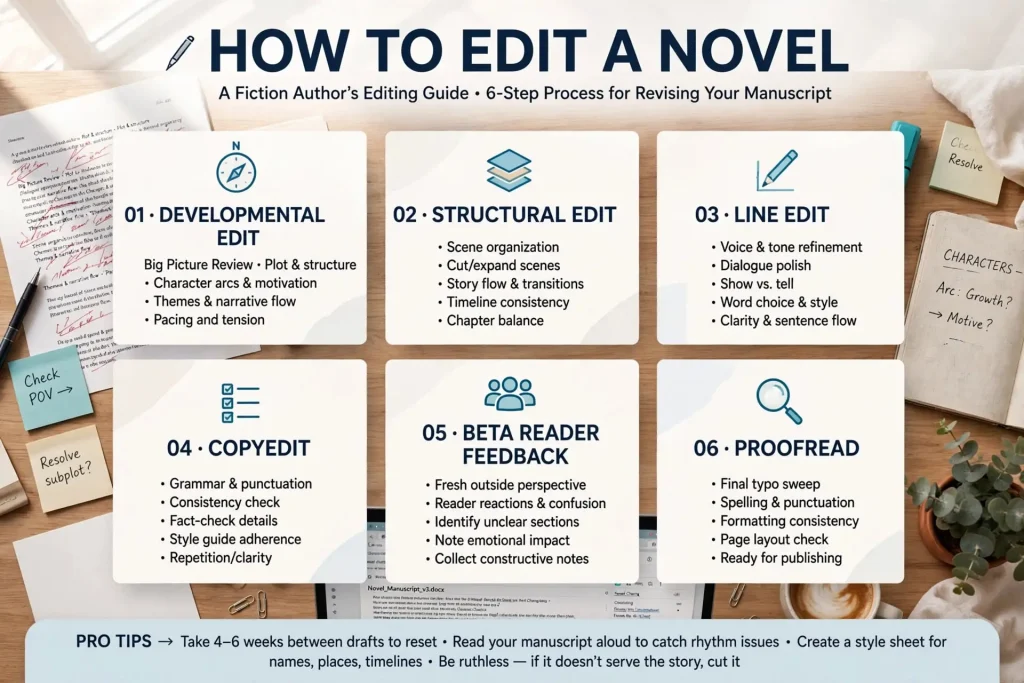
Most editing advice treats fiction and nonfiction as essentially the same work. The reality is that novel editing involves specific concerns that nonfiction editing doesn’t. Plot threads that need tracking. Character arcs that need verifying. Dialogue that needs polishing. Scenes that need evaluating. Description that needs balancing. POV that needs maintaining. The work to edit a novel well requires fiction-specific methodology rather than generic editing approaches. Authors who learn novel-specific editing tend to produce stronger fiction than authors applying general editing principles without fiction-specific knowledge.
This post walks through the specific editing concerns that fiction requires, the techniques that address each, and how to approach novel editing as the craft discipline it actually is.
Why Novel Editing Has Specific Demands
Fiction editing differs from nonfiction editing in specific ways.
The story structure dimension. Novels require story structure that holds together across the entire manuscript. Pacing, tension, character arcs all interact.
The character work dimension. Characters must feel dimensional and consistent. Multiple characters require differentiation. Character arcs require completion.
The dialogue craft. Fiction depends heavily on dialogue. Dialogue must feel natural, reveal character, advance story.
The description craft. Descriptions must serve story without overwhelming pacing. Setting, action, sensory detail all require balance.
The POV management. Fiction often uses specific POV approaches that require consistency. Head-hopping breaks reader trust.
The scene-by-scene work. Novels build through scenes. Each scene must serve purposes within the larger story.
The voice creation. Fiction develops voice through narrative choices that nonfiction doesn’t make in the same way.
These dimensions don’t apply to most nonfiction. Novel editing requires attention to all of them simultaneously.
Plot Editing
Plot editing addresses the story architecture itself.
The main plot throughline. Does the main story actually work from beginning to end? Cause and effect logical throughout.
The subplot integration. Subplots supporting main plot rather than distracting from it. Subplot resolution timing serving overall story.
The plot pacing. Plot events distributed appropriately across the manuscript. Not too front-loaded. Not too back-loaded.
The plot hole catching. Logical inconsistencies, timing problems, or causal gaps in the plot.
The setup and payoff verification. Setups planted earlier paying off later. Payoffs feeling earned by setups.
The midpoint reversal. The middle event that often shifts story direction. Strong novels typically have meaningful midpoints.
The climax adequacy. Climax matching the buildup. Stakes feeling appropriate to setup.
The resolution completeness. Resolution closing appropriate threads. Some threads can be left open for series but main plot needs closure.
Plot editing typically requires careful note-taking. Tracking plot threads across hundreds of pages by memory rarely works.
Character Arc Editing
Character work distinguishes strong fiction from weak fiction.
The character motivation clarity. Each major character has clear motivation. Motivation drives their actions consistently.
The character voice differentiation. Different characters sounding different in dialogue. Different thinking patterns in POV sections.
The character arc verification. Main characters changing meaningfully across the story. Static main characters typically need work.
The supporting character roles. Supporting characters serving specific story purposes. Characters without purpose can usually be cut or combined.
The antagonist development. Strong antagonists have depth and believable motivation. Flat antagonists weaken the entire story.
The character consistency checks. Characters behaving consistently with their established personalities. Inconsistency confuses readers.
The character relationship development. Relationships between characters changing in believable ways across the story.
The backstory integration. Character backstory revealed at appropriate moments without overwhelming current action.
Character work requires knowing how readers connect with fictional characters. The connection drives reader investment.
Pacing Work for Fiction
Fiction pacing affects reader engagement continuously.
The chapter-level pacing. Chapter lengths varying to create rhythm. Strong novels rarely have uniform chapter lengths.
The scene-level pacing within chapters. Mix of fast and slow scenes. Action and reflection alternating.
The tension cycles. Tension rising and falling throughout. Constant high tension exhausts readers. Constant low tension loses them.
The information delivery pacing. Information arriving when needed. Not too early. Not too late.
The reflection moments. Moments where characters and readers process what happened. Important for emotional engagement.
The opening pacing. Opening scenes pulling readers in without overwhelming them.
The middle pacing. The middle of novels typically has pacing challenges. Specific attention needed.
The climax pacing. Climax with appropriate buildup and execution. Not rushed. Not dragged out.
Pacing problems typically have specific structural causes worth investigating rather than just trying to “fix the pacing” vaguely.
Dialogue Specific Editing
Dialogue requires its own editing attention.
The natural rhythm. Dialogue feeling natural without being literally realistic. Different from formal prose.
The character voice consistency. Each character’s dialogue sounding like that specific character throughout.
The subtext development. Strong dialogue includes subtext. What characters don’t say matters as much as what they say.
The tag and beat handling. Dialogue tags appropriate. Action beats supporting dialogue. Attribution clear without being repetitive.
The dialect and accent treatment. Consistent handling of character speech patterns. Subtle hints rather than heavy-handed phonetic spelling.
The conversation flow. Dialogue exchanges moving naturally. Not feeling forced or contrived.
The information delivery balance. Dialogue not delivering exposition awkwardly. Maxim that characters speak to other characters, not to readers.
The dialogue pacing. Dialogue can pace scenes. Quick exchanges create urgency. Longer exchanges allow character revelation.
Dialogue is often the most-noticed element of fiction. Strong dialogue draws readers in. Weak dialogue pushes them away immediately.
Description Balance
Description requires careful editing balance.
The description amount. Enough description for readers to visualize. Not so much that pacing dies.
The sensory variety. Visual description supplemented by sound, smell, touch, taste. Strong descriptions engage multiple senses.
The character description placement. How and when characters get described physically. Avoiding mirror-look introductions.
The setting establishment. Settings established without info-dumping. Details revealed as readers need them.
The action choreography. Action scenes with clear physical description. Readers should know what’s happening.
The atmosphere and mood. Descriptions supporting story mood and atmosphere.
The metaphor and imagery. Strong fiction often uses metaphor and imagery purposefully.
The description placement. Where descriptions occur. Avoiding description dumps that interrupt scenes.
Description balance affects reader immersion. Too little leaves readers confused. Too much exhausts them.
Scene Level Editing
Scenes are the building blocks of fiction.
The scene purpose. Each scene serving specific purposes. Scenes without purposes typically need cutting.
The scene conflict. Each scene having tension or conflict. Scenes without conflict are usually weak.
The scene structure. Scenes typically have their own openings, middles, and ends. Each scene functions as mini-story.
The scene-level pacing. Individual scene pacing supporting the story.
The scene transitions. How scenes connect. Strong transitions support reading flow.
The scene endings. Strong scenes end at significant moments that motivate continued reading.
The scene character work. Characters developing or revealing themselves within scenes.
The scene-level revision. Sometimes individual scenes need significant work even when story structure works.
Scene-level editing catches issues that structural editing misses. The work matters significantly.
POV Consistency
POV management requires specific attention.
The chosen POV approach. First person, third limited, omniscient, multiple POV. Each requires specific handling.
The POV consistency within scenes. POV maintained within each scene. Head-hopping breaks reader trust.
The POV transitions between chapters or scenes. POV changes typically at chapter or scene breaks. Mid-scene POV changes usually problematic.
The POV character voice. Different POV characters having distinct voices in their POV sections.
The POV character knowledge limits. POV characters only knowing what they can know. Other characters’ thoughts hidden.
The deep POV versus shallow POV decisions. Different stories benefit from different POV depth.
The POV character development through POV. Characters’ POV revealing them. Internal thoughts showing what dialogue can’t.
POV problems are among the most common amateur fiction issues. Strong POV management distinguishes professional fiction.
Worldbuilding Continuity
For genre fiction with significant worldbuilding, continuity matters.
The world rules consistency. Magic systems, technology, social structures consistent throughout.
The geography consistency. Locations and distances making sense.
The timeline consistency. Story timeline working. Days, weeks, ages all consistent.
The character history consistency. Character backgrounds remaining consistent across references.
The terminology consistency. Specialized terms used consistently throughout.
The cultural detail consistency. Cultural details consistent within the worldbuilding framework.
The system implications. Worldbuilding rules actually affecting story logically. Not just decorative.
The reader-accessible worldbuilding. Worldbuilding revealed at pace readers can absorb.
Worldbuilding errors break reader immersion when discovered. Editing catches them before publication.
Voice & Tone
Voice and tone hold fiction together.
The author voice consistency. Distinctive author voice maintained throughout. Not generic prose.
The narrative voice for the specific story. The narrating voice appropriate for this specific story.
The tone consistency. Mood and tone maintained. Not shifting randomly between scenes.
The tone variation when appropriate. Some scenes intentionally lighter or darker. The variation serving story.
The genre tone alignment. Tone appropriate to genre. Thrillers feel different from cozies.
The character voice within author voice. Character voices distinct within consistent author voice framework.
The dialogue voice. Dialogue voices consistent with character voices established elsewhere.
The voice protection during editing. Strong editing protects the author’s distinctive voice rather than flattening it toward generic correctness.
Voice is what makes specific novels recognizable. Editing should support rather than damage voice.
Novel Editing as Craft You Develop Across Books
Novel editing is craft discipline that develops across years of practice rather than skill that arrives complete. Authors who treat novel editing as serious craft to develop tend to produce fiction that improves consistently across their careers. Authors who treat editing as obstacle between writing and publishing often produce fiction that doesn’t reflect their improving writing skills because the editing limits the work.
The investment in developing novel-specific editing skills pays back across every subsequent novel. The skills apply across genres within fiction. The methodology supports both self-editing and productive collaboration with professional fiction editors. The fiction-specific knowledge accumulates over time and supports increasingly sophisticated work. First novels benefit from learning fiction editing approach. Fifteenth novels benefit from refined skills developed across previous fourteen. Each novel adds to editing skill that supports subsequent novels. The compound effect across a fiction career typically produces work that demonstrates editing skill alongside writing skill. Authors recognizable as serious fiction writers usually have both. Authors operating without the editing development typically plateau at levels their actual writing skill would otherwise exceed. Novel editing deserves the same serious craft attention novel writing receives. Both are required for producing fiction that competes in modern publishing.


