
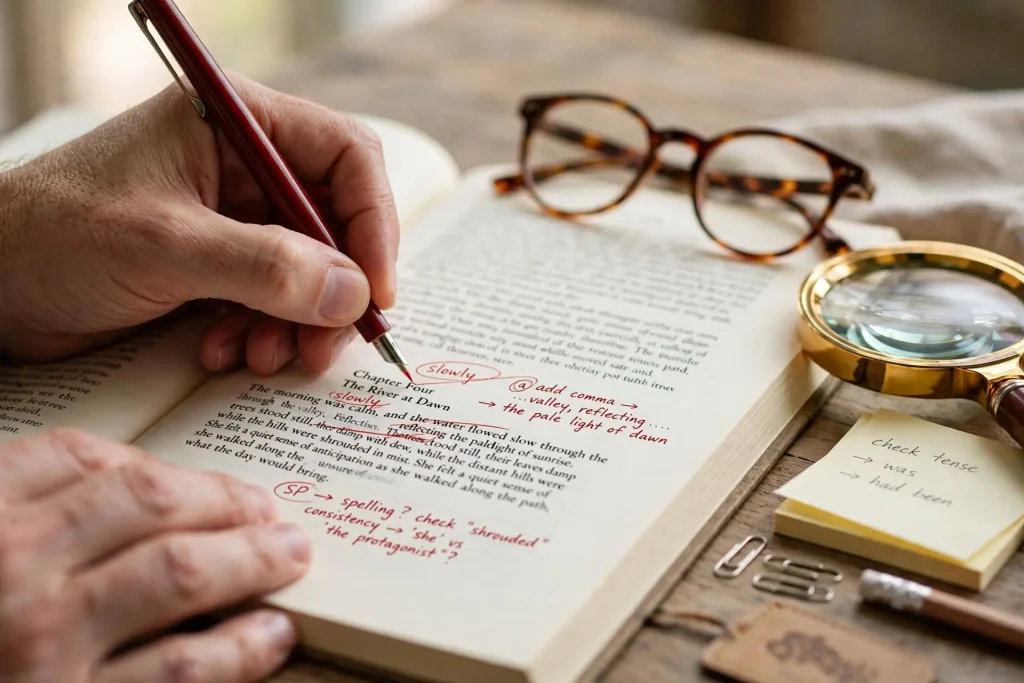
Most authors confuse proofreading with editing. They use the words interchangeably and assume any thorough read-through counts as both. The two are different stages with different purposes, and skipping proofreading specifically is one of the most common reasons polished-looking books still end up with embarrassing errors in the final published version. Proofreading books is the last quality control before publication, and the work catches problems that no other editing stage was designed to catch.
This post walks through what proofreading actually is, how it differs from copyediting, what proofreaders specifically check for, and how to plan for the proofreading stage as part of a working publishing process.
What Proofreading Actually Is
Proofreading is the final pass before publication. It happens after all other editing has been completed and after the manuscript has been laid out in its final format.
The proofreader’s job is to catch errors that survived previous editing rounds and to verify that the laid-out version of the book is ready for publication. This includes typos that weren’t caught earlier, formatting errors that only appeared during layout, inconsistencies that became visible in final form, and small mistakes that previous editors didn’t have the right context to spot.
Proofreading is narrower in scope than copyediting. The proofreader doesn’t rewrite sentences or restructure paragraphs. The proofreader catches small errors and verifies layout integrity.
Proofreading is also faster than other editing stages. A typical novel can be proofread in 8 to 20 hours. A typical nonfiction book might take 10 to 30 hours depending on complexity.
The output is typically a marked-up PDF or printed copy showing the errors found, along with sometimes a brief note summarizing patterns or remaining concerns.
Proofreading Versus Copyediting
The two stages serve different purposes and happen at different points in the process.
Copyediting works on the manuscript before layout. The copyeditor focuses on sentence-level craft. Grammar, syntax, word choice, consistency, fact-checking, style. The copyeditor reads the text without yet knowing how it will appear in final form.
Proofreading works on the laid-out version after layout. The proofreader focuses on catching errors that survived previous editing and on issues specific to the laid-out format. Page breaks, widows and orphans, formatting consistency, errors introduced during layout.
The two stages catch different problems. A copyeditor reading raw manuscript can’t see widow lines because they don’t exist until layout. A proofreader reading final layout doesn’t focus on substantive grammar issues because copyediting should have handled those.
Both stages are needed for thorough quality control. Skipping copyediting and relying on proofreading produces books with substantive language problems. Skipping proofreading and relying on copyediting produces books with layout-stage errors that copyediting wasn’t designed to catch.
What Proofreaders Specifically Check For
The proofreader’s checklist focuses on specific categories of error.
Typos that survived copyediting. Even thorough copyediting leaves some typos. A second careful read catches more.
Inconsistent spelling. Character names spelled different ways across chapters. Compound words handled inconsistently. Hyphenation patterns that vary.
Punctuation errors. Missing periods. Comma misuse. Quotation mark issues. Apostrophe problems.
Formatting inconsistencies. Chapter openings styled slightly differently. Drop caps that vary in size. Heading styles that don’t match.
Layout problems. Widows (last lines of paragraphs alone at the top of pages). Orphans (first lines alone at the bottom of pages). Awkward page breaks that interrupt sentences or dialogue.
Page numbering issues. Wrong page numbers. Missing numbers. Numbers that appear on pages they shouldn’t (chapter openings, full-page illustrations).
Header and footer errors. Wrong chapter titles in headers. Missing headers on pages that should have them. Inconsistent header styling.
Front matter and back matter problems. Title page issues. Copyright page errors. Dedication formatting. Acknowledgments completeness.
Cross-reference accuracy. Page numbers referenced in the text matching the actual layout. Internal links in ebooks pointing to correct destinations.
Spacing problems. Double spaces where there should be single. Missing spaces between words. Inconsistent spacing around punctuation.
Each category catches different errors. The cumulative effect produces a substantially cleaner final book than skipping proofreading would.
When Proofreading Happens in the Process
Proofreading happens after layout is complete. This timing matters because many proofreading-stage errors only exist after layout.
The standard publishing process sequence is. Manuscript completion. Developmental editing. Author revisions. Copyediting. Author review of copyedits. Interior layout. Proofreading. Final corrections. Publication.
Proofreading at the wrong point in the process misses errors. Proofreading before layout can’t catch widow lines or page break problems. Proofreading before copyediting wastes effort on issues that copyediting will address.
For ebooks, the equivalent of layout is final EPUB or MOBI generation. Proofreading the final ebook file catches errors specific to that format that wouldn’t appear in the source manuscript.
For audiobooks, the equivalent is the recorded audio file. Proofreading happens through careful audio listening, catching mispronunciations, missed words, or recording errors that survived earlier production stages.
Where to Find Proofreaders
Several reliable sources connect authors with professional proofreaders.
Reedsy. Vetted proofreaders with verified credentials. Most have publishing industry experience. Quality is consistently high.
Editorial Freelancers Association (EFA). Professional membership organization. Member directory searchable by specialty and rates.
ACES: The Society for Editing. Professional organization with member directory.
Referrals from other authors in your genre. Often the most reliable source. Authors with proofreader relationships can give honest feedback.
Direct outreach to proofreaders mentioned in books you admire. Acknowledgments often credit proofreaders by name.
Upwork and similar freelance platforms. Wide quality range. Requires careful vetting.
For ongoing publishing, building a relationship with a proofreader who learns your voice across multiple books produces better work than constantly switching proofreaders.
Proofreading Costs
Proofreading is the least expensive editing stage because the scope is narrower than developmental editing or copyediting.
For a typical novel of 80,000 words, proofreading costs run $400 to $1,200. The per-word rate runs roughly $0.005 to $0.015 per word.
Most authors should plan on roughly $600 to $800 for proofreading a typical novel.
For nonfiction with similar word count, costs are similar unless the book has many references, tables, or citations requiring verification. Reference-heavy nonfiction can cost 25% to 50% more.
For shorter works (novellas, short story collections), costs scale proportionally. A 30,000-word novella might proofread for $200 to $500.
For longer works (epic-length novels, dense nonfiction), proofreading scales similarly. A 150,000-word book might cost $800 to $1,800.
Rush proofreading (compressed timeline) typically costs 25% to 50% more than standard rates.
Why DIY Proofreading Falls Short
Many authors try to proofread their own work. The results usually disappoint.
Authors are blind to their own errors. The brain fills in what should be there rather than what actually is. This effect is strongest for errors the author made multiple times during writing.
Familiarity reduces attention. Authors who’ve read their own manuscript many times read it on autopilot. The reading speed increases and errors become invisible.
Lack of process distinguishes professional proofreaders from amateurs. Professional proofreaders use specific techniques (reading aloud, reading backwards, checking against a printed copy). Amateurs read normally and miss what professionals catch.
Beta readers and ARC readers aren’t proofreaders. They report what they noticed, which is far less than a trained proofreader catches.
Software tools (Grammarly, ProWritingAid) catch some errors but miss many. They’re useful supplements but not replacements for human proofreading.
For most authors, hiring a professional proofreader is the right choice even when budgets are tight. The cost is modest relative to other publishing expenses and the quality difference shows in the final book.
Time Required for Proofreading
Plan adequate time for proofreading in your publishing schedule.
Most proofreaders need 1 to 2 weeks of working time for a typical novel. Plus booking lead time before they can start. Plus author review time after they deliver.
Total proofreading phase typically runs 3 to 6 weeks from when you hand off to when you have final corrected files.
Compressed timelines reduce quality. Proofreaders rushing through their reading miss errors that careful work would catch.
For series authors with rapid release schedules, building proofreader relationships with predictable availability matters. The proofreader who knows you’ll send book three of the series 60 days after book two can plan around that schedule.
Things That Slip Past Even Good Proofreaders
Even professional proofreading isn’t flawless. Some errors survive into the published book.
Very subtle inconsistencies. Character eye color mentioned different ways across chapters. Sometimes catches by proofreaders, sometimes not.
Specialized terminology errors. Industry-specific jargon used incorrectly in nonfiction. Proofreaders without subject expertise may not catch these.
Numerical errors. Statistics quoted incorrectly. Dates that don’t match across references. Proofreaders catch obvious math errors but may miss subtler statistical problems.
Cultural references. References that worked in the manuscript but became outdated by publication. Proofreaders may not catch these without subject context.
The remaining errors are minimal compared to skipping proofreading entirely. A book with 2 surviving errors per 100,000 words is far better than a book with 50.
The Final Set of Eyes Before Print
Proofreading is the last quality gate between your manuscript and your readers. Every error caught at this stage is an error that won’t appear in reviews. Every formatting issue fixed is a moment of reader frustration prevented. Every typo addressed is a small piece of credibility preserved.
The investment in professional proofreading pays back across every reader who picks up the book. The cost is modest. The quality difference is real. The work catches problems that no amount of writer self-review or beta reader feedback can address. Authors who treat proofreading as essential rather than optional tend to produce books that read smoothly across thousands of copies. Authors who skip proofreading often discover the errors their readers find for them, posted in reviews that drag down the book’s reception for years afterward. The few hundred dollars spent on a thorough proofread protects every other investment you made in writing, editing, and producing the book.


