
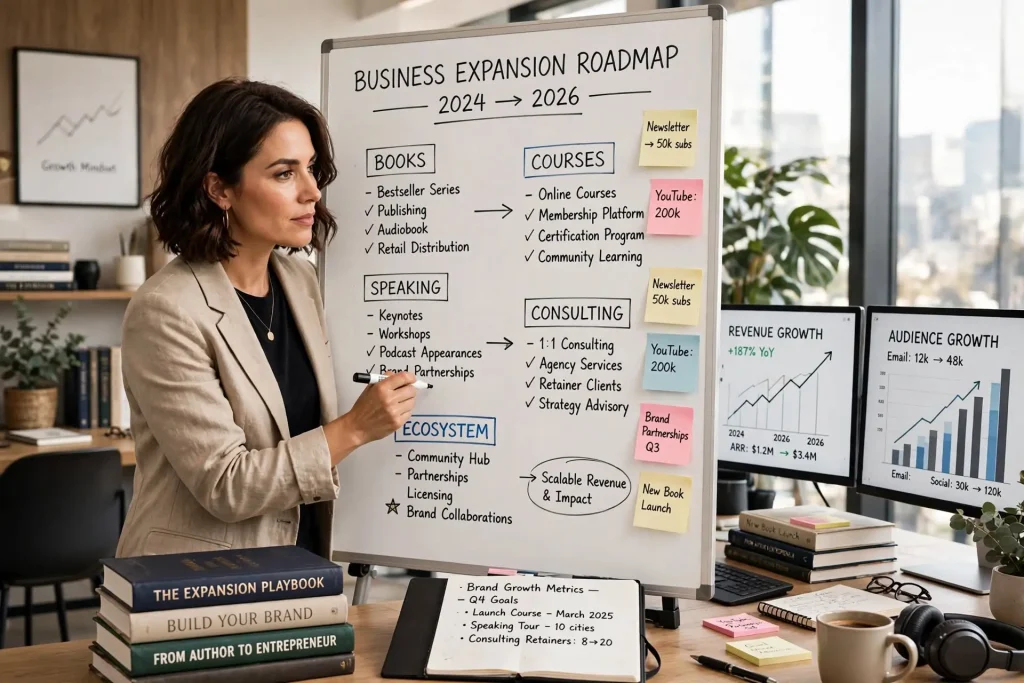
Most successful authors hit a ceiling on book sales alone. Even prolific authors with strong catalogs find that book royalties plateau at some level that’s smaller than their goals. The authors who build seven-figure businesses around their writing typically don’t do it through book sales alone. They expand into adjacent revenue streams that leverage the audience and authority their books built. The author business expansion question becomes important once your books have built enough audience to support additional offerings. Knowing which expansions work and which waste effort helps you grow the business deliberately rather than through trial and error.
This post walks through the main expansion paths beyond book sales, what each path actually involves, and how to choose which expansions fit your specific situation.
Why Book Sales Alone Hit a Ceiling
The math on book sales has natural limits.
Per-book royalty caps. A book at $4.99 ebook generates $3.49 in royalty. Even doubling sales doesn’t dramatically change the per-book economics.
Audience saturation. Once your books have reached most readers in your target audience, growth slows. Continued book launches reach the same audience that’s already bought your earlier books.
Time per book. Writing books takes time. Even prolific authors at 6 to 12 books per year hit production limits.
Format limitations. Books serve specific reader needs. Some audience needs aren’t served well by books and require different formats (courses, coaching, software).
These limitations mean that authors looking to build larger businesses around their writing typically need to expand beyond books themselves. The expansions leverage the audience the books built to offer additional products and services.
Online Courses as Expansion
Online courses are the most common author expansion path, especially for nonfiction authors.
The model. Take the content from your book and expand it into a structured course with video lessons, exercises, worksheets, and other learning materials. Sell the course to readers who want deeper or more practical engagement than the book provides.
Course pricing. Most online courses for author audiences run $97 to $2,997 depending on depth and positioning. The price points reflect both the perceived value and the audience’s willingness to pay.
Revenue compared to books. A course at $297 selling 100 copies per month generates $29,700 monthly. Comparable book sales (10,000 ebook copies at $4.99 producing $3.49 royalty each) generate $34,900. But ebook sales rarely sustain that volume monthly. Course sales can.
Course platforms. Teachable, Thinkific, Kajabi, and similar platforms handle course delivery, payments, and student management. Pricing runs $50 to $300 per month plus payment processing fees.
Course creation timeline. Building a strong course typically takes 3 to 6 months of focused work. The investment is significant but the ongoing revenue justifies it for authors with engaged audiences.
For nonfiction authors particularly, courses often produce more total income than book royalties.
Coaching & Consulting
Coaching and consulting leverage your authority for high-ticket services.
The model. Sell direct expertise to clients who want personalized application of your book’s content. Sessions, programs, or ongoing engagements at premium pricing.
Pricing. Coaching ranges from $200 to $2,000+ per hour for established experts. Consulting projects run $5,000 to $100,000+ depending on scope. The pricing reflects the personalized nature of the work.
Revenue characteristics. Each client engagement produces significant revenue. But coaching and consulting scale through time rather than units. Each hour you sell is an hour you can’t sell again.
Capacity limits. Most coaches and consultants can sustain 10 to 30 client engagements at any given time depending on intensity. Beyond that, quality and personal capacity suffer.
For some authors, coaching and consulting become the largest revenue stream while books drive lead generation. The model works particularly well for business consultants, executive coaches, and specialty service providers.
The challenge. Coaching and consulting require strong sales and delivery skills beyond writing. Authors who hate the sales conversations and client management often find these revenue streams more taxing than they’re worth.
Speaking Engagements
Public speaking generates revenue and builds platform simultaneously.
The model. Get paid to deliver talks at conferences, corporate events, association meetings, and other gatherings. Speaking fees range from free (early career, audience building) to $50,000+ per keynote (established speakers with strong platforms).
Speaking fees for typical author-experts. $2,500 to $15,000 per engagement is common for authors with published books and some speaking experience. $15,000 to $50,000+ for established speakers with strong demand.
Revenue range. Authors with active speaking practices can sustain 20 to 50 paid engagements per year. The revenue compounds with travel costs covered separately and often substantial book sales at events.
Speaker bureau representation. Bureaus connect speakers with events. They take 20% to 30% of speaking fees. Established bureaus produce more bookings than authors can typically generate alone.
Speaking-related products. Books often sell at speaking events. Other products (courses, services) can be promoted to audiences from the stage.
The challenge. Speaking requires significant travel and stage time. The work is rewarding but exhausting. Authors with significant speaking practices often choose to scale back over time as the lifestyle wears.
Licensing & Subsidiary Rights
Licensing book content for various uses generates revenue without ongoing work.
Foreign rights. Selling rights to publish your book in other languages produces advance payments and ongoing royalties. Top business books often have rights sold in 20+ languages.
Audio rights. Granting audiobook production rights to publishers or platforms produces advances and royalty income.
Film and TV rights. Most books don’t sell film rights, but some do. The option payments and eventual production deals can produce significant income for the books that get picked up.
Excerpting and reprint rights. Permission to use chapters or excerpts in anthologies, publications, or other works. Modest individual fees but accumulate over years.
Translation into other formats. The content of your book might fit other formats. Comic adaptations, illustrated children’s versions, workbooks, and other format adaptations all represent licensing opportunities.
For most self-published authors, licensing is a secondary income stream rather than a primary one. The opportunities exist but require active outreach to possible licensees in most cases.
Productized Services & Software
Some authors expand into productized services or software products.
The model. Build a software tool, template library, or systematized service that solves a specific problem your audience has. Sell at scale rather than through one-on-one client work.
Examples. Email template libraries for marketing authors. Software tools for productivity authors. Assessment platforms for personality or career-focused authors. Membership communities for business authors.
Revenue characteristics. Software and productized services scale better than coaching or consulting. Once built, they sell to many customers without proportional time investment.
Investment required. Building software products requires significant upfront investment. Six-figure development budgets aren’t unusual. Most authors who pursue this path partner with technical co-founders rather than building solo.
Risk profile. Software products require ongoing development, customer support, and platform maintenance. The work doesn’t end at launch.
For authors with technical interest or strong technical partners, productized offerings can scale significantly beyond what services alone produce.
Membership & Subscription Models
Recurring revenue through memberships provides predictable income that one-time sales don’t.
The model. Members pay monthly or annual fees for ongoing access to content, community, coaching, or other recurring value. The recurring nature produces predictable revenue.
Pricing. Membership ranges from $9.99 per month for low-tier content to $1,000+ per month for premium business memberships.
Revenue characteristics. 100 members at $97 per month generates $116,400 annually. The recurring nature makes the income more reliable than one-time product sales.
Churn challenges. Members cancel. Sustainable memberships require ongoing value delivery that prevents excessive churn. Most memberships see 5% to 10% monthly churn that must be replaced through new member acquisition.
Time investment. Memberships typically require ongoing content production and community management. The recurring revenue offsets this work, but the work doesn’t end.
For authors with consistent content production and audience engagement, memberships often become a significant revenue stream.
Sequencing the Expansions
Most authors should expand gradually rather than launching multiple new revenue streams simultaneously.
Year one to two. Focus on books and email list building. The foundation that supports later expansion.
Year two to three. Add one expansion area. Most commonly courses for nonfiction authors or consulting for business authors. Build to working scale before adding others.
Year three to four. Add a second expansion area if appropriate. Speaking, licensing, or another product line.
Year four and beyond. The business has multiple revenue streams. Optimization focuses on which streams produce the best returns for the time invested.
This pace allows each expansion to be built properly before the next one starts. Authors who try to launch multiple expansions simultaneously usually execute all of them poorly.
Common Author Business Expansion Mistakes
Several patterns regularly weaken author business expansions.
Expanding too early. Authors who launch courses before they have meaningful audience usually find that the courses don’t sell. Build the audience first.
Wrong expansion for the audience. Some audiences want books but don’t want courses. Some want consulting but not group programs. Match the expansion to what your specific audience actually wants.
Too many expansions at once. Launching multiple expansions simultaneously usually means executing all of them poorly. Sequential expansion produces better results.
Treating expansions as side projects. Expansions that get partial attention rarely produce strong results. Each expansion needs dedicated focus during its development and launch.
Underpricing. Authors often underprice expansions because they undervalue their own expertise. Premium pricing typically produces better results than discount pricing for serious offerings.
Skipping the platform building. Expansions sell to audiences. Authors without significant platforms struggle to sell expansions even when the offerings are strong.
Ignoring the business operations. Expansions require business operations beyond writing. Customer service, sales funnels, financial management. Authors who don’t build these capabilities often find expansions consume more time than they generate revenue.
Growing Beyond the Single Income Stream
The decision to expand beyond books opens significant business possibilities. Authors who execute the expansion well often find that book royalties become a minor portion of their total income while expansions produce the majority. The author with a $50,000 annual book royalty income and a $400,000 annual course revenue is a different business than the author with $50,000 book royalties alone, even though both authors have similar reader audiences.
The trade-off is real though. Author business expansion adds complexity. The simple business of writing and publishing books becomes a multi-product business with multiple sales channels, customer relationships, and operational requirements. Some authors prefer the simplicity of book-only careers and accept the income ceiling that comes with that simplicity. Others find that the expanded business produces both more revenue and more interesting work than books alone could provide. There’s no objectively right answer. The decision depends on what kind of business you actually want to build and how much complexity you’re willing to manage to build it.


