
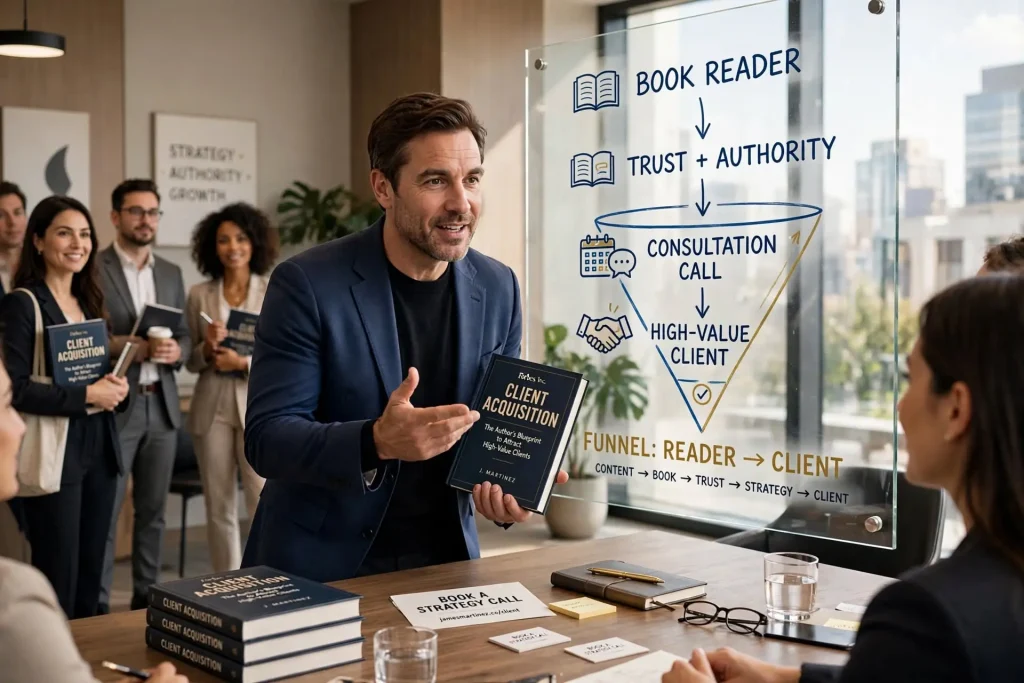
Most authors who eventually expand beyond book sales discover that client acquisition is a separate skill from book marketing. The tactics that sell books to readers don’t automatically work for selling consulting, coaching, courses, or other services to clients. The author client acquisition challenge requires its own strategic thinking, its own marketing channels, and its own conversion mechanics. Authors who treat client acquisition like book marketing usually struggle to build service businesses. Authors who learn client acquisition as a distinct discipline tend to build service revenue that exceeds what their book sales alone produce.
This post walks through how client acquisition actually works for authors and publishing service providers, the specific marketing channels that produce clients, and how to build acquisition systems rather than depending on referrals alone.
Why Client Acquisition Differs From Book Marketing
The differences between selling books and selling services affect every aspect of marketing strategy.
Sale value differences. Books sell for $5 to $30 typically. Services sell for $500 to $50,000+. The economics of acquiring customers shift dramatically at different price points.
Sales cycle length. Book purchases happen in minutes or hours from interest to buy. Service purchases often take weeks or months from initial interest to engagement.
Decision complexity. Book purchases are relatively simple decisions. Service purchases involve more evaluation, comparison, and risk assessment.
Trust requirements. Books require some trust but the limited downside makes the decision easier. Services require significantly more trust because the financial commitment is larger.
Personal connection. Book sales rarely require personal interaction. Service sales often require multiple touchpoints and conversations before clients commit.
These differences mean the marketing channels and approaches that work for books often don’t translate to service businesses. Authors expanding into services need new marketing strategies designed for the different sales dynamics.
The Acquisition Funnel for Service Businesses
The client acquisition funnel has specific stages that each require different work.
Awareness. Prospects discover that you exist and have services they might need. Awareness happens through content marketing, advertising, referrals, networking, and other top-of-funnel activities.
Interest. Prospects engage with your content beyond initial awareness. They read blog posts, listen to podcast appearances, follow social media, sign up for emails. The engagement signals interest in your specific expertise.
Consideration. Prospects begin actively evaluating you against alternatives. They visit your website carefully, read case studies, watch videos, attend webinars. The evaluation period reveals if the fit is right.
Conversation. Prospects engage in direct contact. Inquiry forms, discovery calls, consultations. The conversation phase shifts from one-way information consumption to two-way evaluation.
Conversion. Prospects sign agreements, pay deposits, and become clients. The conversion happens through specific sales processes that move qualified prospects to commitment.
Retention and expansion. Clients continue working with you and refer others. Strong retention significantly affects total business value beyond initial acquisition.
Each stage requires different marketing work. Authors who focus only on awareness without building later-funnel infrastructure struggle to convert interest into clients.
Content Marketing as the Foundation
Content marketing serves as the foundation of most successful client acquisition systems for authors.
Blog content for SEO. Articles that rank for relevant searches bring prospects to your website automatically. The content needs to address specific problems prospects have rather than promoting your services directly.
Long-form content. Detailed posts that demonstrate expertise. Prospects evaluating your knowledge can read thorough content that builds confidence in your capabilities.
Podcast appearances as guest. Reaching podcast audiences interested in your topics. Each appearance produces evergreen content that continues attracting prospects for years.
Podcast hosting. Some authors build their own podcasts as authority-building platforms. The hosting role positions you as an expert who interviews other experts.
Video content. YouTube particularly serves as an alternative search platform where prospects look for solutions to problems. Video content that addresses specific problems can produce significant lead flow.
Email newsletter. Email content directly to subscribers maintains relationships and demonstrates expertise. Strong newsletters become significant client acquisition channels.
The cumulative effect of consistent content marketing across multiple channels produces ongoing prospect flow that compounds over years.
SEO for Service Businesses
Search engine optimization brings prospects actively looking for solutions to your website.
Keyword research for service businesses. The keywords prospects search for differ from book-related keywords. “Best business book editor” beats “how to write a business book” for someone looking to hire editing services.
Service page optimization. Each service you offer should have a dedicated page optimized for relevant searches. Generic “services” pages don’t compete well against specific service pages.
Local SEO if relevant. For service businesses with local components, local SEO can produce qualified leads. Speakers, local consultants, and authors offering location-specific services benefit from local optimization.
Long-tail keyword targeting. Specific phrases prospects search for. Authors offering “executive ghostwriting for technology CEOs” can rank for that specific phrase without competing with broad “ghostwriting” keywords.
Technical SEO. Site speed, mobile responsiveness, schema markup, and other technical factors affect search visibility. Service businesses with weak technical SEO leave significant traffic unclaimed.
Backlink building. Links from other websites pointing to yours signal authority to search engines. Guest posting, podcast appearances, and other content contributions can produce relevant backlinks.
For most service businesses, SEO is a long-term investment that produces compounding returns over years. The work to rank well takes 6 to 24 months but the resulting traffic continues without ongoing direct cost.
Authority Building as Client Acquisition
Authority building works as both content marketing and direct client acquisition.
Book publishing. The book that establishes your authority also serves as a major client acquisition asset. Prospects who read the book and want personalized application become clients.
Speaking engagements. Live audiences provide direct client acquisition opportunities. Speakers regularly book client engagements that emerge from speaking events.
Media appearances. Major podcast appearances, magazine articles, and other media exposure build authority while reaching prospect audiences.
Industry awards and recognition. Awards in your field provide credibility signals that affect client acquisition. The signals matter more for premium services than for low-priced services.
Strategic partnerships. Collaboration with other established authorities cross-references your work and reaches their audiences with your message.
Academic credentials and certifications. For some fields, academic and professional credentials drive client decisions. Investment in formal credentialing can produce significant client acquisition returns.
Authority building takes years but produces sustainable client acquisition that doesn’t depend on ongoing advertising spend.
Paid Advertising for Client Acquisition
Paid advertising can supplement organic client acquisition with predictable lead flow.
Google Ads for high-intent searches. Prospects searching specific service queries (“hire book ghostwriter,” “business book editor near me”) show strong purchase intent. Google Ads reach these prospects at the moment they’re looking.
Facebook and LinkedIn for awareness. Social advertising builds awareness with specific audiences. The conversion cycle is longer but the targeting can be precise.
YouTube advertising. Video ads attached to relevant content reach prospects researching topics related to your services.
Retargeting campaigns. Ads that follow prospects who visited your website maintain awareness during the consideration phase. Often produces strong ROI compared to cold targeting.
Lead generation campaigns. Ads designed specifically to generate leads (email signups, consultation requests) rather than direct sales. The leads become the funnel that produces clients.
The economics of paid advertising for services usually work because of higher customer values. A $5 customer acquisition cost is too high for a $20 book but reasonable for a $5,000 service engagement.
Networking & Direct Outreach
Beyond content and advertising, direct outreach can produce clients.
Strategic networking events. Industry conferences, professional associations, and other gatherings where prospects exist. Authentic relationship building beats aggressive sales tactics.
Targeted direct outreach. Identifying specific high-value prospects and contacting them with personalized messages. Time-intensive but can produce significant clients when done well.
LinkedIn engagement. The platform supports professional networking that often leads to client engagements. Active LinkedIn presence produces inbound inquiries for many service providers.
Referral request systems. Asking satisfied clients for referrals systematically. Most clients are happy to refer but don’t volunteer referrals without being asked.
Strategic partnerships with adjacent service providers. Other service providers who serve similar clients often refer business when your services complement theirs.
Speaking at relevant events. Direct exposure to prospect audiences. Speakers regularly book client engagements that emerge from their talks.
These activities require time investment but can produce significant client acquisition for service providers willing to do the work.
Converting Inquiries to Clients
The conversation phase determines if interested prospects actually become clients.
Discovery call processes. Most service businesses use initial calls to evaluate fit. Strong discovery calls qualify prospects, demonstrate value, and move qualified prospects toward commitment.
Proposal processes. Written proposals that document the scope, deliverables, timeline, and pricing. Strong proposals make the buying decision easier for prospects.
Pricing strategies. Premium pricing for premium services. Discount pricing usually attracts price-sensitive clients who are less satisfying to work with. Premium pricing attracts prospects who value quality.
Objection handling. Common prospect concerns (cost, timeline, risk) need to be addressed clearly. Strong sales conversations acknowledge concerns and address them honestly.
Decision support materials. Case studies, testimonials, sample work all support prospect decisions. Materials that prospects can review independently between calls help conversion.
Close processes. The transition from prospect to client requires specific steps. Contracts, deposits, kickoff meetings. Clear processes that prospects understand make conversion easier.
Authors expanding into services often struggle with these sales mechanics. Investment in learning sales processes pays back significantly in higher conversion rates.
Retention & Lifetime Value
Beyond initial acquisition, retention dramatically affects total client business value.
Service delivery quality. Clients who feel served well refer others and return for additional engagements. Quality delivery is the foundation of retention.
Ongoing communication. Maintaining relationships with past clients keeps you visible when their needs arise. Periodic check-ins and value-add content sustain the relationship.
Additional service offerings. Clients who engaged for one service may need others. Expanding service offerings creates expansion opportunities within the existing client base.
Referral systems. Systematic processes for requesting and rewarding referrals. Past clients often produce the strongest new client flow.
Case studies and testimonials. Documenting client success generates marketing assets that produce future client acquisition.
The lifetime value of clients often exceeds initial engagement value significantly. Service businesses that focus only on initial acquisition without retention strategy leave substantial revenue unclaimed.
Common Client Acquisition Mistakes
Several patterns regularly weaken service business client acquisition.
Treating it like book marketing. The tactics that sell books rarely translate directly to selling services. Service businesses need their own marketing strategy.
Focusing only on awareness. Content marketing without conversion infrastructure produces lots of audience but few clients. The full funnel needs attention.
Underpricing. Service prices that feel comfortable to set often signal commodity positioning that doesn’t attract premium clients. Premium pricing usually produces better businesses.
Skipping the sales conversation. Authors who hate sales conversations often try to skip them. The conversion phase requires direct engagement.
Inconsistent marketing. Sporadic marketing produces sporadic client flow. Consistent marketing across years produces sustainable acquisition systems.
No retention strategy. Treating each engagement as the end rather than the beginning of a relationship limits total business value.
Wrong service offerings. Services that prospects don’t actually want despite the author’s enthusiasm for offering them won’t convert regardless of marketing strength.
Treating Acquisition as Ongoing Business Discipline
Client acquisition isn’t a one-time setup. It’s ongoing business discipline that requires consistent attention across years. The authors who build sustainable service businesses around their books treat acquisition as a core business function that gets dedicated time, attention, and budget. The authors who treat acquisition as something that should happen automatically because they wrote a good book often find that books alone don’t produce the client flow that service businesses require.
The work compounds when treated as ongoing discipline. Each year of content marketing produces more accumulated content that drives traffic. Each year of authority building adds credentials and visibility. Each year of client engagements produces case studies and testimonials that support future acquisition. The author who started with one book and modest service offerings often finds five years later that the client acquisition system produces predictable revenue that book sales alone could never have generated. The transition from book author to service business owner is significant, but for authors with relevant expertise and willingness to do the business work, the outcomes can far exceed what books alone produce across an entire career.


