
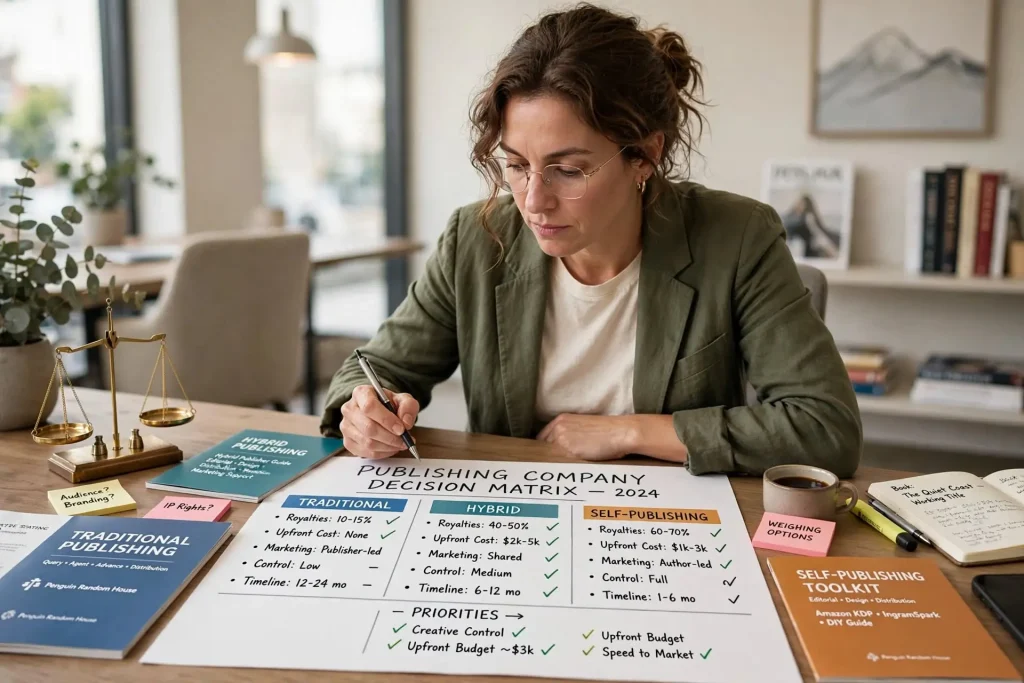
Most authors approach the publishing company decision without a clear framework. They hear about a publisher from another author, get excited about the possibility, and sign a contract without comparing alternatives. This decision shapes the entire trajectory of how the book reaches readers and what the author actually earns from it. The decision to find the best publishing company requires evaluating multiple options against specific criteria, knowing the different categories of publishers that exist, and recognizing the red flags that distinguish legitimate publishers from predatory ones.
This post walks through the different types of publishing companies, the specific questions that reveal fit, and how to make a decision you can live with for years.
The Three Main Publisher Categories
Publishing companies fall into roughly three main categories, each with distinct economics and trade-offs.
Traditional publishers. These pay authors advances against royalties. They handle all production costs (editing, design, printing, distribution). They retain most subsidiary rights and pay royalties of 6% to 25% depending on format and platform. Major examples include Penguin Random House, HarperCollins, Simon & Schuster, Macmillan, Hachette. Smaller traditional publishers operate similarly at smaller scale.
Hybrid publishers. These charge authors fees for some portion of the publishing services while providing professional production and distribution. Authors retain higher royalties (typically 50% or more) and more rights than traditional publishing offers. The model exists between traditional publishing and pure self-publishing.
Self-publishing services. These help authors self-publish without functioning as publishers themselves. Authors retain all rights and royalties. The services charge for specific work (editing, design, distribution setup) but don’t take ongoing royalty cuts.
Each category serves different author needs. The right choice depends on your specific goals, resources, and tolerance for different trade-offs.
When Traditional Publishing Makes Sense
Traditional publishing has specific advantages for specific authors.
Industry credibility. Carrying a major publisher’s imprint provides credibility that self-publishing alone doesn’t match. For authors building careers as thought leaders, journalists, or academics, the credibility transfer can be significant.
Mainstream bookstore distribution. Traditional publishers reach physical bookstore distribution that self-publishers struggle to access. The distribution matters more for some books than others.
Marketing infrastructure. Traditional publishers handle some marketing activities (cover design, publicity, distribution to reviewers). The level varies by publisher and by author advance size.
Editorial development. Traditional publishers provide developmental editing, copyediting, and other services as part of their standard process. Authors don’t pay separately for these.
Advance payments. The advance provides income before book sales start. For authors who need upfront payment, this matters.
Major media access. Traditional publishers have publicity relationships that self-publishers typically can’t build. NYT review consideration, NPR appearances, major podcast bookings.
The trade-offs include lower per-book royalties, longer timelines (often 18-24 months from acceptance to publication), less control over title and cover decisions, and reduced flexibility on pricing and distribution.
For most authors writing books that fit traditional publishing’s commercial parameters, the decision often comes down to if the credibility and infrastructure benefits outweigh the income and control trade-offs.
When Hybrid Publishing Makes Sense
Hybrid publishing fills a specific niche between traditional and self-publishing.
The author pays publication costs while gaining professional production quality and some publisher infrastructure. Royalties are higher than traditional publishing. Timelines are faster. Author control is greater.
Authors who benefit from hybrid publishing often include business professionals using books for authority building (where professional credibility matters but traditional publishing access is limited), authors with substantial advances they’re willing to invest in their own books, authors who want professional production without learning to self-publish themselves, and authors with content that doesn’t fit traditional publishing’s commercial parameters but justifies professional production.
Quality hybrid publishers operate transparently about their fees and what authors receive in exchange. They produce books that compete with traditional publishing quality. They distribute through legitimate channels.
Predatory hybrid publishers charge substantial fees while providing low-quality production. They prey on authors who don’t know how to evaluate the offerings.
Distinguishing between legitimate and predatory hybrid publishers requires careful evaluation.
When Self-Publishing Services Make Sense
Self-publishing services help authors publish independently while retaining all rights and royalties.
The author maintains full ownership and control. The services charge for specific work but don’t take ongoing royalty cuts. Authors who self-publish through services keep significantly more per-book income than authors using traditional or hybrid models.
Authors who benefit from self-publishing services often include established authors with audiences who don’t need traditional publishing’s marketing infrastructure, authors in genres where self-publishing is well-developed (romance, thriller, certain fantasy and sci-fi subgenres), authors who want speed and control more than traditional publishing’s other benefits, and authors who can handle the marketing and business aspects of independent publishing.
The trade-off is taking on more business management. Self-publishing authors handle (or outsource) editing decisions, cover design hiring, marketing, distribution setup, and ongoing platform management.
For authors comfortable with this level of business management, self-publishing services often produce significantly better economic outcomes than traditional publishing for similar quality of work.
Questions to Ask Any Publisher
Specific questions reveal fit better than reading marketing materials.
What is your publication timeline from acceptance to release? Compare against what fits your goals. Traditional publishing’s 18-24 month timeline matters for some books and not others.
What rights do you acquire and for how long? Some publishers acquire all rights for the duration of the copyright. Some acquire specific rights for limited periods. The differences matter significantly for long-term income.
What is the royalty structure? Get specific numbers for each format and territory. Vague answers about “industry standard” don’t substitute for specific contract terms.
What marketing do you provide? Specific activities, not vague promises. Marketing budgets, publicity work, advertising, promotional placements.
Who has final approval on title and cover? Traditional publishers typically retain this approval. Hybrid publishers vary. Knowing in advance prevents conflict later.
What is your distribution reach? Specific channels. Major chains, independent bookstores, libraries, international markets, online retailers.
Can I see recent books you’ve published? The catalog reveals what the publisher actually produces. Quality, design, distribution placement.
Can I speak with recent authors you’ve worked with? Conversations with current authors reveal information that promotional materials don’t.
What is the contract termination process? Some contracts are extremely difficult to exit. Knowing the exit terms matters.
What happens if the book underperforms? Reversion rights, remainder policies, out-of-print clauses all affect long-term author position.
Red Flags Across All Publisher Types
Several patterns signal publishers to avoid regardless of category.
Vague or evasive contract terms. Legitimate publishers can explain their contracts clearly. Confusion or evasion usually indicates problems.
Pressure to decide immediately. Quality publishers give authors time to evaluate carefully. Pressure tactics often indicate predatory operations.
All-rights contracts with low compensation. Some contracts acquire all rights in all formats and territories for the entire copyright term. These should come with significant compensation. All-rights contracts with low advances or fees are particularly problematic.
Fees disguised as something else. Some predatory operations charge fees while claiming to operate as traditional publishers. Knowing what you’re actually paying for matters.
Quality issues in existing catalog. Look at books the publisher has produced. If their catalog quality is low, your book will likely be similar.
Bad reviews from previous authors. Online research often reveals patterns of complaints from authors who worked with predatory publishers.
Lack of transparency about distribution. Legitimate publishers can explain their distribution clearly. Evasion about where books actually reach should raise concerns.
No history or new operations. Recently formed publishing companies without track records carry risk that established publishers don’t.
Unrealistic promises. Publishers promising bestseller status, movie deals, or other specific outcomes are either dishonest or inexperienced.
Evaluating Hybrid Publishers Specifically
Hybrid publishing is where the most evaluation difficulty occurs. The category includes both legitimate professional services and predatory operations.
Transparent fee structures. Legitimate hybrid publishers explain exactly what authors pay for and what they receive. Predatory operations obscure the actual costs.
Production quality. Legitimate hybrid publishers produce books that compete with traditional publishing quality. Predatory operations produce books that look amateur.
Distribution reality. Legitimate hybrid publishers provide actual distribution to bookstores and other channels. Predatory operations claim distribution that doesn’t really happen in practice.
Rights and royalties. Legitimate hybrid publishers offer higher royalties (50%+ for ebook) reflecting the author’s financial contribution. Some hybrid publishers offer traditional-level royalties while charging author fees, which doesn’t make economic sense for authors.
Professional reputation. Look for hybrid publishers with positive industry reputation. Industry observers track which operations are legitimate.
The Independent Book Publishers Association (IBPA) hybrid publisher criteria provide useful evaluation framework. Legitimate hybrid publishers typically meet these criteria.
Making the Final Decision
The decision framework should weight several factors.
Your specific goals for the book. Income? Credibility? Audience reach? Speed to market? Different goals favor different publishing paths.
Your tolerance for business management. Self-publishing requires significant business management. Traditional publishing minimizes this but takes most income.
Your available capital. Hybrid publishing and self-publishing require upfront investment. Traditional publishing pays advances. Match the financial model to your situation.
Your timeline pressure. Traditional publishing takes years. Self-publishing can happen in months. Hybrid publishing falls between.
Your audience situation. Authors with existing platforms can succeed in self-publishing. Authors without platforms benefit more from traditional publishing’s marketing infrastructure.
Most authors should consider all three categories rather than locking into one assumption. The right choice depends on the specific book and the specific author’s situation.
Making the Publishing Choice You Can Live With
Publishing decisions affect career trajectories for years afterward. The wrong choice can be difficult to reverse. Authors who sign with predatory hybrid publishers often spend years trying to recover their rights. Authors who self-publish without proper preparation often struggle for years to overcome the early launches’ weakness. Authors who chase traditional publishing without realistic chances often spend years pursuing deals that don’t materialize while their possible self-publishing income goes uncollected.
The right approach starts with honest assessment of your specific situation. What do you actually want from this book? What are you willing to invest? What are you not willing to compromise? The answers point toward the publishing path that fits your specific reality rather than someone else’s ideals. Authors who choose deliberately, based on their own evaluation rather than romanticized notions of any particular path, tend to end up with publishing arrangements they can live with for years. The choice is significant enough to deserve the time required to make it well.


