
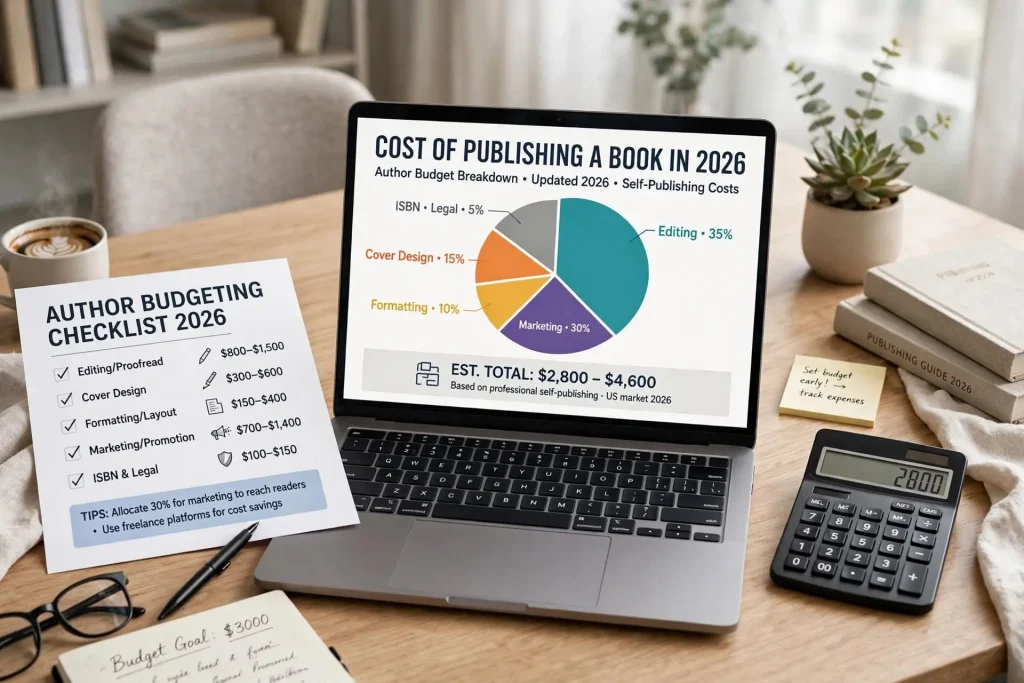
Most authors approaching their first book underestimate publishing costs significantly. They’ve heard about self-publishing being affordable and assume the total cost will run a few hundred dollars. The reality for serious self-publishing in 2026 typically runs $3,000 to $15,000+ for a quality production. The cost to publish a book at the level that competes with traditional publishing involves multiple categories of investment, each affecting the finished product in specific ways. Authors who budget realistically tend to produce books that succeed. Authors who try to cut every corner often produce books that show the corner-cutting in their commercial reception.
This post walks through the actual costs of publishing a book in 2026, what each category includes, and how to budget realistically based on your specific situation.
The Full Cost Breakdown
Publishing costs fall into several main categories. Each can be cheap or expensive depending on choices.
Editing costs. Developmental editing, copyediting, and proofreading. Typically $1,500 to $8,000 for a typical novel-length book.
Cover design costs. Front cover for ebook, full wraparound cover for print. Typically $300 to $5,000 depending on designer and complexity.
Interior layout costs. Formatting the manuscript into final book interior. $0 if you do it yourself with Vellum or Atticus, $300 to $2,000 if you hire professional layout designers.
ISBN costs. $0 if using free platform ISBNs, $125 for one ISBN through Bowker, $295 for a pack of 10.
Production file preparation. Usually included with layout work, sometimes separate.
Distribution setup. Free across most major platforms, though aggregators like Draft2Digital take a percentage of royalties.
Launch marketing costs. Promotional placements, paid advertising, ARC distribution. Typically $500 to $5,000 for a serious launch.
Audiobook production (optional). $1,500 to $6,000+ if producing audiobook at the same time as print/ebook.
Total typical cost for serious self-publishing. $3,000 to $15,000 for first books, with experienced self-publishers sometimes producing for less through DIY efficiency.
Editing Cost Detail
Editing is the largest single category for most authors.
Developmental editing. $1,000 to $4,000 for typical fiction. Higher for specialized nonfiction. The work addresses structural issues and substantive concerns.
Copyediting. $1,000 to $3,000 for typical fiction. Sentence-level grammar, consistency, style application.
Proofreading. $400 to $1,200 for typical fiction. The final pass before publication.
Combined editing investment. $2,400 to $8,200 for the full editorial sequence at standard market rates.
Going below market rates for editing. Possible but produces inferior work. Bargain editors typically deliver work that misses issues good editors catch.
The economics. Authors who try to save money on editing usually pay through worse reviews, lower sales, and reputational damage. The editing investment typically produces returns many times its cost.
For first-time authors, the full editing sequence is usually worth investing in even when budgets feel tight. The editing affects everything else about how the book is received.
Cover Design Cost Detail
Cover design varies widely based on designer experience and project complexity.
Budget covers ($100 to $300). Pre-made covers from sites like SelfPubBookCovers, basic custom work from inexperienced designers. Acceptable for some books but often signal amateur production.
Mid-tier covers ($300 to $1,000). Custom work from competent designers without major industry experience. Most indie authors fall in this range and produce acceptable to good covers.
Strong custom covers ($800 to $2,500). Experienced designers with strong portfolios. Custom work tailored to your specific book. Most authors should aim for this range for serious commercial books.
Premium custom covers ($2,500 to $5,000+). Top-tier designers with extensive credentials. Justified for authors with significant audiences or premium positioning.
Cover refresh costs. Updating older book covers later in their lifetime. Typically $300 to $1,500 depending on what’s being changed.
Print cover wraparound work. Some designers charge extra for the full print cover (front, spine, back, bleeds). Others include it in standard cover pricing. Clarify before hiring.
For most authors, $500 to $1,500 produces strong covers that compete effectively. Going significantly below this range usually produces work that signals amateur production.
Interior Layout Cost Detail
Interior formatting can be DIY or professional with significant cost differences.
DIY using Vellum (Mac only). $200 to $250 one-time purchase. Works for any number of books afterward. Produces professional results for most fiction.
DIY using Atticus (cross-platform). $147 one-time purchase. Similar functionality to Vellum.
Professional layout from designers. $300 to $2,000 per book depending on complexity. Required for books with significant images, design elements, or specialized formatting needs.
Professional InDesign work. $1,000 to $5,000 for design-heavy books like illustrated children’s books, cookbooks, or design-focused nonfiction.
For most fiction and standard nonfiction, DIY tools produce results that compete with professional layout. The investment in learning the tools pays back across multiple books.
For design-heavy books, professional help usually justifies the cost. Standard layout tools don’t handle involved design requirements well.
ISBN & Identification Costs
ISBN decisions affect costs across the catalog.
Single ISBN through Bowker. $125 for one ISBN. Useful only for very small catalogs.
Block of 10 ISBNs through Bowker. $295. Works out to $29.50 per ISBN. The standard purchase for most self-publishers.
Block of 100 ISBNs through Bowker. $575. Works out to $5.75 per ISBN. For prolific authors planning many books.
Free ISBNs through KDP and similar platforms. $0 cost but the ISBN identifies the platform as publisher rather than you. Limits distribution flexibility.
Each format needs its own ISBN. Ebook, paperback, hardcover, and audiobook all need separate ISBNs.
For authors planning long careers with multiple books, buying your own ISBNs makes sense. The flexibility outweighs the modest cost.
Launch Marketing Investment
Marketing for launches falls into specific cost categories.
Promotional placements. BookBub Featured Deals run $200 to $1,500. Secondary promotional sites $30 to $300 per placement.
Paid advertising. Amazon Ads, Facebook Ads, BookBub Ads. Launch budgets typically $500 to $5,000 across platforms.
ARC distribution costs. BookFunnel subscriptions ($20 to $250 per year). NetGalley listings ($399 to $899 per book). Some authors use these. Others build ARC teams without these services.
Email service provider costs. ConvertKit, MailerLite, and similar services. Free for small lists, $20 to $200+ per month at scale.
Public relations costs. Publicist engagements run $3,000 to $20,000+ per book. Most self-publishers don’t use publicists.
Total launch marketing budget. Modest launches run $500 to $2,000. Aggressive launches with significant promotional placement and ad spending can run $5,000 to $20,000+.
Match the launch budget to the book’s commercial chances. Authors investing $5,000 in marketing for a book that will only earn $2,000 in royalties miscalculate. Authors investing $500 in marketing for a book with bestseller chances undercapitalize.
Audiobook Production Costs
Audiobook production adds significant cost for authors choosing to produce in audio.
Royalty share arrangements. ACX allows splitting royalties with narrators rather than paying upfront. Lower out-of-pocket cost but lower long-term per-book income.
Per-finished-hour rates for narration. $200 to $500+ per finished hour at professional rates. A typical 10-hour audiobook costs $2,000 to $5,000+ for narration alone.
Studio and engineering costs. Sometimes included in narrator rates. Sometimes separate. Adds $500 to $2,000 for typical audiobooks.
Author-narrated audiobook costs. Lower direct cost but requires significant author time and adequate recording equipment. Investment in equipment runs $500 to $5,000.
Total audiobook production. $1,500 to $6,000+ for typical professional production. More for premium narrators or extended-length books.
For most authors, audiobook production should follow rather than accompany initial publication. Producing audiobook after the print/ebook editions are established lets you assess if audiobook investment makes economic sense for the specific book.
Hidden Costs Authors Often Miss
Several cost categories often surprise first-time authors.
Software and tools. Adobe Creative Cloud for cover work ($60/month for full suite). Email service provider subscriptions. Editing software. The recurring costs add up.
Mockup and marketing graphics. Tools like Placeit or BookBrush for marketing graphics. $99 to $200 per year.
Website hosting and domain. $100 to $300 per year for basic author websites.
Tax preparation. Self-published authors face specific tax situations that often justify professional preparation. $300 to $1,500 annually.
Legal review. Contract review, copyright issues, and other legal matters. Variable but plan for some legal costs over the years.
Author photo and branding. Professional photos and brand design. $300 to $2,000+ depending on quality and scope.
Continuing education. Conferences, courses, and other professional development. Variable but worth budgeting for.
These hidden costs add up to $1,000 to $5,000+ annually for active authors. Budget realistically rather than treating them as one-time expenses.
Budgeting Realistically for Long Term Success
The cost to publish a book in 2026 isn’t fixed. It varies based on quality choices, marketing investment, and the specific book’s needs. Authors who budget realistically and invest at appropriate levels tend to produce work that succeeds in its market. Authors who try to cut every corner often produce work that shows the cuts in its commercial reception. The investment isn’t optional for serious commercial publishing.
For most authors, planning $5,000 to $12,000 for a first book produces sufficient resources for quality production and modest launch marketing. Subsequent books often cost less as systems mature and relationships develop. The total career investment runs $50,000 to $200,000+ across a 10-book catalog. The investment is significant but the returns for books that succeed often vastly exceed the costs. Authors who treat publishing as a serious business investment tend to produce sustainable careers. Authors who treat it as a hobby or who underbudget consistently often spend the money anyway through inefficient choices and end up with worse outcomes than honest budgeting would have produced.


