
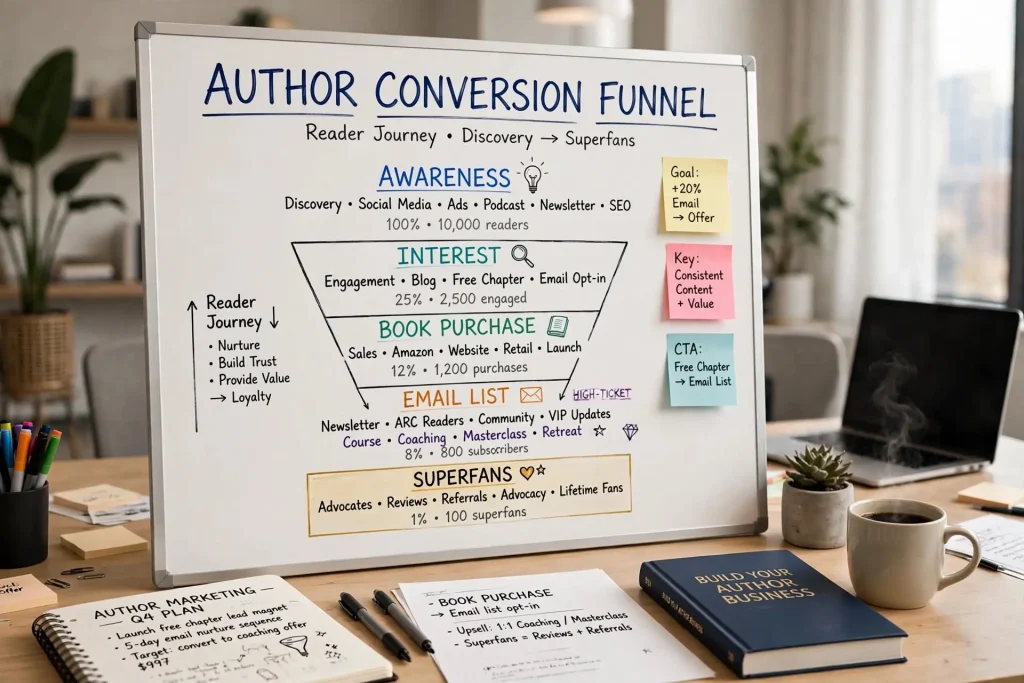
Most authors think about marketing as a collection of separate activities. The social posts. The email campaigns. The ad spending. The book launches. Each happens but the connections between them stay loose. The author conversion funnel is the systematic structure that turns those scattered activities into a coordinated machine that converts strangers into readers and readers into loyal long-term audience. Authors who build proper funnels see significantly better business results than authors of equal writing quality who depend on disconnected marketing activities.
This post walks through how author conversion funnels actually work, the specific conversion goals at each stage, and how to design a funnel that fits your specific author business.
What the Author Funnel Actually Does
The author conversion funnel moves people through specific stages from first awareness of your work to long-term loyal readers.
The strangers stage. People who don’t know you exist yet. Marketing reaches them through advertising, social media, search, podcast appearances, and other top-of-funnel activities.
The visitors stage. Strangers who’ve engaged with you somehow. They’ve visited your website, listened to a podcast you appeared on, seen one of your ads.
The subscribers stage. Visitors who’ve joined your email list. They’ve moved from anonymous traffic to addressable audience.
The buyers stage. Subscribers who’ve purchased one of your books. They’ve crossed the trust threshold required for paying.
The loyal readers stage. Buyers who continue buying your subsequent releases. They’ve become long-term customers rather than one-time transactions.
The advocates stage. Loyal readers who actively promote your work to others. Reviews, recommendations, social mentions.
Each stage has its own conversion rate. The percentage of strangers who become visitors. The percentage of visitors who become subscribers. The percentage of subscribers who become buyers. The cumulative conversion through all stages determines the funnel’s overall effectiveness.
Stage One: Awareness to Engagement
The first conversion is getting strangers to engage with your work in some form.
Awareness channels. Paid advertising, social media organic reach, podcast guest appearances, SEO content, BookBub features, partner promotions.
Engagement signals. Visiting your website, following you on social media, listening to a podcast episode featuring you, reading content you produced.
Typical conversion rates. The percentage of people who see your awareness marketing and then take some engagement action varies widely. Cold ad clicks at 1% to 3%. Organic social engagement at 0.5% to 5%. Each channel has different baseline expectations.
Improving this conversion. Stronger creative. Better targeting. More compelling hooks. The work to test and optimize awareness-to-engagement conversion produces results across all subsequent funnel stages.
The risk of imbalanced funnels. Authors who drive massive awareness without supporting later funnel stages waste the awareness investment. The traffic flows in but doesn’t convert.
Stage Two: Engagement to Subscription
Getting engaged visitors to become email subscribers is one of the highest-leverage conversions in the entire funnel.
The lead magnet approach. Free content offered in exchange for email signup. A free novella or first book. A useful guide or checklist. The lead magnet should solve a specific problem your target reader has.
Why subscribers matter. Email reaches subscribers reliably. Social media reach gets filtered by algorithms. Email subscribers can be reached directly whenever you choose.
Typical conversion rates. Website visitors typically convert to subscribers at 1% to 5%. Strong lead magnets and dedicated landing pages can push this to 5% to 25%.
Email signup placement. Forms throughout your website, exit-intent popups, dedicated landing pages, calls to action in your books. Each placement captures different visitors.
The follow-up matters. Subscribers who join your list and then hear nothing for weeks lose interest. The welcome sequence determines if subscribers stay engaged.
Stage Three: Subscription to Purchase
Converting subscribers to first-time book buyers is where many funnels break down.
The welcome sequence. The first 5 to 12 emails after subscription. Should deliver the promised lead magnet, introduce you and your work, build connection, and eventually present book purchase opportunities.
Trust building before selling. Subscribers who get sold to from email one often unsubscribe immediately. Building relationship through value-providing content before sales pitches produces better long-term conversion.
Specific purchase triggers. Launch announcements for new books. Limited-time promotional pricing. Personal stories that build connection and lead naturally to book recommendations.
Typical conversion rates. Engaged email lists convert at 5% to 25% to a new release. Lower for backlist titles. Highly variable based on list quality and message strength.
The price point effect. Lower-priced first books convert subscribers to buyers more easily than higher-priced ones. Many authors use $0.99 or $2.99 first-in-series books specifically to drive subscriber-to-buyer conversion.
Stage Four: Purchase to Loyalty
Converting first-time buyers to loyal repeat customers determines the lifetime value of your readers.
The reading experience. Books that deliver what their marketing promised create satisfied readers. Books that disappoint create one-time buyers who don’t return.
The follow-up communication. Engaged communication with buyers after their purchase. Thank-you sequences, additional book recommendations, ongoing newsletter content.
Series read-through. For series authors, the percentage of book one readers who continue through later books in the series. Strong read-through indicates strong reader connection.
Typical retention rates. Highly engaged audiences see 60% to 80%+ retention from one book to the next in a series. Weaker engagement sees 20% to 40% retention.
The compounding effect. Each book in your catalog has a chance to convert past buyers to repeat buyers. Authors with 10+ books have many more opportunities than authors with 1 book.
Stage Five: Loyalty to Advocacy
The smallest but highest-value group: readers who actively promote your work to others.
Reviews. Loyal readers who leave reviews produce social proof that drives future conversion at the earlier funnel stages.
Word of mouth. Personal recommendations from readers to other readers produce some of the highest-quality top-of-funnel traffic.
Social sharing. Readers who post about your books on their social media reach their networks with implicit endorsement.
Direct community engagement. Some readers join your community, Facebook group, or other engagement platforms and become active community members.
Conversion rate to advocacy. Typically 2% to 10% of loyal readers become active advocates. The percentage matters because each advocate produces ongoing top-of-funnel traffic.
Treating advocates well. Authors who recognize and appreciate their active advocates often see those advocates’ engagement deepen over time.
Designing Your Specific Funnel
The general funnel structure adapts to specific author situations.
Genre-specific considerations. Romance audiences engage differently than thriller audiences than literary audiences. The funnel design should reflect your specific genre’s reader behavior patterns.
Career stage adaptations. New authors building first audiences design funnels differently than established authors with mature catalogs. The infrastructure scales as the business grows.
Product mix variations. Authors with only books versus authors with books plus services need different funnel designs. The conversion goals at each stage differ.
Audience source variations. Authors driving traffic mostly through paid advertising design funnels differently than authors driving traffic mostly through SEO content. The funnel adapts to the traffic source.
Resource constraints. Funnels can be elaborate or simple. Start with minimum viable funnels and add sophistication over time as the business grows.
Measuring Funnel Performance
Specific metrics reveal funnel health.
Top-of-funnel traffic. How many strangers reach your awareness channels each month.
Engagement conversion rate. The percentage of traffic that engages meaningfully.
Subscription conversion rate. The percentage of visitors who become email subscribers.
Subscriber-to-buyer conversion rate. The percentage of subscribers who buy at least once.
Repeat purchase rate. The percentage of buyers who buy again.
Customer lifetime value. The total revenue an average buyer generates across all their purchases.
Tools to measure these vary. Google Analytics for website data. Email service provider analytics for email data. KDP and other retailer reports for sales data. Spreadsheets to combine the data for full funnel analysis.
Most authors should review funnel metrics monthly. The patterns over time reveal what’s working and what needs attention.
Common Funnel Mistakes
Several patterns regularly weaken author conversion funnels.
No clear funnel design. Random marketing activities without unifying strategy. Authors who haven’t mapped their funnel often have leaky pipes where readers fall out unnoticed.
Top-heavy traffic without conversion infrastructure. Massive social media followings or website traffic that doesn’t convert because the later funnel stages weren’t built.
Weak lead magnets. Generic free content that doesn’t solve specific reader problems converts poorly to subscribers.
Skipping the welcome sequence. New subscribers who hear nothing for weeks after signing up lose interest before you can build relationship.
Over-pitching too early. Welcome sequences that try to sell from email one alienate new subscribers before they have time to trust you.
Neglecting subscribers between launches. Long gaps without communication train subscribers to forget about you.
Treating funnel as one-time setup. Funnels need ongoing optimization. The metrics tell you what’s working. Updates based on data improve performance over time.
Trying to skip stages. Trying to convert awareness directly to purchase without intermediate stages almost always produces worse results than the full funnel approach.
Funnel Thinking as Author Business Mindset
The fundamental shift from random marketing to funnel thinking changes how authors approach their entire business. Instead of asking “what marketing should I do this week,” funnel-thinking authors ask “what stage of the funnel needs work and what specific tactics address that stage.” The questions produce more strategic answers.
Authors who develop funnel thinking early in their careers tend to build sustainable businesses across years. The infrastructure they build compounds. Each book launches into stronger funnels than the previous one. Each year of operation produces more refined conversion mechanics. The business that started as one author publishing one book becomes a system that converts strangers into readers reliably enough to sustain a full-time career. Authors who never develop funnel thinking often find themselves working hard on marketing without proportional results because the activities don’t connect into coherent systems. The mindset shift is the difference between author as marketer and author as business operator. Both can succeed, but the operator typically builds more sustainable careers.


