
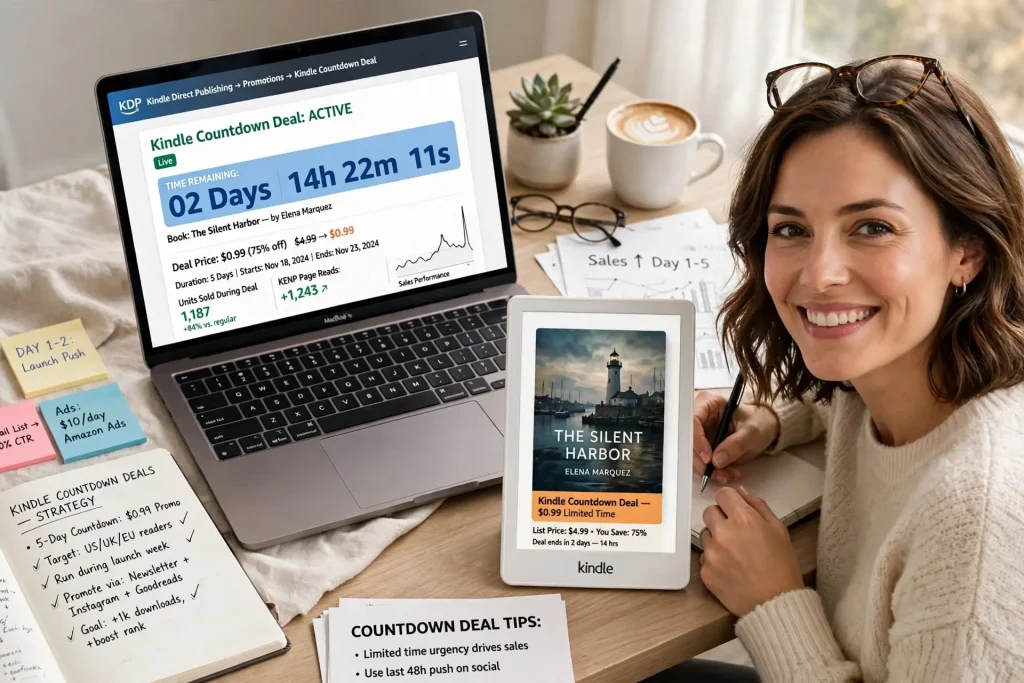
Most authors who enroll books in KDP Select know that Countdown Deals exist but treat them as just another discount option. The Countdown Deal is actually a specific promotional tool with mechanics that produce different results than ordinary price drops. The kindle countdown deals authors run strategically can drive significant sales spikes, ranking boosts, and reader acquisition that ordinary discounting can’t match. Authors who learn the specific mechanics tend to extract more value from each promotional cycle than authors who use Countdowns the same way they’d use any other sale.
This post walks through how Kindle Countdown Deals actually work, the specific strategy that maximizes their impact, and how to fit Countdowns into broader promotional planning.
What Makes Countdown Deals Different
Countdown Deals have specific characteristics that distinguish them from ordinary price changes.
The promotional badge. Books on Countdown display the orange “Kindle Countdown Deal” badge with the current and original prices. The badge attracts attention that ordinary sale pricing doesn’t get.
The price progression. Countdown Deals can run with multiple price tiers that increase as the deal progresses. Starting at $0.99, moving to $1.99, then $2.99 over several days. The price progression creates urgency that single-price sales lack.
The 70% royalty preservation. Books normally at 70% royalty rates keep that rate during Countdown Deals even at the lower promotional price. Ordinary price drops below $2.99 lose the 70% rate.
The limited frequency. Books can only run Countdown Deals once per 90-day enrollment period. The scarcity makes each Countdown more significant than ordinary promotional cycles.
The country availability. Countdown Deals only work in US and UK markets. Other markets see ordinary pricing.
The visibility boost. Countdown books appear on the Kindle Countdown Deals page and in specific promotional placements that ordinary sale books don’t access.
These mechanics combine to make Countdown Deals more powerful promotional tools than simple price changes for books eligible to use them.
Eligibility Requirements
Countdown Deals have specific eligibility requirements that affect strategy.
KDP Select enrollment. The book must be enrolled in KDP Select (exclusive to Amazon). Books distributed wide can’t use Countdown Deals.
Pricing history. The book must have been at its current list price for at least 30 days before the Countdown starts.
Price range. Countdown discounts must result in prices at least 5% below the current list price, with the lowest tier at least $0.99.
Royalty rate stability. The book must have been earning 70% royalty for at least 30 days before the Countdown.
90-day cycle. Each book gets one Countdown per 90-day Select enrollment period.
Maximum duration. Countdown Deals can run from 1 to 7 days.
Authors planning Countdowns need to verify eligibility before scheduling. Books that just had price changes or royalty tier shifts may not qualify until the 30-day waiting period passes.
The Sales Spike Mechanics
Countdown Deals produce concentrated sales spikes through specific mechanisms.
The discount itself drives sales. Lower prices convert more browsers to buyers regardless of other factors.
The badge attracts additional attention. Books with the orange Countdown badge get clicks they wouldn’t otherwise receive in search results and category listings.
The urgency creates conversion. Limited-duration sales convert prospects who would have postponed purchasing at regular prices.
The price progression compounds urgency. Multi-tier pricing creates urgency to buy at the lowest tier before the price increases.
The promotional pages drive traffic. Amazon’s Kindle Countdown Deals page brings additional readers specifically looking for discounted books.
The algorithm rewards the spike. Sales velocity during the Countdown signals to Amazon’s algorithm that the book is popular, which can produce continued algorithmic visibility after the Countdown ends.
Authors running well-supported Countdowns often see 5x to 20x normal sales velocity during the deal period. The spike effects continue with reduced magnitude for 1 to 4 weeks after the Countdown ends as the algorithmic boost fades.
Strategic Countdown Planning
Effective Countdown strategy involves several specific elements.
The right time to run. Countdowns work best during periods when other promotional support is available. Stacking Countdown with BookBub Featured Deals, email blasts, paid advertising, and other promotional activities produces the strongest results.
The price tier strategy. Multi-tier Countdowns starting at $0.99 and progressing to $2.99 typically produce better results than single-price Countdowns. The progression creates urgency that drives concentrated sales.
The duration choice. 5 to 7 day Countdowns typically produce better total results than 1 to 3 day Countdowns. The longer duration allows multiple promotional touchpoints and sustained algorithmic boost.
The launch versus established book decision. New launches typically benefit more from Countdowns than established books. The Countdown’s algorithmic boost compounds with the launch’s natural algorithmic boost.
Series first-book strategy. Running Countdowns on series first books often drives series read-through that exceeds the Countdown’s direct revenue impact. The lower entry price brings readers into series they may not have tried at full price.
Holiday and seasonal timing. Some Countdowns work better at specific times of year. Romance Countdowns around Valentine’s Day. Thriller Countdowns during summer reading season. Christmas-themed books in November and December.
Promotional Stack for Countdown Deals
Maximum Countdown impact comes from coordinated promotional support.
BookBub Featured Deal coordination. Securing a BookBub Featured Deal during the Countdown produces enormous traffic spike. The combined effect of BookBub’s email reach and the Countdown’s price/badge advantage often produces best-of-year sales results.
Secondary promotional sites. Many newsletter promotional sites accept Countdown Deal submissions. ENT (Ereader News Today), Robin Reads, Bargain Booksy, and others can drive additional sales during the Countdown.
Paid advertising amplification. Increasing Amazon Ads spend during the Countdown captures the conversion-friendly traffic at higher rates than normal. Facebook Ads can also drive cold traffic to convert at the promotional price.
Email list deployment. Mailing your own list about the Countdown produces immediate sales spikes from your most engaged readers.
Social media coordination. Posts across social platforms during the Countdown create additional visibility. Author groups and reader communities can amplify the reach.
ARC team activation. Loyal readers who’ve received ARCs can be asked to share the Countdown news with their networks.
Cross-promotion with other authors. Coordinated cross-promotion during Countdowns produces traffic from other authors’ audiences.
The stack determines outcomes. Strong Countdowns with weak support produce modest results. Strong Countdowns with full promotional stack produce the kind of spikes that fund significant chunks of yearly income.
Common Countdown Mistakes
Several patterns regularly weaken Countdown Deal results.
Running without promotional support. Authors who simply schedule Countdowns expecting Amazon’s promotional pages to drive sales usually disappoint themselves. The promotional stack matters significantly.
Wrong price tier strategy. Single low prices instead of multi-tier progressions miss the urgency mechanic that multi-tier pricing creates.
Bad timing. Countdowns scheduled during periods without promotional support don’t reach their possible impact. Coordinate timing carefully.
Wrong book selection. Some books work better in Countdowns than others. Series first books, books with strong covers, books in popular categories all work well. Standalone literary fiction or niche nonfiction may not Countdown as effectively.
Skipping the algorithmic follow-through. Many authors stop promotional support immediately after the Countdown ends. Continued modest support for 2 to 4 weeks after can extend the algorithmic boost.
Frequency abuse. Running Countdowns at maximum 90-day frequency without enough engaged audience produces diminishing returns. Each Countdown should have promotional support ready.
Wide-distribution misunderstanding. Authors who distribute wide can’t use Countdowns. Some authors don’t understand the KDP Select exclusivity requirement.
No promotional planning. Authors who treat Countdowns as last-minute decisions rather than planned promotional events typically produce weaker results than authors who plan promotional stacks weeks in advance.
Tracking Countdown Performance
Specific metrics reveal Countdown effectiveness.
Total Countdown period sales. The headline number that tells you how the deal performed.
Pre-Countdown to during-Countdown ratio. Books selling 10 per day before and 100 per day during show 10x boost. Different ratios indicate different effectiveness levels.
Post-Countdown sustained rate. Sales velocity for 2 to 4 weeks after the Countdown ends compared to baseline before. The sustained rate shows the algorithmic boost duration.
ROI on promotional spend. Total promotional spending during the Countdown versus total revenue from sales. The ratio reveals if the Countdown was profitable on direct basis.
Read-through impact. For series authors, sales of later series books in the weeks after the Countdown reveal if the Countdown produced read-through value.
Email list growth. New subscribers acquired during and after the Countdown through back-of-book CTAs and other capture mechanisms.
Authors who track these metrics across multiple Countdowns develop pattern recognition about what works for their specific books. The data informs better strategy on subsequent Countdowns.
Working Countdown Deals into Year Round Strategy
Countdown Deals work best as part of integrated promotional strategy rather than as isolated tactical decisions. Authors with multiple books in their catalogs can stagger Countdowns across the year to produce consistent quarterly sales spikes. The 90-day eligibility window means each book can run one Countdown per quarter, and authors with 4+ enrolled books can run Countdowns continuously across their catalog.
The strategic integration extends beyond just scheduling. Each Countdown becomes an opportunity to grow the email list, drive reviews for the book, build cross-promotion relationships, and improve the long-term algorithmic position of the book even after the Countdown ends. Authors who treat Countdowns as opportunities for multiple wins simultaneously rather than as simple discount events tend to build promotional infrastructure that produces returns across years. The mechanics of Kindle Countdown Deals haven’t changed dramatically since Amazon launched them, but the strategic sophistication of how authors use them keeps evolving. Authors paying attention to current best practices and adapting their approach over time tend to maintain Countdown effectiveness while authors using identical tactics for years often see results decline as competition evolves.


