
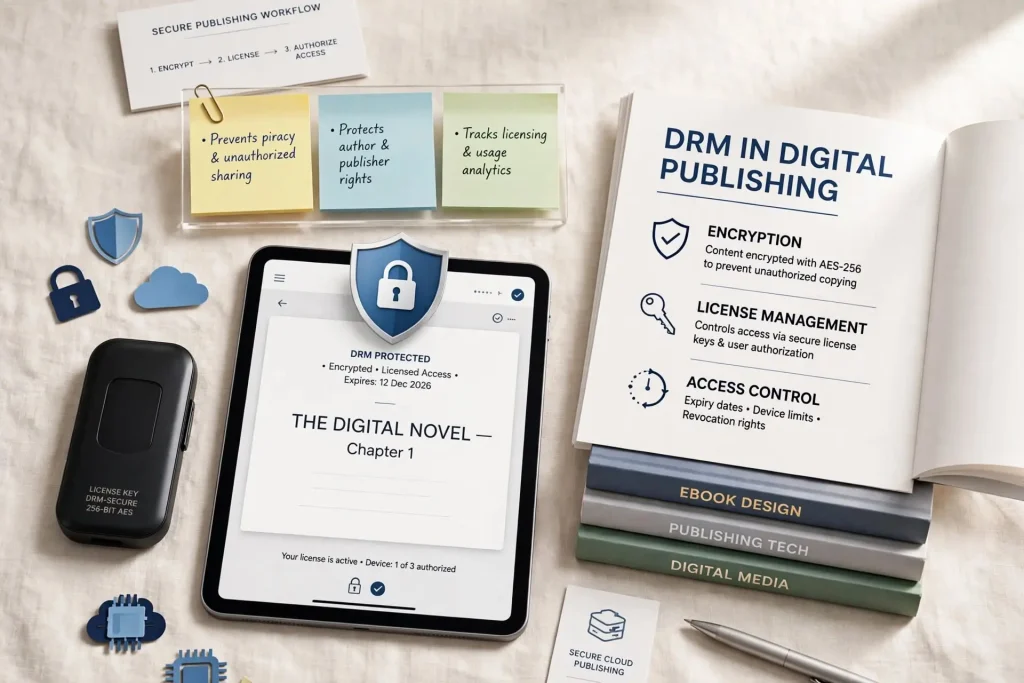
Most authors face the DRM checkbox at upload without practical guidance about what actually happens after they check or uncheck it. The drm books explained at the level authors actually need addresses the operational realities rather than abstract debates. What does DRM actually do to files? How does it affect borrowing? What happens with library lending? What happens with Kindle Unlimited? Can you change DRM status later if you change your mind? These practical questions matter more for most authors than philosophical arguments about copyright protection.
This post walks through the operational realities of the DRM decision, the specific effects on different reading scenarios, and how to make the choice that fits your actual publishing situation.
The DRM Upload Decision Moment
The DRM decision happens during the upload process on most platforms.
Amazon KDP. The DRM checkbox appears during the ebook upload process. Once set, it can be changed for that specific book but only by republishing.
Other platforms. Different platforms handle DRM differently. Apple Books, Kobo, and others have their own DRM policies and implementations.
The default position. Most platforms default to DRM enabled. Authors who don’t think about the decision often end up with DRM by default.
The permanence question. Some authors believe DRM choice is permanent. The reality is more flexible but changes require republishing in most cases.
The platform-specific lock-in. DRM-protected files become tied to the specific platform. The technical implementation varies by platform.
The decision affects readers from the first download forward. Casual handling at upload produces consequences that ripple through every reader interaction afterward.
What Happens With DRM Enabled
When DRM is enabled, specific things happen to your ebook files.
Files become locked to platform accounts. Kindle ebooks with DRM only open in Kindle apps tied to the purchasing account.
Files can’t easily transfer between platforms. A Kindle ebook with DRM can’t simply be transferred to read on Apple Books or Kobo.
Format conversion becomes restricted. Readers can’t easily convert their purchased files to other formats for personal use.
Some accessibility tools face limitations. Certain accessibility software has difficulty with DRM-locked files.
Sharing becomes technically difficult. Casual sharing with friends or family faces technical barriers.
Account dependency increases. Loss of access to your purchasing account can result in losing access to purchased books.
Long-term access depends on platform continuation. If the platform ever shuts down, DRM-locked books may become inaccessible.
These effects matter for legitimate readers, not just casual sharers. Authors should know what DRM actually does to the reading experience.
What Happens With DRM Disabled
When DRM is disabled, different effects occur.
Files can be read across compatible apps. Readers have more flexibility in how they consume the book.
Format conversion becomes easier. Readers who want to convert formats for personal use can do so.
Cross-device transfer simplifies. Moving books between devices doesn’t face DRM barriers.
Accessibility tools work more reliably. Screen readers, text-to-speech, and other tools have fewer issues.
Casual sharing becomes technically possible. Files can theoretically be shared, though this depends on reader behavior.
Inheritance and gifting becomes practical. Books can be passed to family members or shared in other legitimate ways.
Long-term access doesn’t depend on specific platform continuation. Files remain readable regardless of platform changes.
The reader experience improves in specific ways with DRM disabled. The trade-off is the theoretical loss of casual sharing protection.
DRM Effect on Borrowing
Borrowing scenarios get specifically affected by DRM choices.
Library borrowing. Library platforms use their own DRM systems regardless of author preferences. Books distributed to libraries operate under library platform DRM.
Friend-to-friend lending. Amazon’s Kindle Book Lending allows specific books to be lent to friends for 14 days. The feature has specific eligibility requirements.
Family library sharing. Amazon Household, Apple Family Sharing, and similar services allow family members to share purchases. These work regardless of DRM status in most cases.
Subscription service borrowing. Kindle Unlimited and similar services use their own DRM systems for borrowed content.
School and corporate licensing. Institutional purchases sometimes use specific DRM configurations.
Each borrowing scenario has specific DRM dynamics. The author’s DRM choice on retail purchase doesn’t necessarily affect all these scenarios identically.
Library Lending Implications
Library lending deserves specific attention because it affects significant revenue for some authors.
Library distribution requirements. Library platforms (OverDrive, Hoopla, Libby) have specific technical requirements that include DRM components.
The library revenue. Many authors generate meaningful revenue from library lending. The lending model differs from retail but the income matters.
Library platform DRM. Library platforms use their own DRM regardless of how author distributed retail copies. The library DRM controls borrowing duration and concurrent access.
Wide distribution and library access. Authors distributing wide can reach library platforms. Amazon-exclusive authors often miss library distribution.
Multi-format library access. Libraries may want ebook and audiobook editions. Author distribution choices affect library access to each format.
For authors valuing library access, distribution decisions matter more than retail DRM decisions. Library platforms operate under their own DRM systems that authors don’t directly control.
Kindle Unlimited & DRM
Kindle Unlimited has specific DRM requirements that affect strategy.
KU enrollment requires specific configurations. Books in Kindle Unlimited operate under Amazon’s DRM regardless of author preference for retail copies.
The KU revenue model. KU pays based on pages read rather than per-borrow. The revenue model has its own dynamics separate from DRM considerations.
The Amazon exclusivity requirement. KU requires KDP Select enrollment which means Amazon exclusivity. The exclusivity has its own implications.
The 90-day enrollment periods. KU enrollment runs in 90-day cycles. Authors can change strategy between cycles.
KU and library compatibility. KU enrollment prevents simultaneous library distribution. The trade-off matters for some authors.
For authors using KU, DRM decisions on retail copies have less impact since KU copies operate under Amazon’s DRM regardless. The strategic decision shifts toward exclusivity question rather than DRM specifically.
Family Sharing Implications
Family sharing affects how households consume books.
Amazon Household sharing. Allows specific account-level sharing within households. Works on most Kindle books regardless of DRM status.
Apple Family Sharing. Similar Apple system for Apple Books purchases.
The household definition. Each platform defines household differently. Some are restrictive about who counts.
Cross-platform sharing limitations. Family sharing within platforms works. Cross-platform sharing (Kindle book to Apple Books reader in same family) faces DRM barriers.
The practical reality. Most readers don’t actively use family sharing features even when available. The theoretical capability matters less than initially appears.
Children’s account considerations. Children’s accounts have specific sharing rules that affect content access.
For authors thinking about family use of their books, the platform’s own family sharing features matter more than DRM choices on retail copies.
Switching DRM Status After Publication
Authors who change their minds about DRM have specific options.
Republishing with different DRM. Most platforms allow republishing with changed DRM status. Existing copies retain their original DRM status.
The existing reader implications. Readers who bought before DRM change keep their original DRM-status files. New buyers get new DRM status.
The metadata updates. Republishing may affect rankings, reviews, and other metadata depending on platform.
The catalog consistency consideration. Books with different DRM status across the catalog create operational complexity.
The platform-specific implications. Different platforms handle DRM changes differently. Some require entirely new book uploads.
For most authors, initial DRM decision matters more than the theoretical possibility of changing later. The change process has friction that discourages reversals.
The Practical Decision Framework
The practical decision considers several specific factors.
Your distribution strategy. Wide distribution authors might choose differently than Amazon-exclusive authors.
Your audience characteristics. Some audiences prefer DRM-free positioning. Others don’t care.
Your genre conventions. Some genres see more sharing than others. Romance has specific sharing patterns.
Your reader experience priorities. Authors prioritizing reader experience often choose DRM-free.
Your piracy risk tolerance. Authors with very high concern about casual sharing may prefer DRM despite limited effectiveness.
Your platform exclusivity decisions. KU enrollment makes the question less significant for those books.
Your operational simplicity preferences. Single approach across catalog simplifies operations.
These factors point different directions for different authors. The right answer depends on the specific combination of factors for your situation.
Common DRM Decision Mistakes
Several patterns regularly produce DRM choices authors later regret.
Default choice without consideration. Accepting platform defaults without thinking about implications.
Overestimating DRM effectiveness. Authors who expect DRM to prevent piracy meaningfully are usually disappointed.
Underestimating reader experience impact. Authors who don’t consider how DRM affects legitimate readers may damage their relationships with those readers.
Inconsistent approach across catalog. Some books with DRM, others without, without strategic reason.
Failure to consider distribution implications. DRM choices interact with distribution strategy in ways authors often miss.
No reconsideration over time. Authors who set DRM once and never revisit miss opportunities to align with their evolving strategy.
Following advice from authors in different situations. Strategy that works for major bestselling authors may not work for newer authors.
Living With Your DRM Decision Over Years
The DRM choice you make at upload persists across the entire commercial life of each book. Years after upload, the decision continues affecting how readers experience the book, how it works with their devices, and how it relates to the broader ebook reading ecosystem they participate in. Authors who make the decision deliberately tend to live with the outcomes better than authors who chose by default without consideration.
The work to think through the DRM decision takes minutes per book at upload. The implications extend across years afterward. Authors who invest those few minutes in deliberate decision-making typically end up with configurations that match their broader publishing strategy. Authors who default into DRM choices without consideration often discover years later that their accidental choices created consequences they didn’t intend. The DRM checkbox seems minor compared to the cover, the description, the categories, and other upload elements. The practical impact across years matches or exceeds the impact of those more visible elements. Treating DRM as serious decision rather than trivial checkbox tends to produce better long-term outcomes than the default approach most authors use.


