
Most authors approach audiobook production with vague awareness that they should produce one but unclear about how the actual production works. They’ve heard about ACX. They know audiobooks involve narrators. Beyond that, the specifics get fuzzy. How long does production take? What does it cost? Should I narrate it myself or hire someone? What’s the editing process actually involve? The decision to create audiobook editions of your work requires specific knowledge about the production process rather than vague intuitions about what “should” happen.
This post walks through the practical steps of audiobook production, the decisions you’ll face at each stage, and how to produce audiobooks that meet professional standards.
Deciding to Produce an Audiobook
Before starting production, several decisions affect the entire approach.
The market reality. Audiobooks are the fastest-growing format in publishing. Genre matters significantly though. Romance, thriller, and self-help see strong audiobook adoption. Some literary fiction and niche nonfiction see less audiobook market.
The exclusivity question. ACX (Audible’s platform) offers higher royalties for exclusive distribution. Wider distribution through Findaway Voices and other aggregators offers broader reach at lower per-sale royalties. The choice affects platform-specific royalty rates and reach.
The narrator decision. Author-narrated, professionally narrated, or AI-narrated. Each option has different cost structures, quality outcomes, and market reception.
The investment commitment. Audiobook production runs $1,500 to $6,000+ for professional production. Lower for author-narration with adequate equipment. The investment level should match the book’s commercial chances.
The timing decision. Audiobook can launch simultaneously with print/ebook or after. Most authors should launch audiobook after establishing the book in other formats to better assess audiobook viability.
These decisions affect every subsequent step. Making them deliberately rather than defaulting produces better outcomes than rushing into production.
The Recording Phase
The recording phase is where the audiobook comes into existence as audio content.
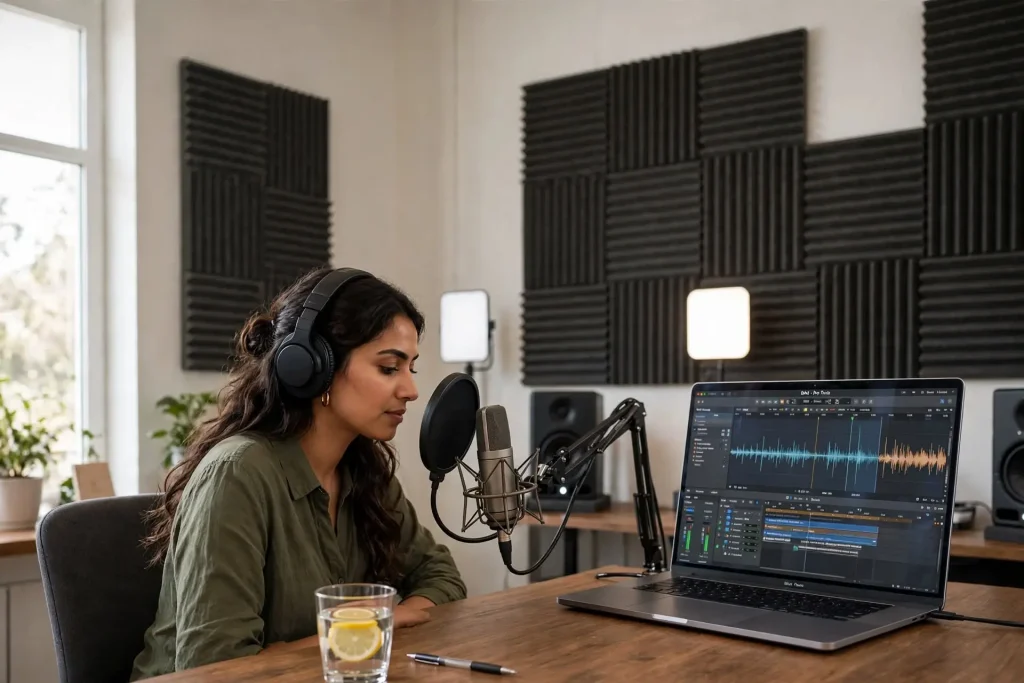
Studio recording. Professional narrators typically record in dedicated studios with sound treatment, professional microphones, and proper acoustic environments. The studio environment produces cleaner audio that requires less post-production cleanup.
Home studio recording. Author-narrators or professional narrators with home studios use treated spaces with appropriate equipment. Quality varies based on space treatment and equipment choices.
Recording session structure. Most narrators record in 2 to 4 hour sessions to maintain voice quality. A typical 10-hour audiobook might require 30 to 50 hours of recording time across multiple sessions.
The take approach. Narrators record passages and re-record passages where mistakes occur or quality dips. Multiple takes get edited together in post-production to produce the final narration.
The pacing decisions. Strong narrators vary their pacing based on content. Dialogue moves differently than exposition. Action passages differ from reflective passages. The pacing decisions happen during recording.
The character voice decisions. For fiction, narrators develop voices for different characters. The character voice consistency across the recording matters significantly for listener experience.
The pronunciation choices. Proper names, technical terms, and other specific pronunciation decisions get made during recording. Strong narrators research pronunciations rather than guessing.
Recording typically produces 1 to 3 finished audio hours per 8 hour studio day. The intensive process explains why professional narration costs what it does.
The Editing Phase
After recording, audio gets edited into the final audiobook product.
Mistake removal. Stumbles, mispronunciations, and other audible errors get removed. The narrator’s clean takes replace the flawed ones.
Pacing adjustments. Editors can adjust pacing between sentences and paragraphs to produce listening flow. Pauses get adjusted to natural breathing patterns.
Breath management. Audible breaths get reduced or removed where they interfere with listening flow. Some breath remains for naturalness. Excessive breath gets cleaned up.
Mouth click and pop removal. Specific oral sounds (clicks, pops, smacks) get cleaned up. These sounds become noticeable in quiet audiobook listening even though they’re inaudible in normal conversation.
Volume leveling. Different passages get leveled to consistent volume. Quiet sections get raised. Loud sections get controlled. The overall listening level stays consistent.
Background noise management. Any ambient noise (HVAC sound, traffic, electrical hum) gets removed or reduced. Clean audio requires diligent noise management.
Editing typically takes 3 to 6 hours per finished audio hour for professional work. The detailed work is what produces broadcast-quality audiobooks.
The Mastering Phase
After editing, audio gets mastered to meet platform standards.
The platform requirements. ACX has specific technical requirements (RMS levels between -23dB and -18dB, peak below -3dB, noise floor below -60dB). Other platforms have similar specifications. Audiobooks must meet these requirements to be accepted.
The room tone consistency. Each file should have consistent room tone (the sound of the recording space without speech). Inconsistent room tone between files creates audible quality variations.
The chapter file structure. Audiobooks typically deliver as separate files per chapter rather than one continuous file. Each file requires proper labeling and ordering.
The opening and closing standards. Each audiobook includes opening credits (book title, author name, narrator name, retail sample announcements) and closing credits (production information). Specific standards apply to format and content.
The retail sample. A 5-minute sample of the audiobook gets included for retailer use. The sample should represent typical narration rather than openings that may differ from main content.
The final quality check. Listening to the entire final master before submission catches issues that might survive earlier processes. Authors should listen to their finished audiobooks before submission, not just review the editor’s work.
Strong mastering ensures the audiobook will be accepted by platforms and will sound professional to listeners.
Distribution Options
Once the audiobook is produced, distribution decisions determine where it sells.
ACX (Audible/Amazon/iTunes). Exclusive distribution earns 40% royalty. Non-exclusive earns 25%. ACX exclusivity matters significantly for some authors and not for others depending on overall distribution strategy.
Findaway Voices (now Spotify Audiobooks for Authors). Wide distribution to Apple Books, Google Play, Kobo, Scribd, library systems, and many other platforms. Lower per-platform royalties but broader reach.
Direct sales. Authorsdirect.com and other direct sales options. Higher per-sale revenue but less marketing infrastructure.
Library distribution. Specific library platforms (Hoopla, OverDrive) accept audiobooks. The library market is significant for audiobook revenue.
Multiple-platform strategies. Some authors distribute wide. Others go ACX exclusive. The decision depends on total catalog strategy.
The choice between exclusive ACX and wide distribution often determines significant aspects of audiobook earnings. Authors should evaluate carefully rather than defaulting to either option.
Cost Considerations
Audiobook production costs run higher than other publishing investments. The numbers matter for budgeting decisions.
Professional narrator costs. $200 to $500 per finished hour at standard rates. Higher for established narrators. A 10-hour audiobook costs $2,000 to $5,000 for narration alone.
Royalty share arrangements. ACX allows splitting royalties with narrators rather than paying upfront. Lower out-of-pocket cost but lower long-term per-book income.
Studio costs. Sometimes included in narrator rates. Sometimes separate. Adds $500 to $2,000 for typical audiobooks if separate.
Editing and mastering costs. $300 to $1,500 if hiring separate editors. Often bundled with narrator services.
Author-narration cost considerations. Lower direct cost but requires significant author time. Equipment investment runs $500 to $5,000 for adequate recording setup.
Total professional production. $2,500 to $7,000 for typical professional audiobooks. More for premium narrators or extended-length books.
The investment is real. Authors should match audiobook production investment to the book’s commercial chances. Books unlikely to recoup audiobook investment in 2 to 3 years may not justify the production cost.
Quality Standards That Matter
Several quality factors significantly affect audiobook reception.
Narrator selection. Strong narration is the biggest single factor in audiobook quality. Match narrator voice and style to book content.
Recording quality. Technical recording quality (mic quality, room treatment, low noise floor) matters significantly for professional results.
Editing thoroughness. Strong editing makes ordinary narration sound polished. Weak editing makes good narration sound amateur.
Mastering compliance. Audiobooks that don’t meet platform technical standards get rejected. Compliance matters for acceptance and quality reputation.
Chapter organization. Clean chapter file structure with consistent file naming and metadata supports listener experience and platform requirements.
Sample selection. The retail sample drives listener purchase decisions. Strong sample selection improves conversion.
Production duration matching. The total audiobook duration should match the book’s actual content. Mismatch in either direction creates problems.
Authors should review samples from prospective narrators carefully. The narration quality directly determines listener experience.
Common Audiobook Production Mistakes
Several patterns regularly produce weak audiobook results.
Wrong narrator choice. Narrators whose voices don’t fit the book’s tone or genre conventions damage the listening experience.
Skipping the sample evaluation. Authors who hire without thorough sample evaluation often discover quality issues only after production.
Inadequate recording quality. Author-narration with poor equipment produces audiobooks that don’t compete with professional production.
Rushing production. Compressed timelines produce inferior work. Strong audiobooks need adequate time for narration, editing, and mastering.
Cheap shortcuts. Bargain-rate narrators usually produce work that requires significant editing remediation or that listeners find amateurish.
Wrong format strategy. Choosing ACX exclusive when wide distribution would serve better, or vice versa. The strategic decision affects long-term economics.
Inadequate quality control. Authors who don’t listen to finished audiobooks before submission miss errors that proper QC would catch.
Wrong pricing strategy. Pricing that doesn’t match the audiobook’s actual production quality or genre conventions produces poor sales.
Audiobook Production as Career Expanding Skill
The decision to produce audiobooks expands what your publishing business actually does. Authors who add audiobooks to their catalogs often find that audiobook revenue eventually rivals or exceeds ebook revenue. The format reaches listeners who don’t read traditional books. The format works during commutes, exercise, and other activities where reading is impractical. The audience continues growing rapidly.
The production knowledge required to do audiobooks well takes time to develop. The first audiobook involves significant learning. The second audiobook applies what the first taught. By the fifth or tenth audiobook, the process becomes manageable. Authors who commit to audiobook production as ongoing capability rather than one-time experiment tend to build catalogs that reach all major reading formats over time. The investment in learning the production process pays back across every audiobook in the catalog for as long as those audiobooks remain in distribution. The audiobook market continues growing while the production knowledge remains broadly stable, making audiobook production one of the better long-term skill investments available in indie publishing today.


