
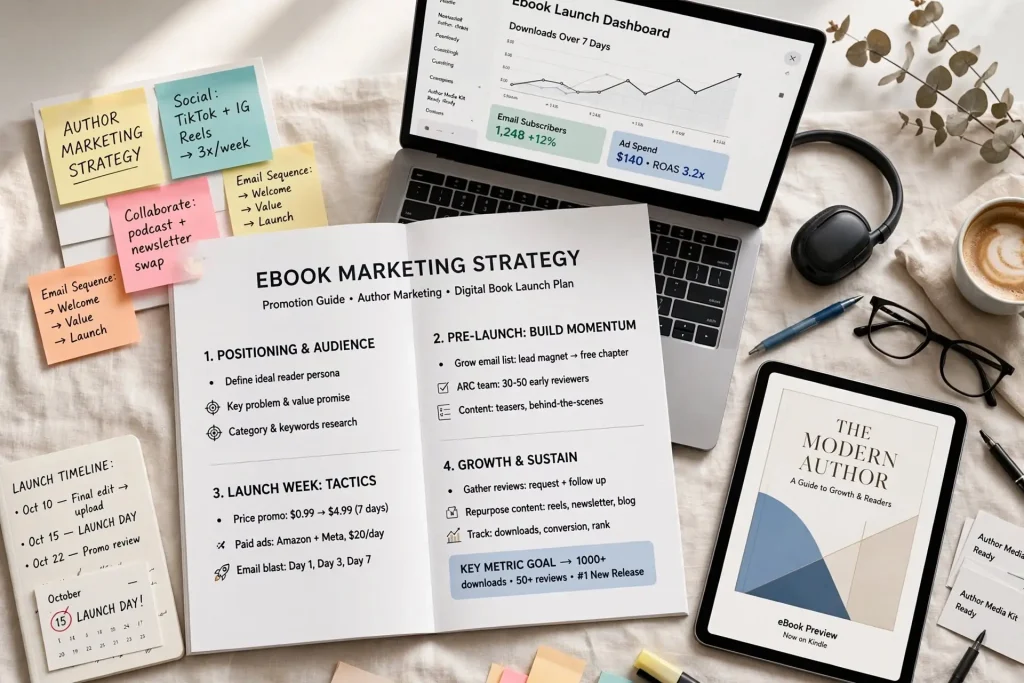
Most authors approach ebook marketing as a collection of tactics they try when sales feel slow. They run an Amazon ad here. Submit to a promotional site there. Email their list occasionally. The tactical scattered approach produces tactical scattered results. The ebook marketing that drives sustainable sales involves systematic tactical work integrated into ongoing operations rather than reactive responses to sales concerns. Authors who develop marketing systems tend to outperform authors of equal book quality who handle marketing reactively.
This post walks through the specific tactics that actually drive ebook sales, how to integrate them into systematic marketing operations, and how to build the discipline that produces consistent ebook revenue rather than sporadic spikes.
What Ebook Marketing Actually Involves
Ebook marketing involves specific tactical work across multiple channels.
The platform optimization work. Working within Amazon, Apple Books, Kobo, and other platforms to support discovery. Keywords, categories, descriptions, A+ content.
The advertising work. Paid advertising across Amazon, Facebook, BookBub, and other platforms. Active campaign management.
The promotional placement work. Submitting books to promotional sites for featured placement. BookBub, ENT, Robin Reads, others.
The email marketing work. Building and engaging email lists. Newsletters, automated sequences, launch announcements.
The content marketing work. Blog posts, podcast appearances, social media presence that supports author brand and book discovery.
The cross-promotion work. Coordinated promotional activity with other authors. Mailing each other’s lists, bundle releases, shared marketing events.
The launch coordination work. Coordinated marketing activity around new releases to maximize launch velocity.
The backlist marketing work. Ongoing promotional support for older books that maintains catalog-wide sales.
These tactical elements interact within broader marketing strategy. Authors who handle them systematically produce better results than authors handling each tactically in isolation.
Pricing as Marketing Tool
Pricing decisions affect marketing effectiveness across all channels.
The genre price benchmarks. Different genres have different price expectations. Pricing within genre norms supports marketing efficiency.
The promotional pricing rotation. Most successful indie authors run periodic promotional pricing. The cycles drive sales spikes that sustained pricing alone wouldn’t achieve.
The $0.99 entry point. First-in-series at $0.99 drives series read-through. Tactical use rather than permanent positioning.
The $2.99 royalty threshold. Books priced $2.99 or above qualify for 70% royalty. Below threshold royalty drops to 35%. Affects pricing decisions significantly.
The $4.99 to $5.99 sweet spot. Many bestselling ebooks price in this range. Strong margin while remaining accessible.
The premium pricing experiment. Some books support $7.99 to $14.99 pricing. Requires positioning and audience that justify premium.
The free pricing strategy. Permafree first-in-series for some authors. Time-limited free for others. Tactical use of free can drive significant series sales.
Pricing should be reviewed and adjusted based on data rather than set permanently at launch.
Promotional Site Marketing
Promotional sites remain important ebook marketing channels.
BookBub Featured Deals. The largest single promotional opportunity. Significant cost ($300-$2,000 depending on genre and market) but produces substantial sales spikes when accepted.
ENT (eReader News Today). Major promotional newsletter. $30-$150 per placement depending on slot.
Robin Reads. Strong newsletter with active subscriber base.
Fussy Librarian. Genre-targeted promotional newsletter.
BookSends. Newsletter promotional service.
Bargain Booksy. Newsletter for discounted books.
The Fussy Librarian, Book Cave, and many others. Various smaller newsletters that contribute incrementally.
Genre-specific promotional sites. Romance, science fiction, fantasy, thriller all have genre-specific promotional opportunities.
Promotional site strategy involves stacking placements during promotional cycles. Multiple placements during a single promotional week typically outperform single placements.
Email Marketing for Ebooks
Email remains one of the highest-ROI ebook marketing channels.
The list building investment. Growing email lists takes time but produces compounding returns. Specific lead magnets, prominent signup placement, content that motivates signup.
The newsletter cadence. Weekly newsletters produce stronger engagement than monthly. Bi-weekly often hits sweet spot.
The launch announcement sequence. Specific email sequences for book launches produce significantly better launch results than single announcement emails.
The promotional announcement strategy. Announcements of price promotions, sales, and special offers to email lists drive concentrated purchase activity.
The reader engagement focus. Newsletters that engage readers (sharing about writing, asking questions, providing value beyond just sales pitches) build stronger reader relationships.
The list segmentation possibilities. Segmenting lists by reader preferences, purchase history, or engagement levels allows targeted marketing.
The automated sequence opportunities. Welcome sequences for new subscribers. Series-specific sequences. Re-engagement sequences for inactive subscribers.
Email service providers (ConvertKit, MailerLite, ActiveCampaign, others) provide tools to handle these strategies. Investment in proper email service typically pays back quickly.
Amazon Advertising
Amazon’s self-serve advertising platform drives significant ebook sales.
The sponsored products approach. Ads appearing in search results and on product detail pages. The most common ad type for ebooks.
The sponsored brands approach. Brand-level ads for authors with multiple books. Less common but useful for established authors.
The keyword targeting. Selecting search terms to target. Strong keyword research drives ad performance.
The product targeting. Targeting specific competitor books. Sometimes more effective than keyword targeting.
The bid management. Setting bid levels for keywords. Lower bids produce less traffic but better ROAS. Higher bids produce more traffic at higher cost.
The campaign optimization. Ongoing analysis and adjustment. Pausing underperforming keywords. Scaling successful keywords.
The ACoS targeting. Advertising Cost of Sales. Lower ACoS produces more profit per sale. Strategic ACoS targets vary by book and goal.
Amazon Ads require ongoing attention rather than launch-and-forget operation. Active management produces meaningfully better results than passive approach.
Facebook Advertising for Ebooks
Facebook advertising reaches readers Amazon ads don’t.
The cold audience targeting. Reaching readers who don’t know your books yet. Interest-based and lookalike audience targeting.
The retargeting capabilities. Reaching readers who visited your website or engaged with your previous ads.
The creative requirements. Strong cover images and compelling copy required. Bad creative produces poor results regardless of targeting.
The funnel approach. Cold ads to lead magnet, then email nurture, then book promotion. The funnel produces better results than direct book ads to cold audiences.
The pixel installation. Facebook pixel on author website supports retargeting and conversion tracking.
The testing discipline. Multiple creative variations and audience tests. The testing finds what works for your specific situation.
The ongoing optimization. Facebook ads require active management. Set-and-forget produces wasted budget.
Facebook advertising works well for some authors and poorly for others. Genre, creative skill, and ad management capability all affect results.
BookBub Advertising & Featured Deals
BookBub offers two distinct marketing opportunities.
The BookBub Featured Deals. Promotional placements in BookBub’s newsletters. Most coveted promotional opportunity. Application-based with rejection common.
The BookBub Ads platform. Self-serve advertising platform similar to other platforms. Reaches BookBub’s engaged book buyers.
The application requirements for Featured Deals. Specific submission requirements. Strong sample, strong cover, competitive pricing, genre fit.
The acceptance rates. Featured Deal acceptance rates run low. Multiple applications often required.
The sales velocity at Featured Deals. Accepted Featured Deals typically produce 1,000+ sales for first-in-series titles at promotional pricing.
The BookBub Ads strategy. Self-serve ads can run while waiting for Featured Deal acceptance. Continuous BookBub presence supports overall results.
The BookBub list building. BookBub allows authors to build follower bases. Followers receive notifications when authors release new books or run promotions.
BookBub remains important enough to most ebook authors to deserve specific marketing attention.
Platform Algorithm Optimization
Working with platform algorithms supports ongoing discoverability.
The sales velocity importance. Algorithms favor books with strong recent sales. Concentrated promotional activity supports algorithmic visibility.
The conversion rate impact. Books that convert listing visitors well get more algorithmic surfacing than poor converters.
The review accumulation effect. Higher review counts and average ratings support algorithmic visibility.
The category placement impact. Strong category placement supports broader algorithmic exposure.
The keyword targeting. Strong keyword choices affect which searches produce your books.
The series effects. Series books cross-promote algorithmically. Strong individual book performance helps related books.
The new release window. Algorithms typically favor new releases for limited windows. Strong launch performance supports ongoing visibility.
Algorithm optimization involves all aspects of book performance rather than specific algorithm-hacking tactics. Books that succeed on conversion, sales, and review metrics get the algorithmic attention.
Common Ebook Marketing Mistakes
Several patterns regularly weaken ebook marketing results.
No systematic marketing approach. Random tactical activity without strategic framework.
Set-and-forget mentality. Marketing initiatives launched and abandoned.
No data tracking. Marketing without performance measurement.
Single-channel reliance. Depending on one marketing channel exclusively.
Reactive rather than proactive. Marketing only when sales feel slow.
No promotional cycles. No regular promotional rhythm in operations.
Weak landing pages. Marketing traffic to weak listings produces poor conversion.
No email list building. Skipping the highest-ROI marketing channel.
Random pricing. Pricing decisions made tactically without strategic framework.
Marketing without backlist support. Heavy launch marketing followed by abandonment of backlist promotion.
No author brand building. Marketing books without building author brand that supports all books.
Marketing Discipline That Compounds Across Years
Ebook marketing rewards systematic discipline over time. The author who runs systematic email marketing across years builds list that supports every subsequent release. The author who maintains active platform optimization across years builds catalog visibility that compounds. The author who runs regular promotional cycles across years builds revenue patterns that scattered tactics can’t match.
The marketing investments that pay back best are usually the boring ones. Consistent email engagement. Regular promotional cycle execution. Ongoing platform optimization attention. These don’t generate exciting wins but produce reliable returns across years. The exciting marketing campaigns sometimes work and often don’t. The boring sustained discipline almost always works given enough time. Authors who develop marketing discipline as serious professional work tend to build careers that authors operating reactively can’t match. The marketing systems built carefully across years become assets that support every book in the catalog. The list of email subscribers. The accumulated knowledge about which promotional sites work for which genres. The relationships with other authors for cross-promotion. The platform algorithm history that supports new releases. Each builds across years and supports everything that comes afterward. The patient compounding approach typically produces better long-term results than the quick-win approach most authors default to when thinking about marketing.


