
Most authors set ebook prices once at launch and rarely revisit those decisions afterward. The price gets chosen based on hunches about what feels right, comparison with a few visible bestsellers, or following advice from author communities without specific application to the author’s situation. The ebook pricing that actually maximizes revenue requires more systematic thinking than this casual approach typically produces. Different books deserve different prices. The same book may deserve different prices at different points in its commercial life. The pricing decision deserves ongoing attention rather than one-time guess at upload.
This post walks through the specific factors that should inform ebook pricing decisions, how to use data and competitive analysis to identify optimal price points, and how to manage pricing as ongoing business discipline.
Why Pricing Decisions Matter Strategically
Pricing affects multiple aspects of book performance simultaneously.
The conversion rate effect. Price affects what percentage of listing visitors actually purchase. Wrong pricing produces poor conversion.
The royalty implications. Different prices produce different royalty amounts per sale. The price-royalty relationship affects total revenue.
The algorithmic visibility effect. Sales velocity affects platform algorithms. Pricing affects sales velocity which affects algorithmic visibility.
The promotional efficacy. Marketing investments work differently at different price points. The same promotional spend produces different results based on pricing.
The positioning signal. Price signals positioning to readers. Premium pricing signals premium positioning. Bargain pricing signals bargain positioning.
The competitive dynamic. Your pricing affects how your book competes with alternatives. Wrong pricing makes books invisible relative to better-priced competitors.
The series strategy implications. Pricing of individual books affects series read-through dynamics. Strategic series pricing produces better total series revenue than uniform pricing.
Each effect compounds with the others. Pricing decisions shouldn’t be made based on single considerations but on integrated thinking about how price affects total book performance.
The Genre Price Benchmark Approach
Genre patterns provide baseline pricing reference.
The bestseller analysis. What do the top 100 books in your specific subgenre actually charge? The patterns reveal what works in your category.
The bestseller distribution. Look at the full pricing range among top sellers. Some genres see wide ranges. Others have tight pricing clusters.
The new vs established author pricing. Established authors often price higher than new authors. Adjust benchmarks for your career stage.
The first-in-series vs later-series pricing. Many series price first books lower than later books. The pattern affects pricing benchmarks.
The format pricing relationships. How does ebook pricing relate to print and audio pricing in your genre? Industry patterns inform format-specific pricing.
The international pricing patterns. Different markets may have different pricing patterns even within genres.
The platform pricing differences. Some books price differently on Amazon than on other platforms. Tactical reasons may justify the differences.
Genre benchmarks provide starting points rather than rigid rules. Your specific book may justify pricing above or below genre patterns based on specific factors.
Reader Psychology of Pricing
Pricing psychology affects how readers respond to specific prices.
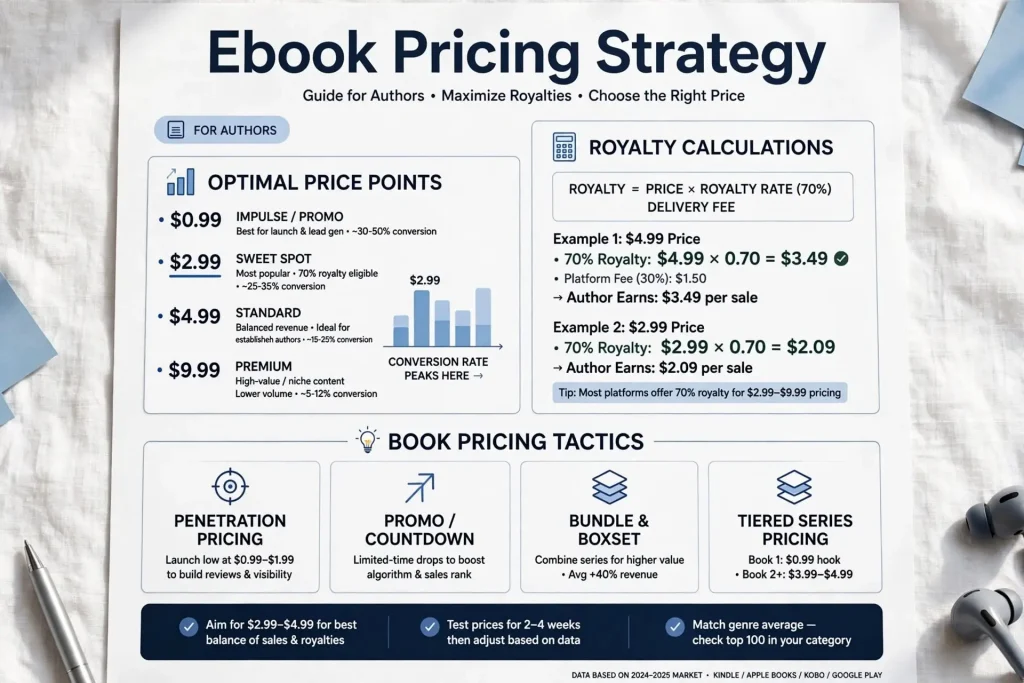
The $0.99 impulse zone. Books at $0.99 trigger impulse purchases. The price feels effectively free, eliminating purchase hesitation.
The $1.99 to $2.99 friction reduction. Books in this range are easy purchase decisions for engaged readers. Some genres see this as standard pricing.
The $2.99 royalty threshold. Books priced $2.99 or above earn 70% royalty on Amazon. Below this, only 35% royalty. The mathematical threshold affects strategic pricing.
The $4.99 to $5.99 sweet spot. Many ebook bestsellers price in this range. Margin and accessibility both supported.
The $7.99 to $9.99 premium zone. Books that justify premium pricing through positioning, audience, or content. Higher per-sale revenue but more pricing resistance.
The $14.99+ specialty zone. Some specialized content (textbooks, certain nonfiction) supports higher pricing. Most fiction doesn’t.
The .99 ending tradition. Books priced at $X.99 (3.99, 4.99) sell better than equivalent prices ending in .00 or other digits. Standard psychological pricing.
The free pricing dynamics. Free books drive massive volume but no direct revenue. Strategic free pricing for series first books produces significant downstream sales.
Pricing psychology compounds with genre patterns. The combination affects optimal pricing for specific books in specific contexts.
Competitive Pricing Analysis
Competitive analysis informs strategic pricing decisions.
The direct competitor identification. Which specific books compete most directly with yours? Same subgenre, similar themes, similar audience.
The competitor pricing tracking. What do those specific competitors charge? Track over time to see how their pricing evolves.
The promotional pattern observation. When do competitors run promotional pricing? The patterns reveal market dynamics.
The new release pricing approach. How do competitors price new releases? The patterns inform launch pricing decisions.
The series pricing strategy observation. How do competitors handle series pricing? Specific strategies reveal what works in your genre.
The premium versus standard positioning. Which competitors position as premium versus standard? Pricing supports positioning differentiation.
The market gap identification. Are there pricing gaps where you could position uniquely? Sometimes specific price points are underutilized.
Competitive analysis isn’t about copying competitor pricing. It’s about knowing the competitive context where your pricing decisions get made.
The Free Through Premium Spectrum
Different pricing strategies serve different purposes.
The permafree strategy. First-in-series at $0.00 permanently. Drives series read-through. Works for some series and not others.
The temporary free promotion. Books priced at $0.00 for limited time through KDP Select promotional tools. Drives volume and visibility for promotional periods.
The $0.99 launch pricing. Discounted launch pricing that builds initial momentum. Often combined with promotional placements.
The $2.99 entry pricing. Standard entry-level pricing that supports 70% royalty.
The $3.99 to $4.99 standard pricing. Common pricing for established ebook fiction. Strong balance of accessibility and revenue.
The $5.99 to $6.99 elevated pricing. Higher pricing supported by positioning or audience.
The $7.99 to $9.99 premium pricing. Premium positioning requires audience and content that justify the price.
The $9.99+ specialty pricing. Specific niches with audiences willing to pay specialty pricing.
The strategy choice depends on your specific situation. Books with promotional support and series infrastructure may benefit from lower entry pricing. Standalone books may justify standard or elevated pricing.
Series Pricing Strategy
Series pricing involves multi-book dynamics.
The first-in-series investment. Lower pricing on book one drives readers into the series. The investment recovers through subsequent book sales.
The middle-series pricing. Books 2 through N often price at standard rates. The series momentum supports full pricing for subsequent books.
The completion incentive pricing. Some authors price final series books slightly higher than middle books. The completion incentive supports the pricing.
The boxed set pricing. Series boxed sets typically discount from individual book totals while exceeding individual book pricing. The math requires specific consideration.
The series promotional cycles. Series-wide promotions during specific windows drive concentrated series read-through. Strategic timing matters.
The launch pricing for new series books. New books in established series can launch at promotional pricing to drive series momentum.
The backlist pricing for old series. Older series may benefit from pricing adjustments that maintain catalog vitality.
Series pricing as integrated strategy outperforms pricing each book individually. The math across the full series matters more than individual book optimization.
Pricing Across Markets
International market pricing requires specific attention.
The currency conversion baseline. Most platforms allow local currency pricing. Simple conversion of US prices often produces suboptimal local pricing.
The purchasing power adjustments. Different markets have different purchasing power. Strategic local pricing accounts for this.
The competitive market pricing. Local market competitors provide better pricing reference than US competitors for local pricing decisions.
The promotional pricing variations. Promotional pricing patterns differ across markets. Aggressive promotional pricing standard in some markets, less common in others.
The tax considerations. Different markets have different tax structures. Net pricing after taxes affects strategic price decisions.
The royalty threshold across markets. The 70% royalty threshold applies across markets but exchange rates affect what qualifies.
The platform-specific pricing tools. Different platforms provide different international pricing tools. Authors should understand their options.
International pricing typically produces better results when handled actively rather than through default currency conversion.
Price Testing Approaches
Active price testing reveals optimal pricing for specific books.
The A/B price testing. Different price points for similar time periods. Compare sales results. Watch for confounding factors.
The before/after comparison. Change price and compare results to previous period. Less rigorous than A/B but easier to execute.
The promotional cycle analysis. Track results across promotional pricing cycles. The data reveals which pricing approaches work for your books.
The competitor pricing experimentation. Watch what happens when competitors change pricing. The data informs your decisions.
The cross-platform pricing variation. Different platforms may benefit from different pricing. Test where possible.
The seasonal pricing variation. Some books may benefit from seasonal pricing adjustments. Test patterns reveal opportunities.
The market expansion pricing tests. Testing new market pricing before committing to long-term strategy.
Testing produces data that informs pricing decisions. Pricing without testing is guessing.
The Royalty Threshold Considerations
The $2.99 to $9.99 royalty threshold affects strategic pricing.
The 70% royalty zone. Books priced $2.99 to $9.99 in major markets earn 70% royalty on Amazon. This range maximizes per-sale revenue.
The 35% royalty zone. Books priced below $2.99 or above $9.99 earn 35% royalty. The math significantly favors the 70% zone for most authors.
The strategic implication. Pricing decisions should consider the royalty threshold. Setting prices just below the threshold ($2.98 vs $2.99) costs significant royalty for tiny price difference.
The premium pricing trade-off. Books that could support pricing above $9.99 face the 35% royalty penalty. The trade-off requires specific volume to justify.
The international threshold variations. Different markets have different threshold prices. Authors should know the threshold for each market.
The Kindle Unlimited considerations. KU pages-read royalty operates differently from per-sale royalty. The KU dynamic affects pricing strategy for KU-enrolled books.
The royalty threshold is technical detail with significant strategic implications. Awareness of the threshold informs better pricing decisions.
Common Pricing Mistakes
Several patterns regularly weaken pricing decisions.
The set-and-forget pricing. Price set at launch and never revisited. Misses optimization opportunities.
The wrong genre benchmarks. Pricing without genre-specific reference data.
The premium pricing without justification. Pricing books at premium levels without the positioning or audience that supports premium pricing.
The bargain pricing without strategy. Pricing low without strategic purpose. Just leaves money on the table.
The ignore-royalty-threshold mistakes. Pricing decisions made without considering the royalty implications.
The no promotional pricing strategy. Static pricing without promotional cycles misses revenue opportunities.
The series pricing inconsistencies. Books in series priced without strategic relationship to each other.
The international pricing neglect. Currency conversion treated as international pricing strategy.
The reactive pricing. Pricing changes made in response to short-term concerns rather than strategic considerations.
Pricing Decisions as Ongoing Business Discipline
Ebook pricing isn’t a decision authors make once at upload. It’s ongoing business discipline that continues across the entire commercial life of every book in the catalog. Authors who treat pricing as serious ongoing work tend to capture significantly more revenue than authors who set prices once and forget about them. The work to maintain pricing discipline isn’t extreme. Quarterly pricing reviews. Periodic competitive analysis. Strategic promotional cycle integration. Ongoing attention to pricing as variable rather than fixed.
The discipline pays back across years of subsequent sales for every book in the catalog. The patient compounding of better pricing decisions across years often exceeds what specific marketing investments produce. Pricing is one of the few business variables under complete author control. Marketing requires external investment. Distribution requires platform relationships. Cover design requires specific skills or hiring. Pricing requires only thoughtful attention. The accessibility of pricing as business lever combined with its significant impact on revenue makes it one of the highest-leverage business skills authors can develop. Authors who develop pricing discipline early in their careers benefit from the compounding effects across decades of subsequent publishing work. Authors who never develop pricing discipline often leave significant revenue unrealized year after year without recognizing the gap between actual and possible results.


