
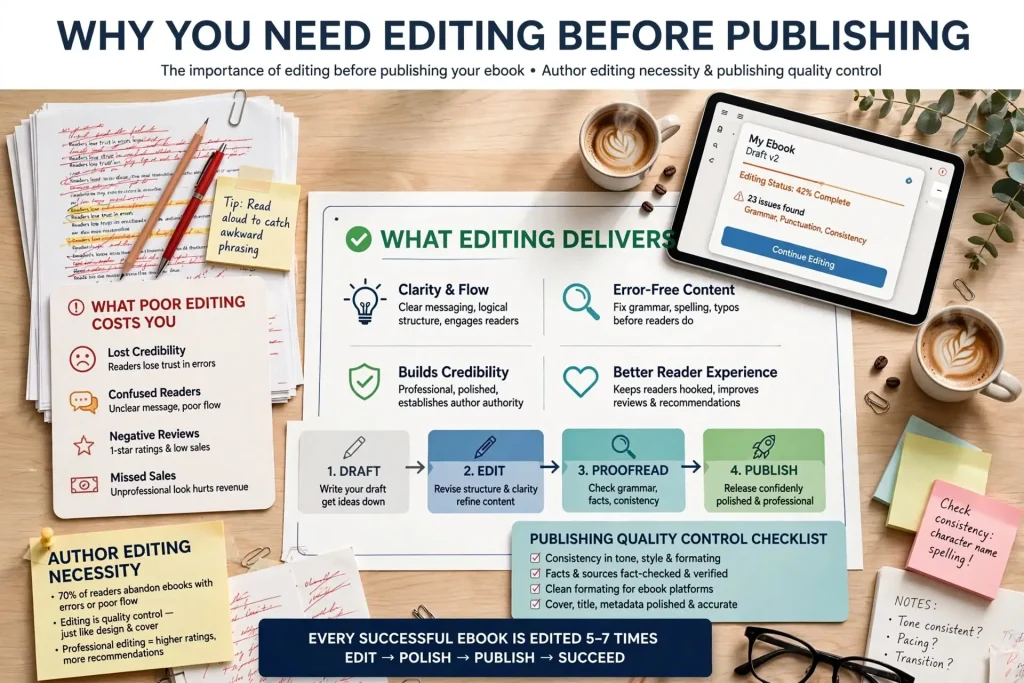
Most authors who skip professional editing tell themselves stories about why their specific book doesn’t need it. The writing is already strong. The budget is tight. The book is short. Friends have read it and said it’s good. These rationalizations don’t change the fundamental reality. Editing before publishing isn’t optional for serious commercial publishing. Books that skip editing get treated differently by readers, by reviewers, and by the broader publishing infrastructure. The business consequences of skipping editing aren’t theoretical. They’re measurable patterns of damage that affect career trajectory over years rather than just individual book performance.
This post walks through the specific business reasons editing isn’t optional, the measurable consequences of skipping it, and the framing that helps authors invest appropriately rather than rationalizing skipping the investment.
Why Editing Isn’t Optional for Serious Authors
Editing matters for specific business reasons beyond just craft.
The professional standard expectation. Readers expect books to be edited. The expectation is so baseline that violations get noticed quickly.
The credibility infrastructure. Unedited books signal amateur production. The signal damages credibility across everything else you do as author.
The review profile impact. Reviewers notice editing quality. Unedited books accumulate one-star and two-star reviews specifically calling out editing failures.
The recommendation engine effect. Algorithms favor books with strong sales and reviews. Editing weaknesses produce weak reviews which produce weak algorithm visibility.
The brand building reality. Each book contributes to author brand. Books with editing problems damage the brand that subsequent books would benefit from.
The professional positioning question. Authors operating as serious professionals invest in editing. Authors not investing in editing position themselves outside the serious tier.
The long-term career implication. Career trajectories of edited and unedited authors typically diverge significantly across years. The investments in editing compound.
These business realities make editing non-negotiable for serious commercial publishing. Skipping editing for hobby books or family memoirs may be reasonable. Skipping editing for commercial books rarely is.
The Credibility Stakes
Author credibility is the foundation that supports everything else.
The expertise signaling. For nonfiction particularly, books signal expertise. Books with editing problems signal lack of professionalism that undermines expertise claims.
The fiction craft credibility. Fiction authors who can’t produce edited manuscripts signal craft weaknesses that affect reader assumptions about the writing itself.
The author platform credibility. Authors building platforms (newsletters, social media, speaking) need credibility to support those efforts. Books that damage credibility damage the entire platform.
The professional opportunities. Speaking engagements, podcast invitations, partnership offers depend on professional credibility. Authors known for unedited books rarely get these opportunities.
The series readership confidence. Readers of series invest in author credibility for ongoing book purchases. Editing problems in early series books reduce subsequent purchase confidence.
The genre-specific credibility. Some genres have particularly strong editing expectations. Romance, thrillers, and certain other genres punish editing problems significantly.
Credibility, once damaged, takes years to rebuild. The cost of credibility damage usually exceeds the cost of editing that would have prevented it.
The Reader Trust Foundation
Reader trust enables everything in author-reader relationships.
The first book reader risk. Readers trying new authors take risk. Unedited books punish that risk-taking and reduce future risk-taking with the same author.
The series trust building. Series readers invest in trust that subsequent books will deliver. Editing problems break this trust.
The recommendation behavior. Readers recommend books they trust. Unedited books rarely get recommendations even when content is interesting.
The review motivation. Readers write reviews based on overall experience. Editing problems motivate negative reviews even when story is otherwise strong.
The price tolerance. Readers tolerate higher prices for authors they trust. Unedited books get pushed toward bargain pricing because higher pricing feels unjustified.
The patience for slow openings. Readers who trust authors give books more chance to develop. Unedited books get abandoned quickly.
The benefit of doubt extension. Trusted authors get readers’ benefit of doubt for unusual choices. Unedited books don’t get this latitude.
Trust accumulates slowly across many books. Each book either builds or damages trust. Unedited books typically damage trust significantly.
The Review Profile Impact
Reviews drive much of book discovery and conversion.
The star rating averages. Books with editing problems typically average half-star to full-star lower ratings than equivalent books with strong editing.
The review content specifics. Reviews specifically mention editing quality. Negative reviews calling out editing remain visible to future browsers.
The review count impact. Books with editing problems often accumulate fewer reviews because readers don’t finish books with editing issues that frustrate them.
The early review trajectory. First reviews shape ongoing review momentum. Strong early reviews attract more positive reviews. Weak early reviews limit accumulation.
The reviewer audience reach. Some reviewers have significant audiences. Negative editing-focused reviews from these reviewers can damage book sales significantly.
The cross-platform review consistency. Editing problems appear in reviews across Amazon, Goodreads, BookBub, and other platforms. The criticism multiplies.
The platform algorithm effect. Lower star averages produce lower algorithmic visibility. The compounding effect across the book’s life is significant.
Review profile damage from editing problems persists for years. The reviews don’t go away. The averages don’t recover. The damage compounds.
The Algorithm Implications
Algorithm visibility depends on factors editing affects.
The conversion rate impact. Books with editing problems often have lower conversion rates because reader signals discourage purchase.
The completion rate impact. Books readers don’t finish (because editing problems frustrate them) signal weakness to algorithms.
The read-through impact in KU. KU revenue depends on pages read. Books readers abandon mid-book due to editing problems produce less KU revenue.
The review velocity. Books that frustrate readers produce slower review accumulation. Algorithm signals based on review velocity get affected.
The recommendation engine input. Algorithms recommend books based on what similar readers actually liked. Books with editing problems get fewer “people who liked X also liked” recommendations.
The category ranking. Lower sales velocity from editing problems produces lower category rankings.
The bestseller list eligibility. Books with editing problems rarely reach bestseller status that supports significant career advancement.
Algorithm visibility compounds dramatically. Books that gain visibility get more visibility. Books that don’t get visibility usually never recover. Editing affects which direction this compounding goes.
The Long Term Reputation Cost
Author reputations build across books and years.
The cumulative book quality. Authors are known by their catalogs collectively. Several unedited books damage author reputation more than single book.
The Google search history. Negative reviews accumulate in Google search results for author names. The accumulated negativity affects future readers researching authors before buying.
The author community awareness. Other authors notice editing quality. Author communities (where cross-promotion happens) treat authors differently based on quality reputation.
The industry recognition. Awards, recognition lists, and industry attention require sustained quality across books. Editing problems exclude authors from this recognition.
The book club consideration. Book clubs and reading groups select books partly on quality reputation. Authors with editing problem reputations rarely get book club selection.
The library and bookstore relationships. Libraries and bookstores curate selections. Editing reputation affects which authors get carried.
The traditional publishing pathway. Authors hoping to traditional publish or sell rights face significantly worse outcomes with editing problem catalogs.
Reputation, once established, persists. Building strong reputation takes years. Damaging reputation can take single bad book.
The Comparison to Traditional Publishing
Traditional publishing maintains editing standards self-publishing must match.
The traditional publishing standard. Major publishers wouldn’t release unedited books. The competitive context expects edited books.
The reader expectation. Readers don’t distinguish self-published from traditionally published when buying. They expect similar quality.
The genre competitor reality. Your books compete with traditionally published books in the same genre. Comparison is unfavorable when editing differs significantly.
The price competition. Traditional publisher books at $9.99 may compete with self-published at $4.99. Self-published needs editing equal to or better than traditional to justify lower pricing being attractive.
The shelf life expectations. Traditional publisher books often have substantial shelf lives because quality investment pays back over years. Self-published books with editing problems often have minimal shelf lives.
The industry credibility. Self-publishing has earned legitimacy partly through quality matching traditional. Books that damage this perception damage the entire self-publishing community.
Self-published authors compete on the same shelves as traditional publishers. Skipping editing means competing at a disadvantage that’s largely self-imposed.
The DIY Limitation Reality
Authors who think they can self-edit to publication-ready quality misunderstand the editing function.
The blind spots reality. Authors can’t see their own work with the objectivity professional editors bring. Some issues require external perspective.
The skill differential. Professional editors have skills developed across many books. Most authors don’t match this skill level even when they’re capable writers.
The fresh-eyes limit. Authors close enough to their work to write it can’t be far enough away to edit it properly.
The intentional choices versus errors confusion. Authors sometimes can’t distinguish their intentional stylistic choices from accidental errors. Professional editors make this distinction reliably.
The marketplace standard expectations. The standard expected by readers and platforms typically exceeds what most authors can self-edit to.
The exception authors. Some authors with editing backgrounds can self-edit at near-professional level. They’re rare exceptions, not the norm.
The reality test. Authors who think they don’t need editing typically need editing most. The confidence often correlates with the gap between actual and self-perceived skill.
The DIY limitation isn’t insult to author skill. It’s recognition of how editing actually functions and what it requires.
The Investment Justification
Editing investment justifies itself financially.
The conversion rate math. Editing improvements increase conversion rates. Even modest improvements pay back editing costs quickly.
The review profile math. Strong editing produces higher average ratings. Higher ratings produce more sales. The math works.
The lifetime sales calculation. Editing affects sales across the entire commercial life of books. The lifetime returns typically exceed editing investment significantly.
The catalog effect. Strong editing across catalog supports overall author brand. The brand effect produces returns beyond individual book performance.
The marketing efficiency. Marketing investments work better on edited books. Same marketing produces different results based on book quality.
The cost per book amortization. Across a catalog of 10 books, total editing investment of $50,000 amortizes to $5,000 per book. If editing produces even modest sales improvements, the investment justifies itself.
The opportunity cost consideration. Money spent on editing produces returns. Money saved by skipping editing produces ongoing costs (lower sales, damaged reviews, reduced opportunities).
The financial framing helps authors recognize editing as investment rather than expense.
Common Skip Editing Mistakes
Several patterns regularly lead to editing skipping.
The budget rationalization. “I can’t afford editing.” The cost of skipping usually exceeds editing cost.
The friend feedback substitution. “My friends loved it.” Friends aren’t editors and rarely provide useful editorial perspective.
The early success delusion. Some unedited books sell despite editing problems. This rarely sustains across catalogs.
The genre exception thinking. “My genre doesn’t need editing.” Every genre has editing standards.
The volume strategy. Some authors prioritize publishing many books quickly over editing investment. The strategy rarely produces sustainable careers.
The AI editor substitution. AI tools help but don’t replace professional editing.
The traditional editing tier confusion. Authors paying for proofreading and thinking they got developmental editing.
The cheap editor selection. Bad editing can be worse than no editing in some cases.
Editing as Business Investment Not Optional Expense
The framing matters significantly. Authors who view editing as expense to minimize tend to under-invest and produce books that damage their broader publishing careers. Authors who view editing as investment to optimize tend to make different decisions and produce books that support their career building over years. The financial math works decisively in favor of viewing editing as investment for any author taking publishing seriously.
The investment framework changes specific decisions. Quality tier of editor selected. Total budget allocated. Timeline allowed for editing. Coordination between editing stages. Each decision improves when made within investment framing rather than expense-minimization framing. Authors who develop this framing early in their careers benefit across decades of subsequent publishing work. The investments made on early books pay back through career trajectory effects that compound across years. The publishing industry has always required editing. Self-publishing doesn’t change this requirement. The expectation that books be edited is so foundational that violations get punished quickly through review profiles, sales, and career trajectory. Authors who recognize editing as non-negotiable rather than optional tend to build sustainable publishing careers. Authors who fight against this expectation typically produce careers that plateau at levels significantly below their actual writing skills would otherwise support.


