
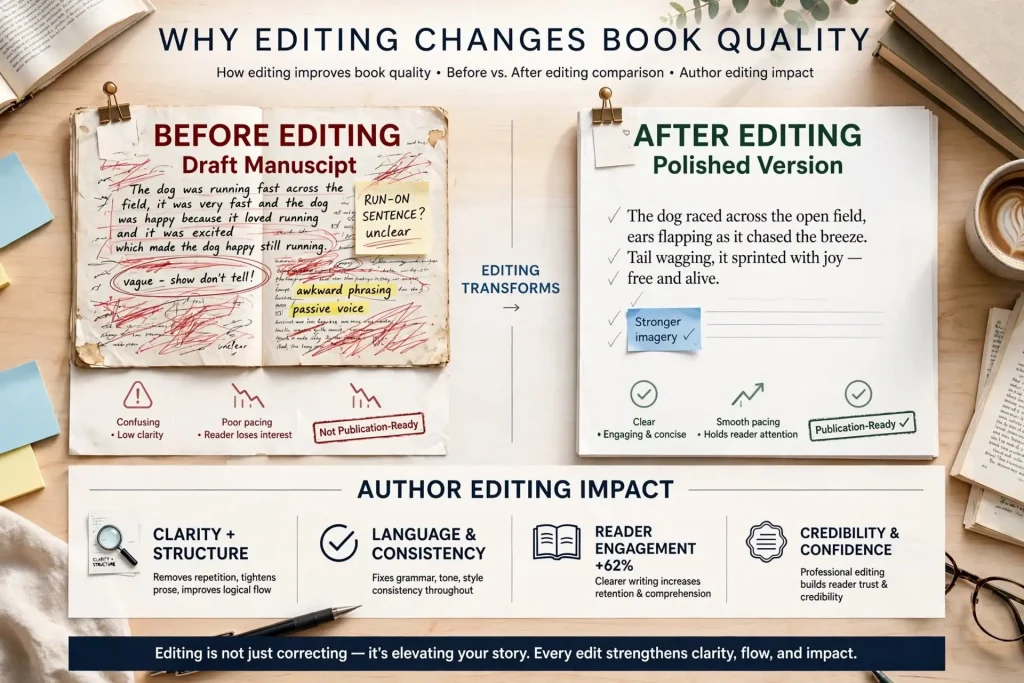
Most discussions of editing focus on if to edit or what editing costs. The discussion of what editing actually does to manuscripts gets less attention. Yet this is the most important question for authors trying to make sense of editing decisions. What specifically changes between unedited manuscript and edited final book? Where does the improvement actually come from? Which dimensions of quality get affected and which don’t? The editing improves quality question deserves specific answers rather than vague claims about editing being important. Authors who know what editing actually does to manuscripts can make better decisions about editing investments and work more productively with editors.
This post walks through the specific dimensions of manuscript quality that editing addresses, what changes between draft and final, and how to recognize the improvements editing produces.
What Editing Actually Improves in Manuscripts
Editing addresses specific dimensions of manuscript quality.
The structural integrity. Story or argument structure that actually works. Foundation upon which everything else builds.
The pacing dynamics. How readers move through the material. If the pacing serves the content.
The character work. How characters develop, behave, and create reader investment.
The dialogue quality. How characters speak. If dialogue serves story and reveals character.
The prose craft. The actual sentence-by-sentence writing quality.
The word-level precision. Specific word choices that affect reader experience.
The voice consistency. The author’s voice maintained reliably across the manuscript.
The continuity reliability. Internal consistency throughout the book.
The reader experience smoothness. How the cumulative reading experience actually feels.
Each dimension gets addressed by editing in specific ways. The improvements compound to produce significantly better final books than unedited drafts.
Story Structure Improvements
Developmental editing addresses the largest issues first.
The act structure refinement. Traditional three-act structure or alternatives. If the structure actually works for the specific story.
The opening hook strengthening. If the opening does what openings need to do. Hook strength affects everything that follows.
The inciting incident placement. Where the story actually starts. Common manuscript problem is delayed inciting incident.
The midpoint reinforcement. If the middle has the strength to sustain reader investment. Mid-book sag is common manuscript problem.
The climax setup. If the climax has been earned by what came before. Climaxes that feel unearned damage reception.
The resolution work. If the resolution addresses what the story has set up. Loose ends and unresolved threads frustrate readers.
The subplot integration. If subplots support the main story or distract from it.
The character arc completion. If character development actually completes within the story span.
Structure problems can require substantial rewriting to fix. Identifying them at developmental editing stage prevents wasted prose-level work on scenes that need to be cut.
Pacing Refinements
Editing identifies and addresses pacing issues throughout manuscripts.
The chapter length variation. If chapter lengths vary appropriately to create rhythm.
The scene length variation. Within chapters, if scene lengths work for the story.
The action-reflection balance. If action sequences alternate with reflection and character development appropriately.
The information delivery pacing. If information arrives when readers need it. Too much too early overwhelms. Too late frustrates.
The tension cycles. If tension rises and falls in cycles that maintain reader engagement.
The breathing room. If the manuscript provides reader rest between intense sequences.
The momentum building. If the story builds momentum toward its ending.
The opening pacing. If the opening pulls readers in or makes them work too hard.
Pacing affects every reader’s experience of the book. Editing identifies specific pacing problems and suggests specific fixes.
Character Development Deepening
Editors help characters become more dimensional and believable.
The character motivation clarity. If character motivations actually drive their actions. Many drafts have unclear motivations.
The character consistency. If characters behave consistently with their established personalities. Inconsistency confuses readers.
The character growth. If characters change appropriately across the story. Static main characters typically don’t work.
The character relationship development. If relationships between characters develop in meaningful ways.
The character voice differentiation. If different characters speak and think distinctly.
The minor character development. If minor characters serve story purposes effectively.
The antagonist depth. If antagonists have appropriate depth. Flat antagonists weaken stories.
The character backstory integration. If character backstory supports current action without overwhelming it.
Character work often distinguishes strong fiction from weak fiction. Editing helps characters become the dimensional figures readers actually invest in.
Dialogue Polish
Editing improves dialogue significantly.
The character voice consistency. Each character should sound like themselves consistently. Editors catch dialogue that doesn’t fit.
The natural rhythm. Dialogue should feel natural without being literally realistic. Editing helps find the right register.
The subtext development. Strong dialogue includes subtext. What characters don’t say matters as much as what they do say.
The tag and beat handling. The mechanical elements around dialogue. Tags, action beats, attribution clarity.
The dialect and accent treatment. Consistent handling of character speech patterns.
The conversation flow. How conversations move between characters. Forced exchanges damage flow.
The information delivery balance. Dialogue shouldn’t deliver information awkwardly. Editing identifies expository dialogue that needs work.
The cultural and period authenticity. Dialogue appropriate to setting and characters.
Dialogue is often the most-noticed prose element. Strong dialogue draws readers in. Weak dialogue pushes them away.
Prose Tightening
Editing tightens prose throughout the manuscript.
The unnecessary word removal. Words that add nothing. Cumulative effect across thousands of pages.
The awkward construction elimination. Sentences that work but feel awkward. Editing finds smoother ways to convey same meaning.
The redundancy elimination. Saying the same thing multiple times. Once is usually enough.
The clarity improvements. Replacing unclear constructions with clearer alternatives.
The pacing through sentence length. Strategic variation of sentence length affects reading pace.
The strong verb substitution. Replacing weak verbs with stronger alternatives.
The active voice preferences. Converting unnecessary passive voice to active voice.
The dialogue tag minimization. Reducing “he said” / “she said” excess while maintaining attribution clarity.
The exposition smoothing. Making exposition feel less expository.
The cumulative tightening effect can reduce manuscript length by 5% to 15% while improving reading experience.
Word Choice Precision
Editing refines word choices throughout manuscripts.
The specific word selection. The right specific word usually exists. Editing helps find it.
The repeated word identification. Same words used repeatedly without intent. Editing identifies and varies them.
The character tic catching. Author tics (favorite words and phrases used too often) that appear without conscious awareness.
The dialect specifics. Words appropriate to specific characters or settings.
The period accuracy for historical work. Words appropriate to the time period of the story.
The technical accuracy. Specific terminology used correctly in specialized contexts.
The cultural sensitivity. Words and phrases that may have specific cultural implications.
The cliché replacement. Cliched phrasing replaced with fresh language.
The connotation alignment. Word choices that carry appropriate connotations for the context.
Word choice precision distinguishes professional prose from amateur prose. Editing catches the imprecisions authors miss in their own work.
Sentence Rhythm Improvement
Editing improves the music of prose.
The sentence variety creation. Mix of sentence lengths and structures.
The opening pattern variation. Avoiding consecutive sentences with similar openings.
The repetition for effect versus accidental repetition. Intentional repetition versus unintentional. Editing distinguishes them.
The rhythm matching content. Sentence rhythm aligned with what the prose is doing emotionally.
The breath and pause creation. Where commas, dashes, and periods create reading pauses.
The flow between sentences. How sentences connect or contrast.
The paragraph-level rhythm. The rhythm of paragraphs within sections.
The section-level rhythm. The rhythm of sections within chapters.
Sentence rhythm affects reading experience continuously across the manuscript. Editing improves rhythm in ways readers feel without articulating.
Voice Consistency
Editing maintains the author’s voice throughout the manuscript.
The voice identification. Strong editors recognize the author’s voice and protect it.
The voice consistency across chapters. If voice changes inappropriately between sections.
The voice consistency across pov characters. Different POV characters should have voice differences within consistent author voice.
The voice intentional shifts. Voice changes that should happen versus voice changes that shouldn’t.
The dialogue voice within author voice. Dialogue maintains character voice within author voice framework.
The narrative voice maintenance. The narrating voice that holds everything together.
The voice strength preservation. Avoiding edits that weaken the author’s distinctive voice in favor of generic correctness.
The voice development support. Helping voice develop where it’s emerging.
Voice is part of what readers come to specific authors for. Editing protects and strengthens voice rather than flattening it.
Continuity Repair
Editing catches and fixes continuity problems.
The fact consistency. If internal facts stay consistent. Common manuscript problem: character details changing.
The timeline reliability. If the story timeline actually works. Days of week, ages, sequences.
The setting consistency. If settings remain consistent across references.
The detail consistency. Eye color, names, physical descriptions all consistent.
The character knowledge consistency. If characters know things they should and don’t know things they shouldn’t.
The relationship consistency. If character relationships remain consistent.
The geographic consistency. If locations and distances stay consistent.
The cultural consistency. If cultural details stay accurate throughout.
The mechanical consistency. Number formatting, style choices, formatting consistent.
Continuity errors break reader immersion when discovered. Editing catches them before publication.
Reader Experience Smoothing
Beyond specific dimensions, editing smooths the overall reading experience.
The flow optimization. Removing friction that interrupts reading.
The clarity prioritization. Making meanings clear without reader effort.
The implicit assumption identification. Catching where authors assumed reader knowledge they didn’t actually establish.
The transitions polishing. Making transitions between scenes and chapters feel natural.
The pacing variation. Creating rhythm that supports sustained reading.
The reader expectation management. Setting and meeting reader expectations through structural choices.
The accessibility considerations. Making the book work for readers with various reading habits.
The reading session breaks. Natural places where readers can put the book down without losing momentum.
The reader experience after editing differs significantly from the reading experience of unedited manuscripts. Readers may not articulate the differences but they feel them.
Quality Improvements Readers Actually Notice
The improvements editing produces aren’t theoretical. Readers actually notice the differences between well-edited and poorly-edited books even when they can’t articulate what they’re noticing. The well-edited book feels effortless to read. The pacing works. The characters feel real. The dialogue sounds natural. The prose flows. The reading experience supports immersion.
The poorly-edited book produces friction that readers feel. The pacing drags. The characters feel inconsistent. The dialogue sounds wrong. The prose tires the reader. The reading experience fights immersion at every turn. Readers reading edited versus unedited versions of the same content would describe their experiences differently even without knowing one was edited and one wasn’t. The differences manifest in specific noticeable ways. The book that takes 4 hours to read versus 6 hours of the same content. The book they recommend to friends versus the one they don’t mention. The book they read again versus the one they forget. The book they trust the author’s next release based on versus the one that makes them cautious about the author. Editing produces these noticeable differences across hundreds of small ways throughout every page of every chapter. The cumulative effect across the entire book significantly affects reader response and ongoing relationship with the author.


