
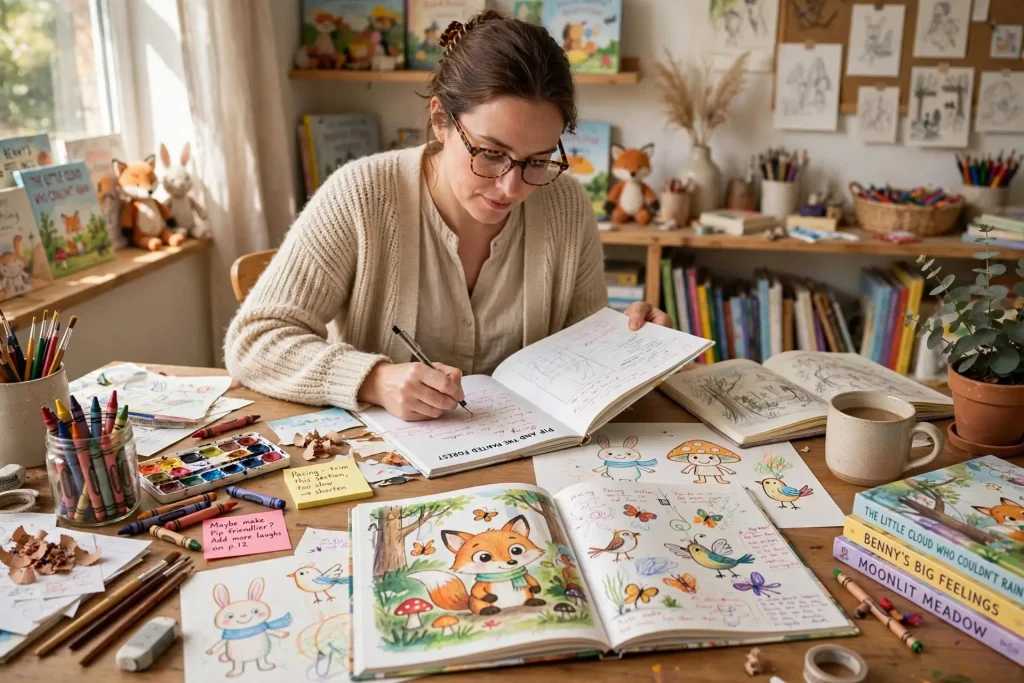
Most authors writing children’s books assume general editing skills transfer to kids’ content. They hire editors with strong fiction or nonfiction backgrounds and hope for the best. The results often disappoint. Children’s book editing is its own specialty with specific knowledge requirements that general editors don’t have. Age-appropriate vocabulary. Reading-level calibration. Engagement patterns that work for specific age groups. Sensitivity to topics handled differently for kids than adults. The childrens book editing requirements are different enough that authors writing for kids need editors who specifically work in the category.
This post walks through what specialized children’s book editing involves, the age-specific considerations at each stage of children’s publishing, and how to find editors qualified to handle kids’ content.
What Makes Children’s Books Different
Children’s books face specific demands that adult books don’t.
Age-appropriate everything. Vocabulary, sentence structure, content themes, illustration content. Each must match the developmental stage of the target reader.
Multiple audiences simultaneously. Children’s books typically serve both child readers and adult buyers (parents, teachers, librarians). The book must engage children while also satisfying adults’ criteria for what their kids should read.
Strict reading level expectations. Educational institutions evaluate children’s books against specific reading level standards. Books that don’t match their stated reading levels get rejected from school libraries and curriculum lists.
Illustration integration. Most children’s books include illustrations that integrate with text. The text must work with the illustrations rather than independently.
Content sensitivity. Topics that adults handle easily require careful treatment for child readers. Death, violence, family conflict, and other difficult themes need age-appropriate framing.
Educational expectations. Many children’s books serve educational purposes beyond entertainment. Vocabulary building, comprehension skills, social-emotional learning. These goals affect editing decisions.
These differences mean children’s book editors need specialized knowledge that general fiction or nonfiction editors typically don’t have.
Age Category Distinctions
Children’s books divide into specific age categories with distinct conventions.
Board books (ages 0-3). Sturdy cardboard pages. Very simple text or no text. Bold visual content. Limited words per page. Word counts typically 0 to 100 words total.
Picture books (ages 3-8). Full illustrations on every page or spread. Text integrated with art. Word counts typically 200 to 1,000 words.
Early readers (ages 5-7). Designed for new independent readers. Simple vocabulary. Short sentences. Predictable structures. Word counts typically 1,000 to 5,000 words. Often divided into levels.
Chapter books (ages 7-10). Transition books with chapters but still relatively simple text. Word counts typically 5,000 to 15,000 words.
Middle grade (ages 8-12). Real novels for kids. More involved plots. Word counts typically 25,000 to 50,000 words.
Young adult (ages 12-18). Books for teens. Adult-level prose complexity but with age-appropriate content. Word counts typically 50,000 to 80,000 words.
Each category has different editing requirements. The same editor rarely handles all categories equally well.
Reading Level Calibration
Reading level matters significantly for children’s books targeting specific age groups.
Common measurement systems. Lexile measures, Fountas and Pinnell levels, Guided Reading Level, ATOS scores, and Flesch-Kincaid grade level all measure reading difficulty differently.
What affects reading level. Vocabulary difficulty (rare words versus common words). Sentence length and complexity. Use of dialogue versus exposition. Use of subordinate clauses and other syntactic complexity.
Editing for reading level. Editors check vocabulary against age-appropriate word lists. They flag overly complicated sentences and suggest simpler alternatives. They identify passages where complexity exceeds the target reading level.
Tools for reading level analysis. Online calculators provide rough measurements. Professional tools provide more detailed analysis. Editors specializing in children’s books often have access to subscription tools.
The balance challenge. Reading level shouldn’t be lower than the target age would find engaging. Books that are too easy bore their target readers as much as books that are too hard frustrate them.
Vocabulary & Language Choices
Children’s book editing focuses on vocabulary at a level adult book editing doesn’t.
Word selection considerations. Are these words appropriate for the target age? Do they appear at the expected difficulty level? Are unfamiliar words introduced with sufficient context for readers to learn them?
Repetition for learning. Young children’s books often deliberately repeat key vocabulary to support learning. Editors verify the repetition pattern works developmentally.
Dialogue authenticity. Kids’ dialogue should sound like kids actually talking. Adults writing children often produce dialogue that sounds adult or condescending. Editors catch these.
Cultural and contemporary references. References that adults take for granted may not be familiar to children. Editors flag references that need explanation or replacement.
Sensitive language. Words that have specific meanings or implications for adults sometimes carry different weight for children. Editors flag potentially problematic word choices.
Reading aloud test. Picture books and early readers need to read smoothly aloud. Editors mentally or actually read passages aloud to catch awkward phrasing.
Content Appropriateness Standards
Content standards for children’s books are stricter than for adult books in specific ways.
Violence and threat. The level of threat or violence acceptable varies by age. Picture books typically have very limited threat content. Middle grade can include more significant peril. YA can approach adult-level intensity.
Death and loss. These themes can be handled in children’s books but require age-appropriate framing. Editors guide authors on what works at each age level.
Family relationships. Conflict between family members, difficult parent figures, sibling rivalry all appear in children’s books but need careful handling.
Romance and physical intimacy. Picture books and early readers have essentially no romantic content. Middle grade can include modest crushes. YA can include significant romantic content but with age-appropriate limits on physical intimacy.
Bodily functions and other potentially taboo content. Children’s books sometimes engage with bathroom humor, body awareness, and similar topics but with careful framing.
Drugs, alcohol, profanity. These topics appear in YA but with restrictions. Editors flag content that might be too mature for the stated age range.
Specific cultural and religious sensitivities. Different markets have different expectations about religious content, cultural references, and other sensitivity areas.
Editors with children’s book expertise know these standards across age categories and apply them consistently.
Illustration Integration
For illustrated children’s books (picture books particularly), the editing considers text-illustration integration.
Text-illustration relationships. Strong picture books show some content through illustrations while telling other content through text. The two work together rather than duplicating each other.
Page-turn moments. Picture books rely on the page-turn for dramatic effect. Editors identify where page-turns should fall and adjust text breaks to land on those moments.
Word counts for visual books. Picture books work best at specific word counts (typically 200 to 1,000 words). Editors flag manuscripts that exceed the appropriate length for the format.
Action versus illustration choices. Some content works better illustrated than described. Editors identify text that could be replaced with illustrations to strengthen the book.
Layout coordination. While illustrators handle visual layout, editors work with the text in ways that support effective layout. Editors flag text passages that won’t work in the page layouts the illustrations will need.
Engagement Patterns for Young Readers
Children engage with books differently than adults. Editing accounts for these patterns.
Hook strength. Kids decide quickly if they want to keep reading. Strong opening pages matter more for kids than for adult readers.
Chapter ending tension. For chapter books and middle grade, chapter endings should produce anticipation for the next chapter. Editors flag chapters that end too quietly.
Action pacing. Young readers want forward movement. Editors identify slow sections and suggest tightening.
Dialogue density. Many children’s books work better with dense dialogue and lighter description than adult books. Editors guide the balance.
Repetition and rhythm. Especially for picture books and early readers, repetitive patterns and rhythmic language engage young readers. Editors evaluate how these elements work.
Sensory engagement. Children respond to vivid sensory details. Editors flag opportunities to add sensory elements that strengthen engagement.
Common Children’s Book Editing Mistakes
Several patterns regularly weaken children’s books at the editing stage.
Adult-level prose in children’s books. Sentence structures and vocabulary that work for adults but exceed children’s reading comfort.
Patronizing tone. Writing down to children rather than treating them as smart readers. Strong children’s editing catches this pattern.
Mismatched age category. Books that don’t actually fit their stated age category in vocabulary, themes, or content.
Wrong word counts. Books too long or too short for their category. Picture books at 3,000 words don’t get published. Middle grade at 15,000 words feels thin.
Outdated references. References to technology, culture, or events that don’t connect with current young readers.
Missing illustration consideration. Picture book manuscripts written without thinking about how illustrations will integrate.
Adult issues handled poorly. Trying to address mature themes without age-appropriate framing.
Cultural insensitivity. Failing to recognize how children’s content interacts with various cultural sensitivities.
Generic editing without children’s expertise. Hiring editors without children’s book backgrounds and accepting their work without verification.
Why Kids’ Editing Deserves Special Attention
Children’s books carry specific responsibilities that adult books don’t. The young readers who engage with your book may form their early relationships with reading based on the experience. Books that handle their craft poorly may discourage young readers from continuing to read. Books that handle their craft well may produce lifelong readers.
Beyond the responsibility to young readers, the practical market for children’s books rewards books that meet professional standards. Schools, libraries, and parents make purchasing decisions based partly on quality signals. Books that meet age-appropriate standards across all the dimensions covered above get adopted into educational settings and recommended by librarians. Books that miss these standards struggle even when they have other strengths.
The investment in specialized children’s book editing produces returns the investment in general editing can’t match for this specific category. Authors writing for kids who treat children’s book editing as a specialized requirement rather than a generic service tend to produce books that find their audiences and serve those audiences well. The work is real but the payback runs across generations of young readers when the books succeed in their category.


