
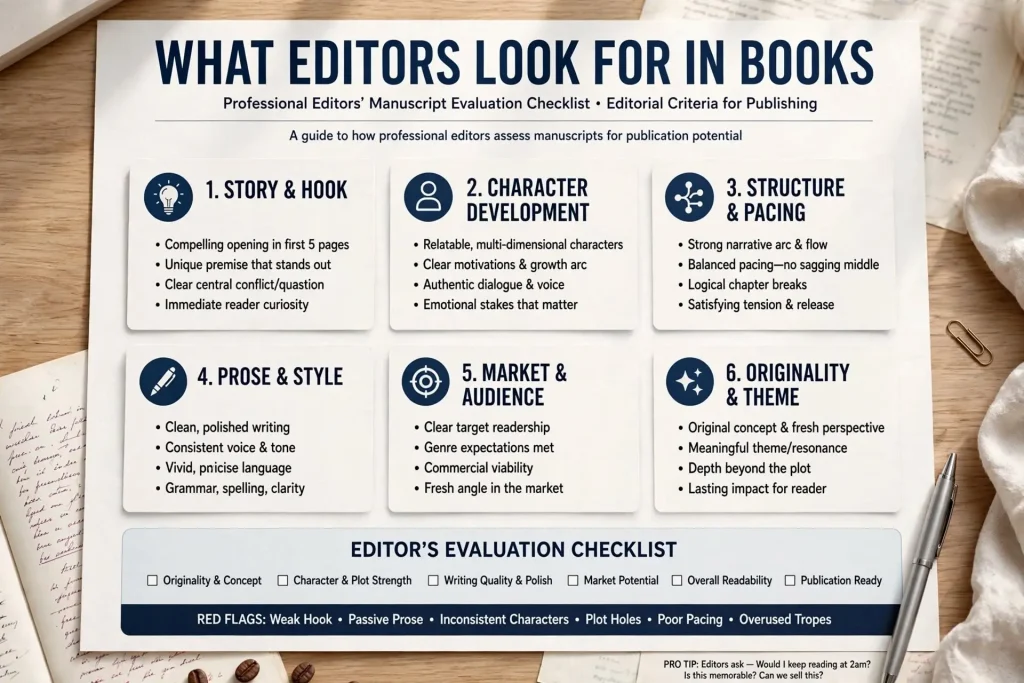
Most authors approach editor relationships without knowing what editors actually evaluate when reviewing manuscripts. They send manuscripts and hope for the best, often missing opportunities to position their work effectively. Editors approach incoming manuscripts with specific evaluation frameworks that authors who know about can leverage. The what editors look for question deserves direct treatment from the editor perspective rather than guessing from author perspective. Authors who learn what editors actually evaluate tend to send manuscripts that get better editor responses than authors who don’t.
This post walks through what professional editors actually assess when reviewing manuscripts, the specific evaluation criteria they apply, and how authors can position their work to get more productive editor responses.
The Editor’s First Read Approach
Editors approach incoming manuscripts with specific reading methodology.
The opening pages evaluation. Editors read opening pages with attention different from later pages. First impressions matter significantly.
The skim-then-deep-read pattern. Many editors initially skim before deep reading. The skim reveals overall structure and quality level.
The note-taking discipline. Editors take notes systematically rather than just reading. The notes inform their editorial response.
The pattern recognition. Experienced editors recognize patterns quickly. Common issues become identifiable within first chapters.
The voice assessment. Editor reading establishes if the author has distinctive voice or generic prose.
The craft evaluation. Specific craft elements get evaluated during reading. Sentence-level work, scene work, dialogue all get assessed.
The marketability consideration. Editors think about market reach alongside craft evaluation. Both matter for editorial decisions.
The first read sets the tone for everything that follows. Strong first reads lead to strong editorial responses.
The Craft Evaluation
Craft assessment happens across multiple dimensions.
The prose-level work. Sentence construction, word choice, rhythm. The basic prose craft.
The voice strength. If the writing has distinctive voice or sounds generic.
The dialogue quality. If dialogue feels natural and serves story.
The description balance. If descriptions serve story without overwhelming pacing.
The character work depth. If characters feel dimensional and believable.
The structural awareness. If the author knows and works with story structure.
The genre conventions handling. If the author follows or knowingly breaks genre conventions.
The technical control. If the author maintains POV, tense, voice consistency.
The craft evaluation determines what editorial response makes sense. Strong craft gets different editing than developing craft needs.
The Genre Conventions Check
Genre awareness significantly affects editor evaluation.
The genre identification. What genre does this actually fit? Sometimes manuscripts fit different genres than authors think.
The genre convention compliance. Does the manuscript meet baseline genre expectations? Or violate them in ways that confuse readers?
The genre convention intentional breaks. Some breaks are intentional and effective. Others are accidental and weaken the work.
The subgenre fit. Within genres, subgenres have specific expectations. Subgenre fit affects marketability.
The genre evolution awareness. Genres evolve. Current expectations may differ from older conventions.
The genre comparison context. How does this manuscript compare to current strong examples in its genre?
The genre audience expectations. What do readers of this genre actually expect?
The cross-genre considerations. Some manuscripts fit multiple genres or sit between genres. The cross-genre dynamics affect strategy.
Editors with genre expertise bring specific knowledge authors often lack. The genre-specific evaluation matters significantly.
The Marketability Assessment
Beyond craft, editors evaluate marketability.
The hook strength. Does the premise have hook strength? Is there compelling reason for readers to choose this book?
The target audience clarity. Is the audience clear? Or is the book trying to appeal to no one specifically?
The commercial fit. Does the manuscript fit commercial categories where books like it sell?
The current market context. What’s happening in the relevant market currently? Trends that affect this book’s reception.
The author platform considerations. Does the author have platform that supports the book’s market reach?
The series possibilities. For genres where series work, does this open series possibilities?
The cross-genre appeal. Could this appeal across genres in ways that expand market?
The international market consideration. Does this have appeal in markets beyond domestic English-language?
Marketability isn’t separate from craft. They interact. Strong craft typically helps marketability. Marketability considerations inform editorial direction.
The Voice & Style Recognition
Voice gets specific attention during editor evaluation.
The voice distinctiveness. Does this writing sound like a specific author or generic prose?
The voice consistency. Does the voice maintain across the manuscript?
The voice appropriateness. Does the voice match the genre and content?
The voice development possibility. Voices can develop with editing support. Editors recognize voices worth developing.
The style coherence. Stylistic choices fitting together coherently. Not random style variations.
The voice protection considerations. How can editing strengthen voice without flattening it toward generic correctness?
The voice market fit. Does this voice fit market for this type of book? Some voices need adjustment for commercial viability.
The voice teachability. Can voice elements be taught to the author or are they natural?
Voice often distinguishes manuscripts editors want to work with from those they don’t. Strong distinctive voice matters significantly.
The Revision Needs Estimation
Editors estimate how much revision will be required.
The revision scope assessment. Heavy structural revision versus light prose polish.
The author capability estimation. How much can the author actually accomplish in revision?
The realistic timeline assessment. How long would needed revision take?
The cost estimation. How extensive does the editing engagement need to be?
The fit assessment. Does this manuscript and author fit the editor’s specific skills and interests?
The collaboration likelihood. How productively can the editor and author work together?
The success probability. What’s the realistic probability this manuscript becomes successful work?
The realistic feedback. Editors estimate what feedback the author can actually use productively.
Revision needs estimation affects if editors take projects on and how they structure engagements.
The Author Collaboration Likelihood
The author component matters for editor decisions.
The author professionalism signals. How the author communicates indicates collaboration likelihood.
The author openness to feedback. Authors defensive about their work make difficult collaboration partners.
The author revision capability. Can the author actually execute revision based on feedback?
The author timeline reliability. Will the author meet timelines or constantly slip?
The author commitment level. Is the author serious about this work or treating it casually?
The author career stage. First-time authors have different needs than experienced authors. Both can work but require different approaches.
The author goals clarity. Does the author have clear goals for what they want this book to accomplish?
The author expectations realism. Are the author’s expectations realistic? Unrealistic expectations damage collaboration.
Author considerations affect editor decisions about which projects to accept and how to structure engagements.
The Project Fit Question
Editors assess project fit specifically.
The genre expertise fit. Does the manuscript fit the editor’s specific genre expertise?
The current workload fit. Does the editor have capacity for this project?
The timeline fit. Does the author’s timeline match the editor’s schedule?
The budget fit. Does the author’s budget match what this editing actually requires?
The complication fit. Is this project at appropriate sophistication level for the editor’s typical work?
The collaboration style fit. Does the author’s collaboration style match the editor’s working approach?
The personal interest. Does the editor find this manuscript interesting? Strong interest improves work quality.
The portfolio strategy fit. Does this fit the editor’s broader portfolio strategy?
Fit determinations affect if editors accept projects. Strong fit produces better outcomes than forcing mismatched projects.
What Strong Manuscripts Show
Manuscripts that get strong editor responses show specific characteristics.
The clean source files. Well-organized files with consistent formatting. Easy for editors to work with.
The strong opening. Opening pages that draw editors in. Same opening that draws readers in.
The clear craft strengths. Specific craft elements that work well. Voice, dialogue, scene work, or others.
The understandable concept. Clear premise that editors can grasp quickly.
The genre fit signals. Clear genre signaling without violating convention awkwardly.
The marketable hook. Compelling reason this specific book should exist in the market.
The author preparation signals. Authors who have done self-editing work and prepared manuscripts properly.
The realistic goals communication. Authors who communicate realistic goals for what they want from editing.
Strong manuscripts get strong editor responses. The strength is visible quickly.
What Weak Manuscripts Show
Manuscripts that get weak editor responses show specific problems.
The messy source files. Inconsistent formatting, unclear chapter structure, hard-to-work-with files.
The weak openings. Openings that don’t draw editors in or readers in.
The unclear concepts. Premises that editors can’t grasp quickly.
The genre confusion. Manuscripts that don’t fit clear genres or violate conventions without intent.
The craft weaknesses visible. Issues that should have been addressed before sending to editor.
The unrealistic expectations. Authors expecting things editors can’t deliver.
The author defensiveness signals. Communication patterns suggesting difficult collaboration.
The platform misalignment. Author platform not supporting the manuscript’s market goals.
Weak manuscripts often get declined or get extensive feedback that overwhelms authors. Better to address weaknesses before sending.
How to Position Your Manuscript
Specific actions improve editor response.
The pre-editing self-edit. Substantial self-editing before sending to professional editors.
The clean file preparation. Properly formatted source files that editors can work with easily.
The clear query letter. Brief professional communication explaining the project.
The honest goal communication. Realistic statement of what you want from editing.
The genre clarity. Clear genre positioning rather than vague genre claims.
The platform context. Brief author platform information when relevant.
The sample chapter selection. If sending samples, choose strong chapters.
The professional tone throughout. Maintain professional communication throughout the engagement.
These positioning steps don’t replace strong manuscripts but they support strong manuscripts getting the attention they deserve.
Knowing What Editors Want Before Submitting
The work to know what editors actually evaluate when reviewing manuscripts pays back significantly in editor relationships. Authors who learn the evaluation framework tend to send manuscripts that get more productive editor responses than authors who don’t. The few minutes of thinking about what editors will actually see and assess produces returns through better editor selections, better editing outcomes, and better author-editor relationships.
Editors aren’t trying to be gatekeepers or to make authors feel bad. They’re trying to identify projects they can actually help succeed. The evaluation criteria reflect what makes projects succeed, not arbitrary editor preferences. Authors who position their work to meet evaluation criteria typically find editor relationships work more productively. Authors who fight against evaluation criteria or refuse to learn them often struggle with editor relationships in ways that affect their entire publishing operations. The investment in learning editor perspective pays back across every subsequent editing engagement across the author’s career. The professional knowledge accumulates and supports increasingly sophisticated editor relationships over time. Strong author-editor relationships produce strong books. Building those relationships starts with knowing what editors actually look for when manuscripts arrive in their queues.


