
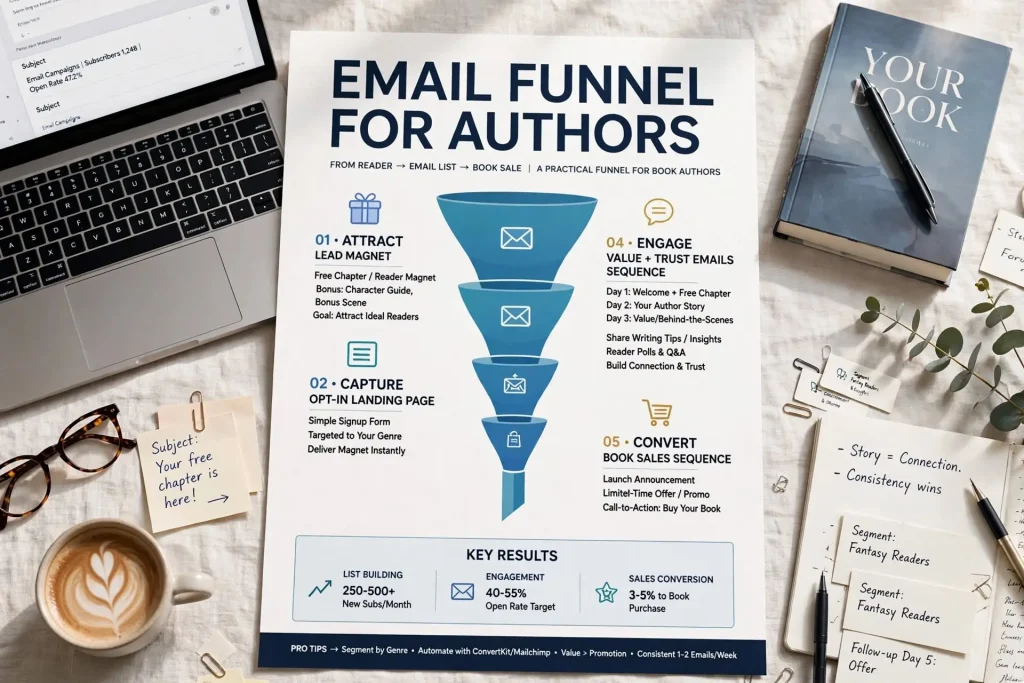
Most authors who build email lists treat subscribers as recipients of occasional newsletters and launch announcements. The casual approach captures small fraction of what email lists actually can do for author businesses. The author email funnel that actually converts subscribers to readers involves systematic automated nurture sequences that build relationships, establish trust, and motivate book purchases. Authors who develop funnels tend to convert subscribers at significantly higher rates than authors who don’t. The work to build funnels isn’t extreme but does require systematic thinking about the subscriber experience.
This post walks through what author email funnels actually involve, the specific sequences that work, and how to build automated systems that convert subscribers to book buyers without requiring per-subscriber attention.
What Author Email Funnels Actually Do
Author email funnels serve specific subscriber relationship purposes.
The relationship building. Funnels build relationships with subscribers over time. Casual newsletter approach doesn’t build relationships as systematically.
The trust establishment. Subscribers learn to trust authors through consistent valuable email content. Trust supports subsequent book purchase decisions.
The reader education. Subscribers learn about your books, your writing, your approach. Educated subscribers convert better than uninformed subscribers.
The expectation setting. Subscribers learn what to expect from your emails. Clear expectations support engaged subscribership.
The audience segmentation. Different subscriber interests get identified through funnel interactions. Segmentation supports targeted communications.
The launch foundation. Strong subscriber relationships built through funnels support stronger launches.
The cross-book promotion. Funnels can introduce subscribers to multiple books in catalog.
The audience retention. Funnels reduce subscriber churn through ongoing engagement.
These purposes serve sustainable author businesses that newsletter approaches don’t fully address.
The Welcome Sequence Foundation
The welcome sequence sets foundation for everything that follows.
The immediate confirmation email. Confirming subscription. Often delivering promised lead magnet. First impression matters.
The welcome message. Personal welcome from the author. Establishes voice and personality.
The expectation setting. What subscribers will receive. How often. What kind of content.
The lead magnet delivery. If lead magnet was promised, delivering it cleanly. Includes any setup needed.
The introduction to author. Brief author introduction. Background, current projects, personality.
The book introduction. Quick introduction to your books. Not aggressive sales pitch. Friendly orientation.
The next steps. What subscribers should do or expect next. Clear direction.
The unsubscribe option clarity. Easy unsubscribe option. Forced retention damages relationships.
Welcome sequences typically run 3 to 7 emails over the first 1 to 2 weeks of subscription. The investment pays back across the subscriber’s entire relationship.
The Trust Building Sequence
After welcome, trust building work continues.
The valuable content delivery. Email content that’s genuinely valuable to subscribers. Not just promotion.
The author personality revelation. Subscribers learn more about the author as person. Connection deepens.
The behind-the-scenes content. Glimpses of writing process, work in progress, author life. Specific to each author’s voice.
The reader question engagement. Encouraging subscriber engagement. Replies, questions, conversation.
The story sharing. Author stories that demonstrate values, perspective, voice.
The community building. Subscribers feeling part of community rather than just on mailing list.
The reciprocity establishment. Author giving value first. Asks for reciprocal action come later.
The voice consistency. Email voice consistent with book voice. Reduces dissonance between books and emails.
Trust building takes time. Funnels supporting trust building work patiently across weeks and months.
The Reader Education Sequence
Reader education makes subscribers more likely to become book buyers.
The book introduction sequences. Specific sequences introducing each major book in catalog.
The series education. For series books, education about series structure, reading order, character continuity.
The genre education. Some authors educate subscribers about genre conventions, sub-genres, recommendations within genres.
The author craft education. Subscribers interested in writing learn about author’s craft approach.
The industry education. Some authors educate subscribers about publishing industry topics relevant to their books.
The reading recommendations. Authors recommending books they love. Builds reader-author trust.
The book club discussion possibility. Encouraging book club use of author’s books. Supports community building.
The author event education. Information about appearances, signings, conferences relevant to subscribers.
Educated subscribers convert to buyers at higher rates than uneducated subscribers. The education work pays back through subsequent purchases.
The Book Launch Sequence
Launches benefit significantly from sequenced communication.
The pre-launch anticipation building. Email sequence in weeks before launch building anticipation. Sample content. Behind-the-scenes. Cover reveal.
The launch announcement. Day-of-launch announcement with specific call to action.
The launch follow-up. Day-after launch follow-up. Reminder for subscribers who missed initial announcement.
The launch week reinforcement. Continued launch communication through launch week. Different angles each day.
The promotional partnership announcements. Promotional placements or partnerships that subscribers can support.
The early review encouragement. Early subscribers encouraged to leave reviews. Honest review requests.
The launch week support. Support for any launch-week challenges. Direct subscriber communication.
The post-launch wrap. After launch week, brief wrap acknowledging support.
Launch sequences turn subscriber bases into launch acceleration infrastructure. The systematic approach significantly affects launch performance.
The Cross Book Recommendation Sequence
Cross-promotion within the catalog deserves systematic treatment.
The catalog introduction. New subscribers introduced to full catalog over weeks.
The series read-through support. Subscribers who bought one series book encouraged toward subsequent books.
The cross-series introductions. Subscribers introduced to series they haven’t tried yet.
The standalone book recommendations. Standalone books recommended based on subscriber interests revealed through engagement.
The bundle promotions. Bundles or boxed sets promoted to relevant subscribers.
The new release for backlist activation. New releases used to activate readers who haven’t read backlist.
The seasonal promotion sequences. Seasonal book recommendations through email funnel.
The reader anniversary sequences. Anniversary of subscription used to introduce books subscribers may have missed.
Cross-book recommendation sequences capture significant catalog revenue that single-book focus would miss.
The Re Engagement Sequence
Inactive subscribers benefit from re-engagement attempts.
The activity decline identification. Identifying subscribers who haven’t opened or clicked emails for some period.
The gentle re-engagement first. Initial re-engagement email checking in without aggressive ask.
The value offer. Re-engagement offering specific value rather than just asking for engagement.
The preference confirmation. Asking subscribers what content they want.
The unsubscribe alternative. Clear unsubscribe option for subscribers who don’t want to remain.
The graceful departure handling. Some subscribers will unsubscribe. Graceful handling preserves option for future return.
The list cleaning value. Cleaning inactive subscribers improves overall list health and email deliverability.
The re-engagement sequence frequency. Periodic re-engagement attempts rather than constant attempts.
Re-engagement work maintains list health. Without it, lists accumulate inactive subscribers that damage deliverability.
Segmenting Subscribers
Segmentation supports targeted communication.
The genre segmentation. Subscribers interested in different genres get different communications.
The series segmentation. Subscribers of specific series get series-specific content.
The buyer segmentation. Subscribers who have bought get different content than subscribers who haven’t.
The engagement segmentation. Highly engaged subscribers get different treatment than passive subscribers.
The geographic segmentation. International subscribers may benefit from market-specific content.
The interest segmentation. Subscribers interested in writing, behind-scenes, or other specific content can be segmented.
The new versus established subscriber segmentation. Different content for different relationship stages.
The launch readiness segmentation. Subscribers most likely to support launches identified.
Segmentation supports more relevant communications. More relevant communications produce better engagement and conversion.
Personalization Strategies
Personalization beyond just inserting names.
The behavioral personalization. Content responsive to subscriber behavior. Clicked links affecting subsequent content.
The interest personalization. Content reflecting expressed interests.
The purchase history personalization. Communication aware of past purchases.
The geographic personalization. Region-relevant content when relevant.
The engagement-level personalization. Different communication frequency for different engagement levels.
The series-progress personalization. Subscribers in different points of series get appropriate content.
The platform preference personalization. Subscribers who prefer specific platforms get platform-appropriate communications.
The communication-style personalization. Different subscribers prefer different communication styles.
Personalization at moderate levels produces returns. Excessive personalization can feel invasive and creepy. Balance matters.
Common Funnel Mistakes
Several patterns weaken email funnel effectiveness.
The over-promotion. Funnels that promote constantly damage subscriber relationships.
The under-engagement. Funnels that don’t engage subscribers fail to build relationships.
The set-and-forget. Funnels not maintained drift from current author work and goals.
The genre misalignment. Funnel content not matching what subscribers expected from genre signaling.
The personality flattening. Funnels using generic marketing voice rather than author’s distinctive voice.
The no testing. Funnels not tested for performance miss optimization opportunities.
The poor segmentation. Treating all subscribers identically when segmentation would produce better results.
The platform-specific limitations. Funnel features depending on specific email service provider capabilities.
The integration failures. Funnels not integrating with website, social media, sales platforms.
The legal compliance issues. GDPR, CAN-SPAM, and other regulations require compliance.
Measuring Funnel Performance
Performance measurement supports optimization.
The open rate tracking. Percentage of subscribers opening emails. Subject line and timing affects open rates.
The click-through rate tracking. Percentage of openers clicking links. Email content quality affects clicks.
The conversion rate tracking. Subscribers actually buying books. The ultimate measure.
The unsubscribe rate tracking. Rate at which subscribers leave. Healthy lists have low unsubscribe rates.
The segment-specific performance. Performance varying by segment reveals optimization opportunities.
The time-period performance. Performance over different time periods reveals trends.
The A/B testing systematic. Testing variations to identify what works.
The cross-funnel comparison. Comparing performance across different funnel sequences.
Performance measurement makes optimization possible. Without measurement, optimization is guessing.
Email Funnels as Long Term Reader Relationship Infrastructure
Author email funnels function as long-term infrastructure rather than as marketing tactics. Built well, funnels support reader relationships across years and decades of subsequent author work. Each book benefits from the relationships funnels build. Each launch benefits from the engaged subscribers funnels nurture. Each promotional cycle benefits from the segmented audiences funnels identify.
The investment in building email funnels pays back across the entire commercial life of every book in the catalog. The funnels work even if you’re actively engaged with marketing or focused on writing. The automation supports ongoing reader relationships without requiring per-subscriber attention. The infrastructure function matters increasingly as author careers develop and catalogs grow. Authors with strong funnel infrastructure tend to have careers that compound across years more reliably than authors with weak email infrastructure. The casual newsletter approach captures small fraction of what email lists can do for author businesses. The funnel approach captures much more. The choice between these approaches significantly affects what kind of author business you build across years of subsequent work. Authors recognizing email as long-term infrastructure rather than as occasional marketing tactic tend to invest appropriately. The investment in funnel development typically produces returns that compound across decades.


