
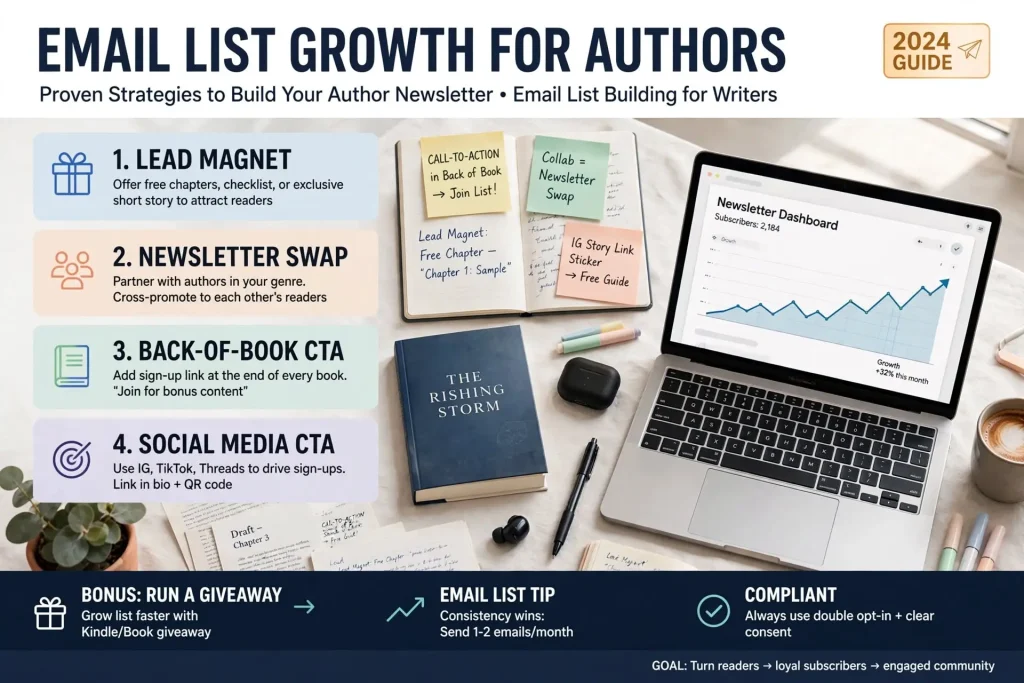
Most authors wish they had bigger email lists but don’t know how to actually grow them. They put a basic signup form on their website and wonder why nobody subscribes. They send occasional newsletters to the few existing subscribers they have. They wonder why other authors have substantial email lists while theirs stays small. The work to grow author email list requires specific systematic activity rather than passive hope that subscribers will appear. Authors who develop list-growth methodology tend to build lists that significantly outperform authors who never develop methodology.
This post walks through the specific strategies that actually grow author email lists, the lead magnets that motivate subscriptions, and the traffic and conversion approaches that compound list growth over time.
Why Email List Growth Matters
List growth affects long-term author business viability.
The launch infrastructure dependency. New book launches depend on subscriber engagement. Larger lists support stronger launches.
The promotional reach foundation. Email reaches subscribers reliably. Social media reach is uncertain. Email lists provide owned reach.
The conversion rate stability. Email converts to book purchases at rates significantly higher than social media followers convert. The list size affects total conversions.
The compound interest dynamics. Lists grow gradually but the growth compounds. Year-five list is much larger than year-one list with consistent growth work.
The marketing efficiency. Email marketing has higher ROI than most other marketing channels. List size affects total ROI possible.
The platform independence. Email lists don’t depend on social platform algorithms or policy changes. Owned audience.
The audience direct relationships. Email allows direct two-way communication with audience. Other channels limit this.
The career sustainability. Authors with strong lists tend to have more sustainable careers than authors without lists.
These benefits make list growth genuinely strategic rather than just nice-to-have activity.
Lead Magnets That Actually Work
Lead magnets motivate subscriptions when they offer genuine value.
The free book or novella. The most powerful lead magnet for many authors. Genuine free book motivates subscription.
The bonus content. Bonus chapters, alternate endings, deleted scenes. Series readers particularly value these.
The behind-the-scenes content. Author commentary, writing process, deleted material.
The character-focused content. Character backstories, character interviews, character sheets.
The world-building content. Detailed world-building documents for fantasy or science fiction series.
The reading guides. Discussion guides for book clubs or schools.
The author content. Personal essays, autobiographical content, author interviews.
The exclusive content. Anything subscribers can’t easily get elsewhere.
The genre-appropriate match. Lead magnets matching genre expectations. Romance readers want different lead magnets than thriller readers.
The lead magnet should be valuable enough that subscribers feel they got a good deal even before any subsequent emails. Weak lead magnets damage trust from the start.
Lead Magnet Format Options
Different formats serve different lead magnet purposes.
The PDF download. Most common format. Easy to deliver and consume. Works for most content types.
The ebook formats. EPUB or MOBI for content that benefits from ebook reader experience. Free novellas particularly.
The audio content. MP3 audio for content that benefits from listening. Author interviews, behind-scenes commentary.
The video content. Video tutorials, author interviews, behind-scenes content. Less common but powerful when appropriate.
The interactive content. Quizzes, surveys, interactive worksheets. Specific use cases.
The email-delivered course. Multi-email course delivered over weeks. Builds engagement from start.
The membership content. Access to ongoing content rather than single download.
The community access. Access to private community of readers and author.
Format choice depends on content type and audience preferences. Multiple formats may serve different audience segments.
Website Signup Optimization
The author website typically captures most subscribers.
The signup form prominence. Forms visible on every page. Not buried in footer.
The signup form placement variety. Forms in header, sidebar, in-content, popup, footer. Multiple opportunities to subscribe.
The value proposition clarity. Forms explaining clearly what subscribers get. Vague forms convert poorly.
The friction minimization. Asking for minimal information. Email only typically. Asking for too much reduces conversions.
The mobile responsiveness. Forms working well on mobile devices where significant traffic comes from.
The privacy reassurance. Brief mention of privacy. Avoiding spam concerns.
The social proof. Subscriber counts or testimonials when meaningful. Establishes legitimacy.
The page-specific forms. Different forms on different pages. Book page forms different from blog post forms.
Website conversion optimization can significantly improve list growth without requiring additional traffic.
In Book Signup Placement
Books themselves can drive signups.
The end-of-book placement. Reader engagement requests at book endings. Strong placement.
The before-book placement. Some authors include signup invitations before the book content.
The series promotion placement. Series books promoting email list as way to learn about next books.
The exclusive bonus offer. Bonus content available only through email signup mentioned in book.
The character information offer. Additional character information available through email signup.
The world-building information offer. Additional world-building available through email.
The author personal access. Direct author access through email subscription.
The QR code use. QR codes in print books linking to signup pages.
In-book placement captures readers at their most engaged moment with author’s work. The placement should appear thoughtfully integrated rather than feeling like aggressive marketing.
Social Media Traffic Strategies
Social media supports list growth through specific approaches.
The pinned post optimization. Pinned posts on profiles featuring lead magnet offers.
The bio link optimization. Single bio link platforms (Instagram, TikTok) using bio link to direct to signup.
The content-to-list pipeline. Social media content with calls-to-action driving to email signup.
The platform-specific tactics. Different platforms supporting different list-growth approaches.
The Instagram Stories use. Stories featuring lead magnet promotion with link stickers.
The TikTok video use. Short videos promoting lead magnets in author’s content style.
The Twitter/X tactical use. Tactical threads, pinned tweets, replies featuring lead magnet.
The Facebook group use. Author or genre groups where appropriate engagement supports growth.
Social media drives traffic. Email captures audience. The pipeline matters more than either platform alone.
Paid Acquisition Strategies
Paid advertising can accelerate list growth.
The Facebook Ads approach. Targeting interest-based audiences with lead magnet offers.
The Instagram Ads approach. Visual ads supporting lead magnet promotion.
The BookBub Ads approach. Reaching engaged book buyers with lead magnet offers.
The Amazon Ads approach. Some authors use Amazon to drive to author websites with email capture.
The cost-per-subscriber tracking. Knowing what each subscriber actually costs.
The ROI calculation per subscriber. Lifetime value per subscriber justifying acquisition cost.
The conversion funnel optimization. Ad clicks need to convert through landing page. Optimization at each step.
The audience testing. Different audiences responding differently to lead magnet offers. Testing reveals best audiences.
Paid acquisition typically supplements rather than replaces organic growth. The investment makes sense when subscriber lifetime value justifies acquisition cost.
Cross Promotion with Other Authors
Other authors can support your list growth.
The cross-promotion exchanges. Mailing each other’s lists for mutual benefit.
The newsletter swap programs. Coordinated swaps with multiple authors simultaneously.
The boxed set collaborations. Multi-author boxed sets that drive subscribers to all participating authors.
The promotional giveaway collaborations. Multi-author giveaways for substantial prizes. Significant list growth opportunity.
The bundled lead magnets. Multi-author lead magnets each author promotes.
The reader magnet exchanges. Each author featuring others’ lead magnets to their lists.
The conference and event collaborations. Sometimes events support cross-promotion among participating authors.
The author group strategies. Specific author groups (BookFunnel for example) supporting cross-promotion.
Cross-promotion requires genre compatibility and audience alignment. Done well, it can produce substantial list growth.
Giveaway & Contest Strategies
Giveaways drive significant list growth when handled well.
The single-author giveaways. Author-run giveaways with email signup as entry requirement.
The multi-author giveaways. Larger giveaways with multiple participating authors.
The big-prize giveaways. Substantial prizes (Kindles, gift cards, prize bundles) driving significant entries.
The genre-specific giveaways. Targeted to specific genre audiences for better subscriber quality.
The KingSumo type platforms. Tools supporting giveaway operations.
The list growth versus quality trade-off. Giveaway subscribers sometimes lower quality than organic subscribers. Important consideration.
The post-giveaway nurture. Subscribers from giveaways need specific nurture to convert to engaged readers.
The legal considerations. Giveaways have legal requirements varying by jurisdiction.
Giveaways work but require specific handling. Quick list growth without strategy can produce churn.
Conversion Optimization
Beyond traffic generation, conversion matters.
The landing page testing. Different landing pages convert at different rates. Testing reveals what works.
The headline testing. Lead magnet offer headlines significantly affecting conversion.
The image testing. Lead magnet imagery affecting click-through and conversion.
The form length testing. Shorter forms typically convert better but reduce data collected.
The button text testing. “Subscribe” vs “Get the free book” vs other options. Tests reveal differences.
The privacy assurance placement. Where privacy text appears affecting conversion.
The mobile-specific optimization. Mobile conversion sometimes differs from desktop. Specific optimization needed.
The cross-device tracking. Subscribers may discover offer on one device, subscribe on another. Attribution complexity.
Conversion optimization compounds traffic acquisition results. Same traffic with better conversion produces significantly more subscribers.
Common List Growth Mistakes
Several patterns weaken list growth efforts.
The weak lead magnets. Lead magnets not valuable enough to motivate subscription.
The hard-to-find signup forms. Signup forms not prominent enough to capture interested visitors.
The no traffic plan. Authors with great signup forms but no traffic plan never grow lists.
The poor mobile experience. Mobile signup that doesn’t work captures no mobile subscribers.
The unclear value proposition. Authors not explaining what subscribers get.
The inconsistent growth work. Sporadic growth attempts followed by neglect.
The no segmentation. Treating all signups identically when segmentation would help.
The no testing. Never testing different approaches misses optimization opportunities.
The platform dependency. Relying entirely on one platform for list growth.
The premature aggressive monetization. Aggressive sales to new subscribers damages relationship and increases unsubscribes.
List Building as Compounding Marketing Asset
Author email list building is among the highest-leverage marketing investments available in indie publishing. The work to build lists compounds across years through multiple mechanisms. Subscribers acquired this year continue producing returns through next year’s launches. Lists built through years of work support careers in ways that newer marketing channels can’t match.
The patient compounding approach typically produces better results than the quick-spike approach most authors default to. Authors who add modest list growth work to their ongoing operations across years tend to build substantial lists that support sustainable careers. Authors who never develop list growth approach often plateau at small lists that limit their marketing options. The choice between consistent attention to list building and occasional bursts followed by neglect typically determines significantly different career trajectories. The investment in lead magnets, signup optimization, traffic strategies, and conversion testing pays back across every book launch and every promotional cycle across years of subsequent work. Email lists become career assets that compound in value over time, supporting everything from individual book launches to ongoing audience relationships to broader career development across decades of publishing work.


