
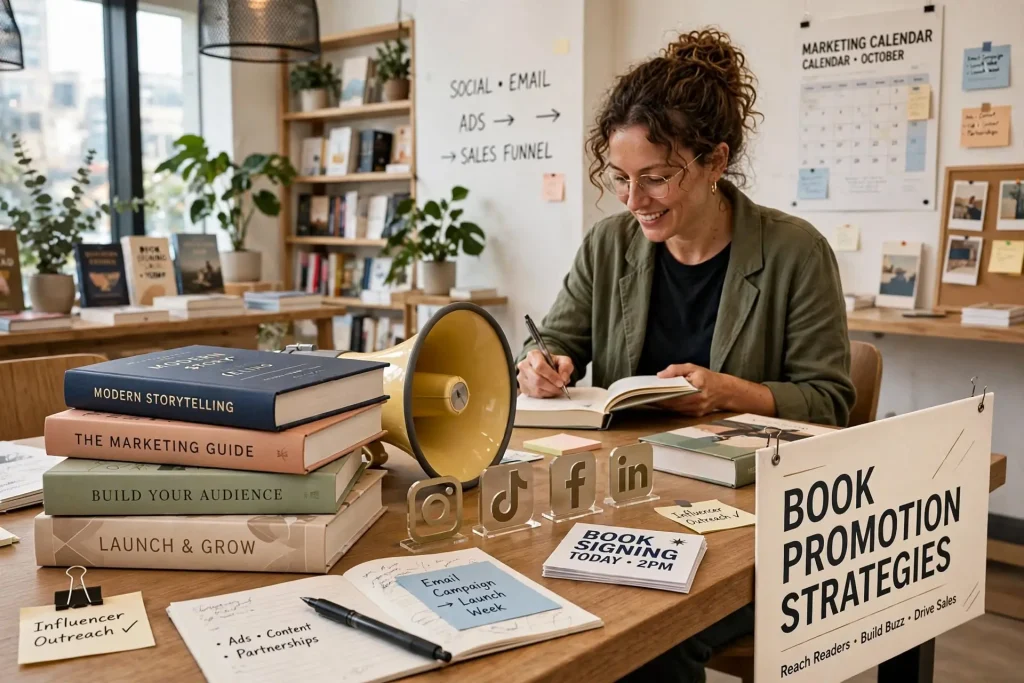
Most authors think of book promotion as launch week activity. Push hard for seven days, hope for the best, move on to the next book. The promotion tactics that actually build sustainable book sales operate on different timelines. Some work for sustained ongoing visibility. Some work for concentrated promotional spikes. Some build audience over years rather than producing immediate results. The book promotion tips that actually matter span all these timelines and require different tactics for different goals.
This post walks through the promotion tactics that actually move sales, what each one does best, and how to combine them into ongoing systems rather than one-shot launches.
What Promotion Actually Includes
Book promotion covers a wide range of activities, each producing different effects.
Paid advertising. Ads on Amazon, Facebook, BookBub, Google. The most directly measurable promotion type. Costs money but produces predictable results once tuned.
Promotional site placements. Featured deals on BookBub, Bargain Booksy, Freebooksy, and similar sites. Single-day or multi-day visibility spikes that drive concentrated sales.
Giveaways and free promotions. Free book days, Goodreads giveaways, multi-author giveaway bundles. Generate downloads and email subscribers more than direct revenue.
Cross-promotion with other authors. Author swaps, joint email mentions, bundle releases. Reach new audiences through trusted relationships.
Price promotions. Sales, Kindle Countdown Deals, limited-time discounts. Drive concentrated buying during the promotional window.
Email list promotion. Announcements to your own subscriber base, promoted partner books to your list. The most reliable channel for engaged audience.
Social media activity. Organic posts, paid social, influencer outreach. Builds awareness more than direct conversion.
Public relations and media. Podcast appearances, press coverage, reviews in publications. Long-term credibility building.
Each tactic produces different outcomes. Authors who use a mix typically outperform authors who depend on one or two.
Paid Advertising as Foundation
Paid advertising is usually the foundation of sustainable book promotion. The platforms work consistently when properly managed.
Amazon Ads reach readers actively browsing the store. The highest direct-purchase intent of any platform. Most book ads cost $0.20 to $1.50 per click. Conversion rates of 5% to 15% are typical for well-optimized campaigns.
Facebook and Instagram Ads reach readers based on interests and demographics. Best for genres with identifiable audience characteristics. Romance, thriller, and certain nonfiction work well. Literary fiction often underperforms.
BookBub Ads (self-serve, separate from Featured Deals) reach engaged readers through BookBub’s network. Higher cost per click but readers are book-buying focused.
Google Ads work for nonfiction with clear search demand and for fiction with strong brand-name searches. Less effective for cold discovery of fiction.
Sustainable advertising budgets for most authors run $5 to $50 per day per book in active promotion. Below $5 per day, the data accumulates too slowly to optimize. Above $50 per day, the marginal returns usually decline.
Promotional Site Placements
Promotional sites feature books to their subscriber lists, driving traffic during placement periods.
BookBub Featured Deals are the strongest single promotional tool. Acceptance is selective. Featured books often see 1,000+ sales spikes. Costs run $200 to $1,500 per feature depending on category and pricing.
Other promotional sites accept more submissions for modest fees. Bargain Booksy, Freebooksy, Robin Reads, Fussy Librarian, ENT, and dozens of others operate at various price points and audience sizes.
Stacking placements across multiple sites for the same promotional period produces compounding visibility. A single BookBub Featured Deal can be supplemented with 3 to 5 secondary site placements during the same week for total spend of $500 to $2,000.
Plan promotional placements 4 to 12 weeks in advance. BookBub particularly requires significant lead time. Last-minute placements rarely produce optimal results.
For backlist titles, run promotional cycles every 3 to 6 months. The combination of pricing reset and visibility spike often reignites sales velocity that had declined to baseline.
Giveaways & Free Promotions
Giveaways generate downloads, email subscribers, and visibility but don’t typically produce direct revenue during the promotion itself.
KDP Select free book days allow up to 5 free days per 90-day enrollment. Combined with promotional site placements, free promotions can generate thousands of downloads.
Goodreads giveaways drive want-to-read additions and modest visibility. Costs $119 to $599 depending on package.
Multi-author giveaway bundles pool prizes from multiple authors to reach broader audiences. Costs are usually shared across participants. Email list growth is the main outcome.
Free promotions work best as audience-building tools rather than revenue events. The downloads generate email subscribers who convert to buyers over weeks and months that follow.
Cross Promotion With Other Authors
Cross-promotion leverages other authors’ audiences without direct payment.
Newsletter swaps. You promote another author’s book to your list. They promote yours to theirs. The exchange reaches each author’s audience.
Joint launches. Coordinated releases where multiple authors launch related books together, cross-promoting throughout the launch week.
Anthology contributions. Joining a multi-author anthology exposes your work to all the other authors’ audiences plus the anthology’s combined marketing.
Book recommendation features. Sharing other authors’ books in your content (newsletter, blog, social media) when they fit your audience. Often reciprocated.
The key to effective cross-promotion is audience fit. Promoting books to your audience that don’t match what your readers want damages your relationship with subscribers. Cross-promoting with carefully chosen partners in compatible genres produces real results.
Price Promotions
Strategic pricing changes drive concentrated promotional spikes.
Kindle Countdown Deals (for KDP Select books) discount prices to $0.99 or higher for up to 7 days while maintaining 70% royalty rate. The promotion creates urgency and signals deal to buyers.
Standard sale pricing drops a book to discount levels for a limited window. Often paired with promotional site placements for compound effect.
Anchor pricing. Setting the regular price higher than the “promotional” price creates the perception of discount even when the promotional price is the price most buyers see.
Bundle pricing. Box sets at significant discount from individual book pricing drive volume. The bundle math works because most buyers who’d have bought one book buy the bundle instead.
Use price promotions strategically rather than constantly. Books always on sale stop feeling like deals. The contrast between standard pricing and promotional pricing is what makes promotions work.
Email List Promotion
The email list is the most reliable promotional channel.
Launch sequences for new releases produce the highest concentrated sales spikes most authors will see. A list of 5,000 engaged subscribers can drive 200 to 1,000 launch-day sales from email alone.
Promotional emails for sales and special offers convert at meaningfully higher rates than other channels. Subscribers who’ve consented to your emails are already qualified as interested.
Ongoing newsletter engagement keeps the list warm between launches. Lists that hear from you only when there’s something to sell go cold over time. Regular value-providing content maintains the relationship.
Newsletter swaps with other authors expose your work to their lists. The conversion rates depend on audience fit but can drive meaningful sales when the match is strong.
Long Tail Promotional Tactics
Beyond active promotional campaigns, some tactics produce ongoing low-level promotional benefit.
Back-of-book calls to action. The last pages of your book asking readers to leave reviews, sign up for your email, or check out your other books. Work for every reader who finishes the book, for as long as the book is in catalog.
SEO-focused content. Blog posts and other content that ranks for relevant searches over years. Drives readers to your books through search rather than active promotion.
Series cross-references. Books in your catalog that reference other books in the catalog naturally drive readers from one to another.
Social media content with evergreen value. Posts that get discovered through search or recommendation over years rather than only during the few hours after posting.
These tactics don’t produce dramatic spikes but accumulate quietly over time. Across a multi-year career, they often produce more total promotional value than active campaigns alone.
Errors That Waste Promotional Budget
Several patterns regularly burn promotional budget without producing returns.
Promoting weak listings. Driving paid traffic to a book with a weak cover, poor description, or no reviews wastes the ad spend. Fix the listing before scaling promotion.
Treating promotion as one-time launches. Concentrating all promotional energy into launch week leaves the book exposed once launch ends. Sustained promotional activity produces better long-term results.
Skipping the data review. Authors who run promotions without tracking results can’t tell which tactics work. The data shapes better future decisions.
Buying placements blindly. Some promotional sites have far better ROI than others. Testing different sites with small spends identifies the ones worth scaling.
Spreading too thin. Trying every tactic simultaneously usually means executing none of them well. Pick the few that fit your situation and execute consistently.
Ignoring cross-platform consistency. Promotional offers that don’t match across Amazon, Apple, Kobo, and your direct sales create confusion that hurts conversion.
Promotion as a Career Long Habit
The most consistent promotional results come from treating promotion as ongoing infrastructure rather than launch-week sprints. The author with active Amazon Ads running quietly every day, periodic promotional placements every quarter, regular newsletter engagement, and strategic price testing produces steadier sales than the author who runs intense launch campaigns followed by long quiet periods.
This long-haul approach takes commitment. The work doesn’t always feel exciting. The results show up over months and years rather than days and weeks. But the cumulative impact across a career typically exceeds what short-burst promotional thinking produces.
Authors who build promotional habits early in their careers tend to find that promotion becomes natural over time. The tactics get familiar. The data analysis becomes routine. The strategic decisions get faster. By year three or four, promotion runs as ongoing background infrastructure that supports new releases and sustains backlist titles simultaneously. Authors who treat promotion as something they’ll figure out later usually find that “later” never quite arrives, and meanwhile the books that could have reached larger audiences quietly fade.


