
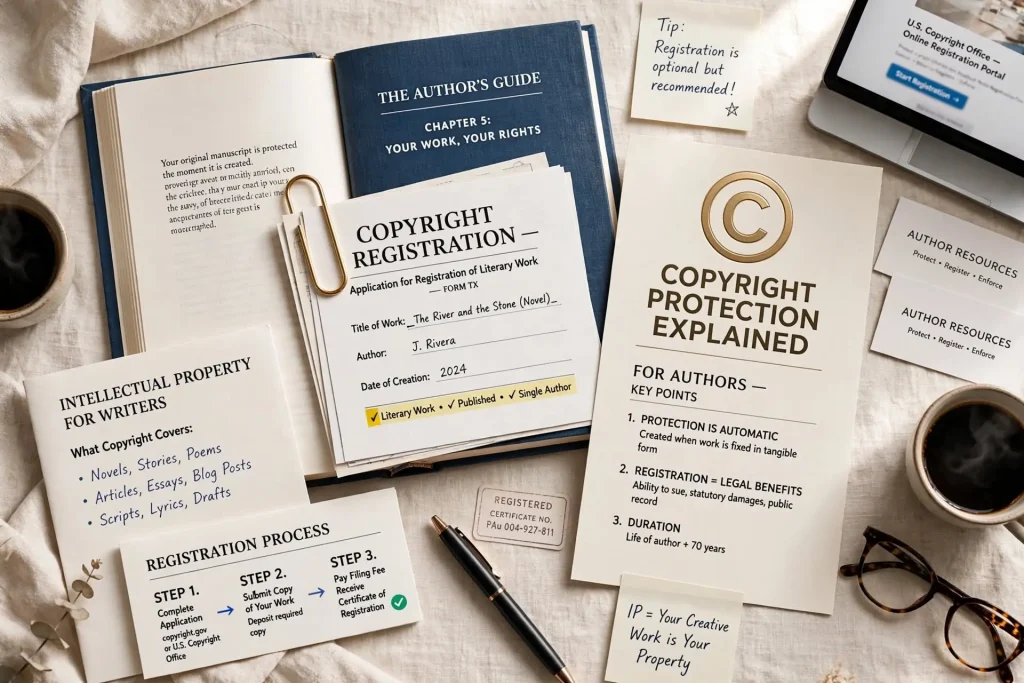
Most authors hold vague ideas about copyright. They know it exists. They know books are protected somehow. Beyond that, the specifics get fuzzy. Do you need to register? What does fair use actually allow? What about quoting other works? What happens if someone copies your book? The copyright books explained at the level authors actually need covers the practical realities of how copyright works for published authors and the specific decisions you face during your career.
This post walks through how copyright actually protects your work, the registration question, fair use boundaries, permissions for quoted material, and what to do when infringement happens.
How Copyright Actually Protects Your Work
Copyright protection begins automatically when you create the work. You don’t need to register, file paperwork, or do anything specific to have copyright protection on your manuscript.
Your copyright exists from the moment you fix the work in a tangible form. The instant you save the file, copyright protection applies.
The protection extends to your specific expression of ideas. Copyright doesn’t protect ideas themselves but protects how you specifically express them. The plot concept of “boy meets girl” isn’t protected. Your specific telling of a boy meeting a girl is protected.
The protection lasts for your lifetime plus 70 years in the United States (and most other countries). Your heirs continue to own the copyright after your death for that 70-year period.
The protection covers reproduction, distribution, derivative works, public performance, and public display. Others can’t legally copy your book, distribute it, create movies from it, or use it in other specific ways without your permission.
This automatic protection means you have legal standing to enforce your copyright even without registration. But registration provides specific advantages that matter for serious enforcement.
The Registration Question
While copyright exists automatically, formal registration with the US Copyright Office provides significant additional protections.
Registration creates public record of your copyright. The record provides evidence of your ownership in legal disputes.
Registration is required before you can sue for infringement in US federal court. Without registration, you can’t initiate a copyright lawsuit.
Registration within 3 months of publication (or before any infringement) allows you to claim statutory damages and attorney fees in successful lawsuits. Without timely registration, you can only claim actual damages, which are often hard to prove.
The cost is modest. Standard online registration costs $45 to $65 per work. Group registration of multiple unpublished works can reduce per-work cost.
The process. Online registration through copyright.gov. Submit the work, pay the fee, wait for processing (currently 6 to 12 months). The protection retroactively applies from the registration submission date.
For serious commercial publication, registration usually makes sense. The modest cost and the significant additional protections justify the investment.
Fair Use Boundaries
Fair use allows limited use of copyrighted material without permission under specific circumstances.
The fair use factors. Courts consider four factors when evaluating fair use claims. Purpose and character of the use (commercial versus educational, transformative versus simple copying). Nature of the copyrighted work (factual versus creative). Amount and substantiality of the portion used. Effect on the market for the original work.
What fair use typically allows. Brief quotations for criticism, commentary, or scholarship. Limited use for educational purposes. Transformative use that creates new meaning or purpose. Use of small portions where the use doesn’t harm the market for the original.
What fair use typically doesn’t allow. Quoting substantial portions of others’ work without permission. Using copyrighted material in ways that compete with the original’s market. Using material just because credit is given (attribution doesn’t substitute for permission).
The murky middle. Fair use is fact-specific and courts evaluate cases individually. Many uses fall in uncertain territory.
For most authors, the practical approach is to either keep quotations very brief, get explicit permission for longer use, or limit use to clearly transformative purposes.
The fair use evaluation often requires legal judgment beyond what authors can confidently assess themselves. When in doubt, consulting a publishing attorney is worth the modest cost.
Permissions for Quoted Material
When fair use doesn’t clearly apply, formal permissions become necessary.
Song lyrics require permission almost always. Even one line of a song lyric typically requires permission from the music publisher. Permission fees can run $50 to $5,000+ per song depending on the song and how it’s used.
Poems often require permission. Most contemporary poetry is protected and requires permission for use in your book.
Substantial prose excerpts from other books require permission. The line between fair use and required permission depends on length, purpose, and impact on the original market.
Images require permission unless they’re public domain or properly licensed. Photos, illustrations, and other visual content need clear permission for use.
How to get permissions. Identify the rights holder (often the publisher or the author’s estate). Contact them with specific information about your intended use. Negotiate fees if applicable. Document the granted permission in writing.
Lead time for permissions. Allow 6 to 12 weeks for permission requests. Some requests take much longer. Plan permissions during the writing or editing process rather than at the end.
Permission denials. Sometimes rights holders refuse permission or demand unreasonable fees. In these cases, you either find different material to use or accept that you can’t use the specific work you wanted.
Copyright Pages
Books include copyright pages with specific information.
Standard copyright notice format. © Year of First Publication by Author Name. All Rights Reserved.
ISBN information. The ISBN for that specific edition.
Publisher information. Even self-published books should include publisher information. The author’s business name or “Independently Published” works.
Edition information. First edition, second edition, etc., if applicable.
Disclaimer language. Standard disclaimer language about fiction characters being fictional, or nonfiction representing the author’s experience and opinions, depending on book type.
Permissions acknowledgments. If you’ve used material with permission, acknowledge the permissions in the copyright page or a separate permissions section.
Library of Congress information. For books distributed through major channels, Library of Congress Control Number (LCCN) can be requested. PCN (Preassigned Control Number) is the standard for self-publishers.
Translation rights notation if applicable. If you’ve sold rights for translations, note this on the copyright page.
The copyright page conventions exist because they communicate important information clearly. Following standard conventions makes your book look professional.
What to Do About Infringement
When someone copies or distributes your work without permission, several response options exist.
Document the infringement. Screenshots, URLs, dates, and other evidence. Save everything before contacting the infringer.
Send a cease and desist letter. Formal letter demanding the infringement stop. Often resolves issues without further escalation. Templates available online but legal review improves effectiveness.
DMCA takedown notices. For online infringement, DMCA takedown notices to hosting platforms often produce quick removal. Amazon, eBay, hosting providers, and others process DMCA notices regularly.
Direct contact. Sometimes the infringer is unaware they’re violating copyright. Direct contact may resolve issues amicably.
Legal action. For serious infringement with provable damages, lawsuits become an option. Requires copyright registration for federal court action.
The reality of enforcement. Most infringement enforcement involves takedown notices and cease-and-desist letters rather than lawsuits. The legal costs of lawsuits often exceed the recoverable damages for most authors.
Pirate sites. Books appear on pirate sites regularly. Authors face an ongoing battle. Many treat this as a fact of life rather than something they can fully prevent. Major pirate sites operate from jurisdictions where US enforcement is difficult.
Common Copyright Mistakes
Several patterns regularly cause copyright problems for authors.
Quoting too liberally without permission. Fair use is narrower than authors typically assume. Substantial quotations require permission.
Using song lyrics without permission. Even one line. The music industry actively enforces lyric rights.
Using images from Google searches. Most images online are copyrighted. Using them in commercial books creates real legal exposure.
Skipping copyright registration. Books worth publishing are typically worth registering. The $45 to $65 cost is modest compared to the additional protections.
Misunderstanding work-for-hire. Content created under work-for-hire agreements belongs to the hiring party, not the author. Authors hiring ghostwriters or contributing to anthologies should understand these arrangements.
Using public domain works incorrectly. Public domain works can be used freely but identifying what’s actually public domain isn’t always obvious.
Ignoring international copyright. Copyright laws vary between countries. Authors distributing internationally should understand the basics of how copyright works in their main markets.
Skipping the copyright page. Books without proper copyright information look amateur and create legal complications.
Mixing fair use and permissions inconsistently. Some content quoted with permission, other content quoted under fair use without clear distinction. The mixing creates problems if challenges arise.
Copyright Decisions That Affect Your Career
The copyright decisions you make early in your career often affect outcomes years later. The book you registered properly maintains stronger legal protection if problems arise. The permissions you handled carefully prevent issues that could otherwise consume time and money to address. The copyright pages you formatted professionally support the credibility your books need.
Authors who treat copyright as serious legal infrastructure tend to avoid the problems that catch unprepared authors. The few hours and modest fees required for proper copyright handling pay back when problems arise that would otherwise be expensive to address. Authors who treat copyright casually often discover the gaps in their protection only when they need protection that proper preparation would have provided. The basics of copyright handling aren’t complicated. Most authors can handle their own basic copyright work with reasonable diligence. But the diligence has to actually happen rather than being deferred indefinitely until problems force the attention that better preparation would have prevented.


