
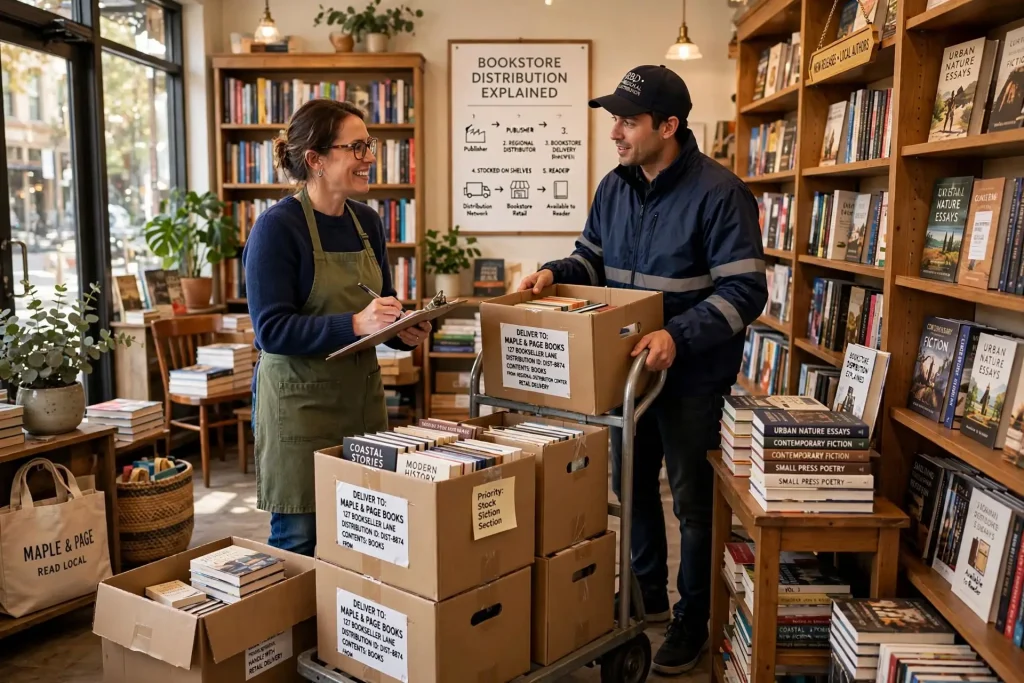
Most self-published authors discover early that bookstore distribution operates on completely different rules than online distribution. Amazon and other online retailers accept almost any properly formatted book. Physical bookstores filter much more aggressively. The bookstore distribution mechanisms aren’t a mystery once you know them, but they require working through specific channels and accepting specific terms that ebook distribution doesn’t involve. Authors who want their books in physical stores need to know how the channels work and which ones realistically produce results for self-published titles.
This post walks through the actual distribution channels that move books into physical bookstores, the wholesale model that drives the industry, and which approaches realistically work for indie authors.
What Bookstore Distribution Actually Means
Bookstore distribution is the chain of relationships and infrastructure that moves books from publishers and authors to physical retail locations where readers can buy them.
The chain typically involves the publisher or author at one end, a distributor or wholesaler in the middle, and retail bookstores at the other end. The intermediary handles inventory, fulfillment, and the financial relationships with retailers.
The wholesale model dominates the industry. Bookstores buy books from wholesalers at a discount off the retail price. The wholesaler buys from publishers or distributors at a larger discount. The publisher or author receives the smallest portion of the retail price after all these discounts work through.
This structure differs sharply from direct online distribution where the platform takes a fixed percentage and the rest flows to the author. The bookstore distribution model produces lower per-book royalties for authors but theoretically larger market reach.
The Wholesale Model
The wholesale model has specific mechanics that determine what authors actually earn from bookstore sales.
Wholesale discount. Bookstores typically buy books at 40% to 55% off the retail price. A book with a $15 list price might be sold to a bookstore at $7 to $9 wholesale.
Returnability. Most traditional bookstores buy books on returnable terms. Books that don’t sell can be returned to the wholesaler for refund. This protects the bookstore from inventory risk but creates uncertainty for authors and publishers.
Distributor margin. If there’s a distributor between the publisher and the wholesaler, the distributor takes a margin. This further reduces the final author payment.
Payment terms. Bookstores typically pay wholesalers 60 to 120 days after delivery. Authors receive their portion after another reporting and payment cycle.
The net result for self-published authors. A book listed at $15 might produce $1 to $3 in author royalty after all the discounts and intermediary cuts.
This math explains why many indie authors find the bookstore distribution math challenging compared to direct online sales where the same book might produce $6 to $8 in royalty per sale.
Ingram & Barnes & Noble Channels
The two main distribution channels that matter for self-published authors are Ingram Content Group and Barnes & Noble’s distribution network.
Ingram is the largest book wholesaler in the United States. Independent bookstores, libraries, and many other retailers source books primarily through Ingram. Books in Ingram’s catalog can be ordered by any of these retailers.
Barnes & Noble operates its own distribution system for stocking its retail stores. Books not in B&N’s system can’t easily appear in B&N stores even if they’re available through Ingram.
For self-published authors, Ingram access typically comes through IngramSpark. The platform provides access to Ingram’s distribution catalog and allows independent retailers to order author books on the standard wholesale terms.
Barnes & Noble access is more challenging for indie authors. B&N’s buying process for its physical stores typically requires sales rep relationships and proven sales velocity. Most self-published books don’t make it into B&N’s physical stores even when they’re available through B&N online.
The practical implication. IngramSpark provides realistic distribution access to independent bookstores and libraries. Mass market bookstore chain placement remains difficult for most self-published authors.
IngramSpark as Distribution Access
IngramSpark is the main route for self-published authors to access bookstore distribution.
Setup process. Authors upload print-ready files to IngramSpark. Initial setup fee runs $49 per book (currently waived through certain partner programs). Books must meet IngramSpark’s quality and content standards.
Wholesale discount setting. Authors choose their wholesale discount, typically 40% to 55%. Lower discount produces higher author royalty per book but reduces bookstore appeal. Higher discount produces lower author royalty but increases the chance bookstores will stock the book.
Returnability setting. Authors can choose returnable or non-returnable terms. Returnable terms increase bookstore willingness to stock but create author exposure to possible returns. Non-returnable terms reduce bookstore interest but eliminate return risk.
Catalog inclusion. Books in IngramSpark appear in Ingram’s master catalog accessible to any retailer that uses Ingram. This is the key access mechanism that gets self-published books into the catalog independent bookstores order from.
The catch. Catalog availability isn’t the same as actual stocking. Independent bookstores order books that customers request or that the store buyer decides to stock proactively. Books in the catalog that nobody knows about don’t get ordered.
Independent Bookstore Distribution
Independent bookstores represent the most realistic bookstore distribution opportunity for self-published authors.
The local connection matters. Authors who live in or near a city where independent bookstores operate can build relationships with those stores directly. Author events, signing sessions, and local press coverage all make local bookstore placement more likely.
Direct outreach to indies. Email or visit local independent bookstores. Discuss carrying your book. Provide professional sales sheet with cover, description, and ordering information through Ingram.
Author events. Bookstores often agree to stock books for confirmed author events. The event drives in-store sales that justify the bookstore’s inventory commitment.
Consignment alternative. Some independent bookstores will accept books on consignment from local authors. The author provides copies, the bookstore displays and sells them, the bookstore keeps a percentage (typically 40% to 50%), the author retrieves unsold copies after a set period.
Regional patterns. Some regions have stronger independent bookstore networks than others. Authors in regions with active indie bookstore scenes have more distribution options than authors in regions where indies are rare.
Library Distribution Channels
Libraries are sometimes overlooked as bookstore distribution targets but represent meaningful sales opportunities.
Public library systems purchase books through wholesalers (Ingram, Baker & Taylor, and others). Books in these wholesale catalogs can be ordered by libraries.
Library purchases at retail price. Libraries pay close to retail rather than the wholesale discount that bookstores receive. This produces better author royalty per library sale.
OverDrive and Hoopla for digital library lending. These platforms license ebooks and audiobooks to libraries for patron lending. Authors receive royalties for each lending event.
Library marketing differs from bookstore marketing. Library Journal, Booklist, and other library-focused publications drive library purchasing decisions. Direct outreach to librarians can also work for authors with relevant content.
For nonfiction authors with topics libraries cover (business, parenting, health, history), library distribution often produces meaningful sales that wouldn’t appear in trade bookstore channels.
Consignment Arrangements
Consignment is a specific distribution model worth knowing about.
Structure. The author provides physical books to the bookstore. The bookstore displays and sells them. The bookstore keeps a percentage of each sale (typically 40% to 50%). Unsold books return to the author after the consignment period ends.
The author bears inventory risk. Books that don’t sell come back to the author, who has to find other uses for them.
Best for local relationships. Consignment works most often with local independent bookstores willing to support local authors.
Less common with chain stores. Major bookstore chains typically don’t accept consignment. They want books through their established distribution and inventory systems.
The administrative overhead. Consignment requires ongoing inventory tracking, periodic reconciliation, and physical book handling. Authors with multiple consignment relationships often find the administrative burden significant.
Direct to Store Sales
Some authors handle bookstore distribution by selling books directly to stores rather than working through wholesalers.
The author maintains book inventory. Bookstores order copies directly from the author. The author ships books to the bookstore at the wholesale discount.
This model works for hyper-local distribution and specialty bookstores. Stores that specifically support local authors or that fit narrow genre niches sometimes prefer the direct relationship.
Author benefits. Higher per-book payment because no intermediary takes a cut. Direct relationship with the bookstore that can produce ongoing sales.
Author costs. Inventory carrying costs. Shipping logistics. Invoicing and payment collection. Administrative time for each relationship.
For most authors, direct-to-store sales make sense for 1 to 5 carefully chosen relationships rather than as a primary distribution strategy.
Distribution Decisions That Compound Over Years
The bookstore distribution decisions you make in your first year typically affect your career for many years afterward. Authors who set up IngramSpark with returnable terms and a 55% discount sometimes regret the choice when they realize the math on per-book royalties. Authors who skip IngramSpark entirely sometimes regret the loss of indie bookstore access years later when their writing career matures.
The strategic question isn’t “should I be in bookstores” as a binary yes or no. It’s “what mix of distribution channels makes sense for my specific career goals.” Some authors thrive entirely through online channels and never invest in physical bookstore distribution. Others find that local indie bookstore relationships, library distribution, and specialty store placement add meaningful income and credibility even when the per-book economics are lower than online sales. Most authors should at least set up IngramSpark to keep the option available, then decide over years if they want to actively pursue bookstore relationships based on how their career and audience develops. The decision made deliberately, after knowing how the channels actually work, tends to produce better outcomes than the decision made by default in either direction.


