
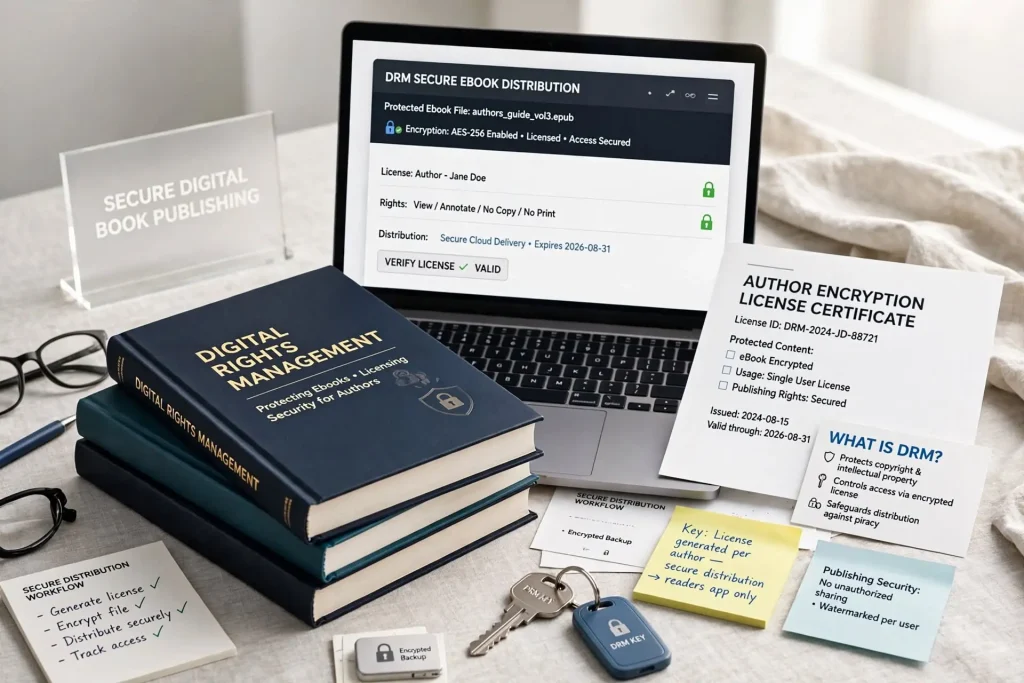
Most authors face the DRM decision at upload without clear information about what it actually does, who it actually helps, and what trade-offs it produces. They check or uncheck the box based on vague impressions about piracy protection. The reality of digital rights publishing involves specific trade-offs between piracy protection and reader experience that deserve more careful evaluation than authors typically give them. The decision affects readers significantly even when authors don’t think about it carefully.
This post walks through what DRM actually does, the arguments for and against it, the reader experience implications, and how to make the DRM decision deliberately rather than by default.
What DRM Actually Does
DRM (Digital Rights Management) is technology that restricts how ebooks can be used after purchase.
The basic function. DRM locks ebooks to specific reader applications or accounts. Locked files can’t easily be transferred between different ebook reader apps or shared with others.
Amazon’s DRM specifically. Amazon’s DRM ties Kindle ebooks to Amazon accounts. Files can’t be transferred to non-Kindle reading applications without breaking the DRM (which is technically illegal under DMCA).
Other platform DRM. Apple Books, Barnes and Noble, and Kobo each have their own DRM systems with their own restrictions.
What DRM prevents. Casual copying and sharing. Easy transfer between platforms. Simple file extraction for redistribution.
What DRM doesn’t prevent. Determined piracy. Books appear on pirate sites within days of major releases regardless of DRM. Technical users can strip DRM from most ebook files relatively easily.
The functional limit. DRM provides modest friction against casual sharing but doesn’t seriously impede determined piracy. The protection it offers is mostly against casual rather than committed copyists.
Arguments For DRM
Several arguments support enabling DRM on your books.
Casual sharing reduction. DRM prevents easy ebook sharing between friends and family. The reduced casual sharing may translate to modest sales benefits.
Industry standard expectations. Some platforms and major publishers expect DRM as default. Going without it can signal nonconformity.
Subscription service compatibility. Kindle Unlimited and similar services require specific DRM configurations. Books wanting KU enrollment need DRM compatibility.
Library lending control. Library systems sometimes prefer DRM for their lending models. Wide distribution to libraries may require DRM.
Psychological deterrent. Even imperfect DRM may psychologically discourage some sharing that might otherwise occur.
Platform requirement compliance. Some platforms automatically apply DRM regardless of author preference. The author can’t opt out on those platforms.
These arguments have merit but vary in strength. Some carry significant weight. Others have weaker basis than they initially appear.
Arguments Against DRM
Other arguments support disabling DRM when possible.
Limited actual effectiveness. DRM doesn’t seriously impede determined piracy. The protection it provides is more theoretical than practical.
Reader experience friction. DRM creates real friction for legitimate readers. Format conversions, platform changes, and device transfers all become harder with DRM.
Legitimate reader limitations. Readers who legally purchased books face restrictions on how they can use those purchases. The restrictions feel anti-customer.
Authors selling without DRM. Many indie authors disable DRM on their books and report no significant piracy increase relative to DRM-enabled alternatives.
Tor and Baen examples. Several traditional publishers (notably Tor and Baen) have released books without DRM and reported strong commercial results.
The piracy reality. Books face piracy regardless of DRM status. The pirate sites get content from various sources and DRM doesn’t significantly affect availability.
The customer trust signal. Some readers actively prefer DRM-free books. Indicating DRM-free status can attract these readers.
These counter-arguments have substantial merit, particularly for authors prioritizing reader experience over theoretical piracy protection.
Reader Experience Implications
DRM affects legitimate readers in specific ways that matter for satisfaction and loyalty.
Format conversion barriers. Readers who want to convert ebooks to different formats (for different devices or accessibility needs) face restrictions with DRM-enabled books.
Cross-platform access difficulties. Readers who want to read across multiple platforms face friction. The Kindle book can’t easily move to Apple Books, for example.
Account dependency. DRM ties books to specific accounts. Account problems can result in losing access to legally purchased books.
Long-term access concerns. DRM systems depend on continued platform operation. If Amazon ever shuts down Kindle, what happens to DRM-locked Kindle books?
Accessibility tool limitations. Some readers use accessibility tools (screen readers, text-to-speech) that may have difficulty with DRM-locked files.
Inheritance and gifting issues. DRM-locked books can’t easily be passed to family members or gifted to others.
Each friction point affects some readers. The cumulative effect across all readers significantly affects overall reading experience.
The Piracy Reality
Knowing the actual piracy world helps inform DRM decisions.
Books appear on pirate sites quickly. Major releases appear on pirate sites within days of publication regardless of DRM status.
DRM stripping is widely available. Tools to strip DRM from major ebook formats exist and circulate widely. The technical barrier isn’t significant for determined pirates.
Pirate sites operate from various jurisdictions. Many operate from countries where US legal action is difficult. Enforcement is challenging.
Pirate users have specific characteristics. Some research suggests pirate users overlap less with legitimate buyers than publishers fear. Pirates often weren’t going to buy at all rather than substituting piracy for purchases.
The display vs distribution distinction. Some piracy involves making books available for download. Other piracy involves direct text scraping for AI training or other uses. DRM addresses primarily the first type.
The pirate ecosystem. Sophisticated pirate operations exist. They have their own quality control, their own community standards, and their own dynamics. They function largely independently of DRM status.
Authors who clearly understand the piracy reality tend to make different DRM decisions than authors operating on vague impressions about what DRM actually accomplishes.
When DRM Makes Sense
Specific situations make DRM enabling reasonable.
Genre-specific patterns. Some genres see more casual sharing than others. Romance has specific patterns that may benefit modestly from DRM. Niche nonfiction may have other patterns.
Audience overlap with casual sharers. If your audience demographic shares ebooks casually with friends and family, DRM may reduce this casual sharing meaningfully.
Subscription service participation. KU enrollment requires DRM-compatible configurations. Authors enrolled in KU effectively have DRM on those books.
Major platform default behaviors. Some platforms apply DRM automatically regardless of preference. The author has limited choice.
Risk-averse positioning. Authors who prefer protection (even theoretical) over reader convenience may reasonably choose DRM.
Each of these situations has merit. DRM isn’t universally wrong. The specific context affects the right decision.
When Going DRM Free Makes Sense
Other situations support disabling DRM when possible.
Reader experience prioritization. Authors prioritizing reader experience over theoretical piracy protection often choose DRM-free.
Tech-savvy audiences. Audiences likely to encounter DRM restrictions in their normal use cases benefit from DRM-free options.
Wide distribution focus. Authors prioritizing wide reach over Amazon-specific tools may choose configurations that allow more reader flexibility.
Direct sales emphasis. Authors selling direct from their websites can offer DRM-free copies as advantage over retailer purchases.
Community trust building. Some author communities specifically value DRM-free positioning as customer-friendly stance.
International market access. Some international markets have different DRM expectations. DRM-free positioning can support international reach.
The choice isn’t binary across the catalog. Some authors choose DRM for some titles and DRM-free for others based on specific situational factors.
Making the Decision
The DRM decision involves several specific considerations.
Honest assessment of piracy risk. Will DRM actually meaningfully reduce piracy of your specific books? Or is the protection mostly theoretical?
Reader experience evaluation. How important is reader convenience for your audience? Will DRM-related friction damage their experience meaningfully?
Platform-specific defaults. What platforms will you distribute on? Their default DRM behaviors affect your effective choice.
Genre-specific norms. What do successful authors in your genre typically do? The norms vary by genre.
Personal philosophy considerations. Some authors have philosophical preferences for or against DRM. The personal alignment matters.
Catalog-wide consistency. Treating all your books consistently usually simplifies operations. Mixed DRM status across catalog can create complexity.
Authors making the decision deliberately tend to be happier with the outcomes than authors who default into whichever option they unthinkingly check at upload.
Making the DRM Decision Deliberately
The DRM choice affects readers significantly even when authors don’t think carefully about it. Default decisions made without consideration often produce outcomes that don’t serve either authors or readers as well as deliberate decisions would. The few minutes invested in actually thinking through the DRM trade-offs typically produce better outcomes than the default checking-the-box approach most authors use.
The right decision depends on your specific situation rather than universal best practices. Some authors should enable DRM. Some shouldn’t. The deciding factors involve your genre, your audience, your distribution strategy, your reader experience priorities, and your personal philosophy about copyright and customer relationships. Authors who think through these factors specifically tend to make decisions they can defend if asked and that align with their broader publishing strategy. Authors who default into DRM choices without consideration often end up with configurations that don’t actually match their strategic priorities. Whichever direction you choose, choosing it deliberately matters more than the specific choice itself. The DRM decision is part of how you treat your readers, and treating it as serious decision rather than upload formality affects the overall reader experience your books provide.


