
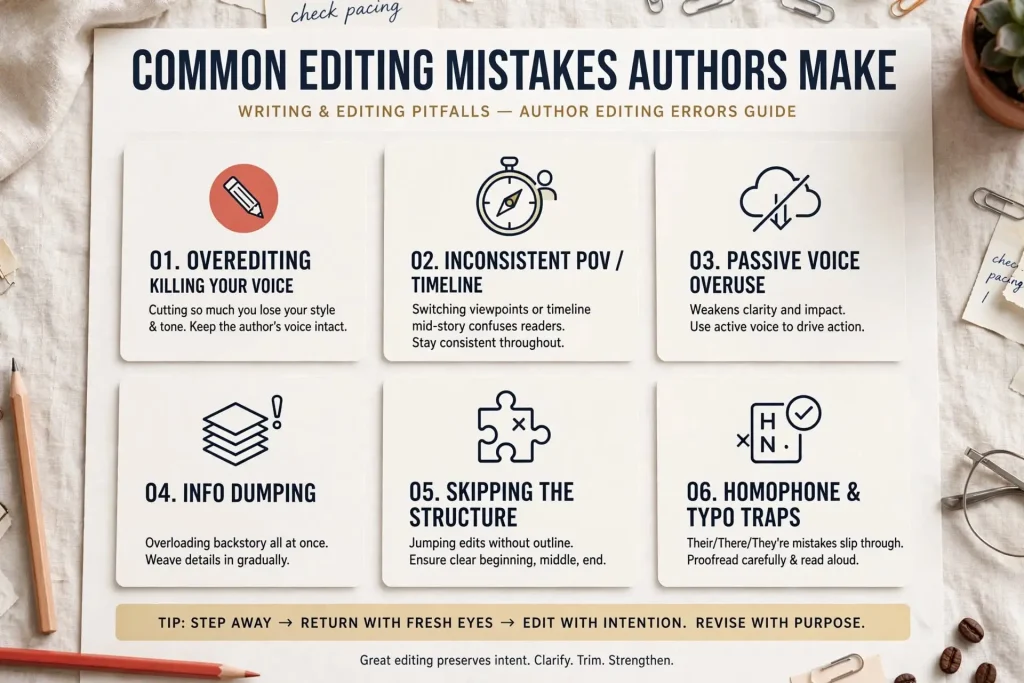
Most authors approach editing without recognizing the patterns of mistakes that consistently produce inferior outcomes. They rush the process. They skip stages. They hire wrong editor types. They under-revise between stages. The same mistakes recur across thousands of indie author publishing operations and produce predictable damage. The editing mistakes authors make aren’t random. They’re identifiable patterns that knowledge can address. Authors who learn the common mistakes can avoid them in their own publishing operations and produce significantly better edited books.
This post walks through the specific editing mistakes that recur most often, why each one happens, and how to avoid them.
Where Author Editing Mistakes Happen
Editing mistakes happen at specific decision points in the publishing process.
The editing decision phase. Mistakes about the choice to edit, when to edit, and how much to invest in editing.
The editor selection phase. Mistakes about which editor type to hire, how to evaluate editors, and which specific editor to work with.
The manuscript preparation phase. Mistakes about manuscript readiness before sending to editors.
The editor collaboration phase. Mistakes about how to work productively with editors during the process.
The revision phase. Mistakes about how to revise based on editor feedback.
The stage sequencing phase. Mistakes about the order of editing stages and time between them.
The completion judgment phase. Mistakes about when editing is actually finished.
Each phase has its own typical mistakes. Authors who know the patterns can address them systematically rather than rediscovering them through painful experience.
Rushing the Process
The most common editing mistake is rushing through the process.
The unrealistic timeline mistake. Authors who plan editing as quick step after writing usually allocate insufficient time. Quality editing takes weeks or months.
The skipped distance period. Authors who edit immediately after finishing first draft can’t see the work clearly enough to edit effectively.
The rushed editor selection. Authors who hire the first editor available rather than finding the right editor for their book.
The compressed revision time. Authors who revise quickly after receiving editor feedback miss opportunities to address issues properly.
The launch-pressure compression. Authors with pre-announced launch dates often rush editing to meet dates. The launch date usually shouldn’t drive editing timeline.
The next-book rush. Authors eager to start next project often shortchange current book editing. The lost quality affects sales of current book.
The publication delay anxiety. Some authors feel pressure to publish quickly because they’ve delayed already. Continuing to delay for proper editing usually serves better than rushing inadequately edited book to market.
Rushing damages editing outcomes consistently. Authors who give editing adequate time produce significantly better books than authors who rush.
Skipping Editing Stages
Skipping editing stages produces predictable problems.
The developmental editing skip. Authors who skip straight to copy editing often have structural problems no amount of copy editing can fix.
The line editing skip. Authors who go from developmental to copy editing miss the prose-level work line editing addresses.
The copy editing skip. Authors who go from line editing to proofreading miss mechanical issues line editing doesn’t address.
The proofreading skip. Authors who consider line and copy editing as final miss the typo-catching proofreading provides.
The beta reader skip. Authors who skip beta readers miss feedback that improves manuscripts before professional editing.
The professional editor skip entirely. Authors who try to self-edit to publication-ready quality usually fail.
The sensitivity reader skip when needed. Books dealing with specific communities benefit from sensitivity reader review.
The fact-checking skip. Nonfiction and certain fiction benefit from fact-checking that authors often skip.
Each skipped stage produces specific problems the skipped stage would have addressed. Authors trying to save money by skipping stages often produce books that cost more in lost sales than the skipped stages would have cost.
Wrong Editor Type Selection
Authors often hire wrong editor types for their specific needs.
The developmental editing as proofreading mistake. Authors who hire developmental editors expecting line-level work get strategic feedback they may not want.
The proofreading as developmental editing mistake. Authors who hire proofreaders expecting structural feedback get only surface-level work.
The fiction editor for nonfiction mistake. Editors specializing in fiction often aren’t strong for nonfiction work, especially specialized nonfiction.
The genre mismatch. Editors strong in literary fiction may not understand genre conventions for romance, thriller, or other commercial fiction.
The generalist for specialized content mistake. Highly specialized content (technical, medical, legal) benefits from editors with subject expertise.
The wrong career-stage editor. Top-tier editors may be overkill for first books. Budget editors may be insufficient for serious commercial work.
The friend or family editor mistake. Authors who use friends or family for editing rarely get the professional perspective they need.
The student or beginner editor mistake. Hiring inexperienced editors to save money usually produces inadequate editing.
Editor selection requires matching editor capabilities to specific book needs. The wrong match produces poor results regardless of editor quality in absolute terms.
Insufficient Revision Between Stages
Authors often revise inadequately between editing stages.
The cosmetic revision mistake. Authors who address only specific items editors mentioned without revisiting connected elements.
The defensive revision mistake. Authors who push back against editor feedback rather than addressing the underlying issues.
The over-revision mistake. Authors who rewrite entire books based on editing feedback, often creating new problems.
The selective acceptance mistake. Authors who accept some feedback while ignoring related feedback, producing inconsistent revisions.
The misinterpreted feedback mistake. Authors who address what they think editors meant rather than what editors actually meant.
The time-pressured revision mistake. Authors who revise too quickly to address feedback adequately.
The single-revision mistake. Authors who consider one revision pass sufficient when multiple passes are needed.
The editor unavailable for clarification mistake. Authors who don’t ask editors to clarify ambiguous feedback.
Revision quality affects how editing translates to manuscript improvement. Poor revision wastes editing investment.
DIY Beyond Capability
Some authors attempt DIY editing beyond what their actual skills support.
The overconfidence pattern. Authors who think their writing is stronger than it actually is often DIY-edit to inadequate quality.
The blind spot reality. Authors can’t see their own work objectively. DIY editing typically misses what professional editors would catch.
The skill development illusion. Authors who think reading editing books or taking courses prepares them for professional-level editing usually overestimate their skill development.
The friend feedback substitution. Authors who treat friend feedback as professional editing substitute don’t get the professional perspective they need.
The beta reader substitution. Beta readers provide valuable feedback but aren’t editor substitutes.
The AI editor substitution. AI tools help but don’t replace human professional editing.
The repeated DIY across catalog. Authors who DIY-edit one book and see acceptable results sometimes extrapolate to all subsequent books, producing weaker books over time.
The DIY exception authors. Authors with genuine editing background can DIY at higher levels than typical authors. They’re exceptions, not the rule.
DIY editing has its place (self-editing before professional review) but rarely produces publication-ready quality.
Friend Editing Substitution
Many authors substitute friend feedback for professional editing.
The friend qualification reality. Friends rarely have professional editing skills regardless of their reading enthusiasm.
The friend bias problem. Friends want to be supportive. Their feedback often skews positive rather than accurate.
The friend feedback limitations. Friends may identify issues but typically can’t articulate how to fix them.
The friend feedback frequency. Friends rarely provide the focused attention professional editing requires.
The friend relationship preservation. Friends often soften feedback to preserve relationships. Honest feedback gets diluted.
The friend genre knowledge limitations. Friends may not know your genre’s specific conventions and expectations.
The friend craft knowledge limitations. Friends typically don’t have craft vocabulary for technical editing concepts.
The friend time investment limitations. Editing takes serious time. Friends usually can’t or won’t invest that time.
Friend feedback has its place (initial reactions, broad impressions) but isn’t editing substitute.
AI Tool Over Reliance
Authors increasingly rely on AI tools beyond what those tools actually deliver.
The AI grammar checker limitations. AI catches some grammar issues but misses many. Doesn’t replace human grammar review.
The AI style suggestion limitations. AI style suggestions often flatten distinctive voice rather than supporting it.
The AI developmental editing limitations. AI can identify some structural issues but doesn’t provide the strategic perspective developmental editors offer.
The AI creativity gap. AI can identify problems but typically can’t suggest the creative solutions humans provide.
The AI consistency mistakes. AI may suggest changes that conflict with other parts of the manuscript.
The AI factual hallucinations. AI may suggest factual changes that are actually wrong.
The AI tone deafness. AI sometimes misses tonal nuances that humans catch.
The AI as full editing substitute mistake. AI assists editing but doesn’t replace professional editing.
AI tools provide value as supplement but not substitute. Authors who rely entirely on AI typically produce inadequately edited work.
Budget Misallocation
Authors often allocate editing budgets in suboptimal ways.
The all-budget-to-cover mistake. Authors who spend entire budget on cover with minimal editing investment produce books that look professional but read amateur.
The all-budget-to-marketing mistake. Authors who skip editing to fund marketing spend produce books that don’t reward the marketing effort.
The under-budgeting for editing. Authors who allocate insufficient budget for editing produce inadequate editing.
The over-budgeting for one stage. Authors who spend everything on one editing stage and skimp on others produce uneven editing.
The wrong stage prioritization. Authors who prioritize proofreading over developmental editing miss bigger improvement opportunities.
The first-book over-investment. Authors who invest everything in first book editing without budget for subsequent books damage long-term sustainability.
The catalog-wide under-investment. Authors who consistently underinvest in editing across their catalog produce careers that plateau below their writing skill.
Budget allocation affects editing outcomes significantly. Strategic allocation typically produces better results than equal distribution across categories.
Hidden Editor Quality Variations
Editor quality varies more than authors typically recognize.
The credential limitation. Editor credentials don’t guarantee specific quality. Strong credentials sometimes accompany weak work. Weaker credentials sometimes accompany strong work.
The portfolio review necessity. Editor portfolios reveal actual capabilities. Authors who skip portfolio review often get surprises.
The sample edit value. Sample edits reveal actual editor approach. Most strong editors offer sample edits.
The reference check value. Talking to other authors who’ve worked with specific editors reveals capabilities credentials don’t.
The genre-specific quality. An editor strong in one genre may be weak in another. Author should verify genre fit.
The communication style fit. Editor communication style affects working relationship. Mismatch creates ongoing friction.
The price-quality correlation limitation. Higher prices don’t guarantee higher quality. Lower prices don’t guarantee lower quality.
The geographic concentration mistakes. Authors who only consider local editors may miss better matches elsewhere.
Editor quality verification requires specific work. Authors who hire editors without verification often produce poor results.
Communication Failures with Editors
How authors communicate with editors affects results significantly.
The unclear brief mistake. Authors who don’t clearly communicate what they want produce editing that doesn’t match their needs.
The defensive response mistake. Authors who respond defensively to feedback damage editing collaboration.
The micromanagement mistake. Authors who specify editing approach too rigidly prevent editors from doing their best work.
The hands-off mistake. Authors who provide too little guidance leave editors guessing about author intent.
The midway change mistake. Authors who change editing scope or approach midway through projects damage outcomes.
The feedback delay mistake. Authors who don’t respond promptly to editor questions slow projects and damage quality.
The acknowledgment failure. Authors who don’t acknowledge editor contributions damage professional relationships.
The renegotiation mistakes. Authors who try to renegotiate fees or scope after work begins damage relationships and future opportunities.
Strong editor relationships develop through clear communication and professional collaboration.
Building Better Editing Habits Across Books
The editing mistakes covered in this post are all preventable. Authors who recognize the patterns and develop better habits across their careers tend to produce books that improve over time. Authors who repeat the same mistakes across multiple books often produce careers that don’t reflect their actual writing ability.
The habits that prevent these mistakes develop with conscious attention rather than appearing automatically. The author who plans realistic editing timelines from first book onward. The author who learns editor selection skills early. The author who develops productive editor collaboration habits. These approaches don’t appear automatically but they’re learnable. The investment in developing these habits pays back across decades of subsequent publishing work. Authors building publishing careers benefit from treating editing as serious professional discipline rather than as expense to minimize or task to rush through. The habits established with early books continue across subsequent books and support increasingly professional work over time. The pattern of recurring mistakes typically traces to treating editing casually rather than as serious work deserving careful attention. Authors who change this orientation typically see their editing outcomes change correspondingly. The change isn’t dramatic but compounds across many books into significantly different career trajectories than continuing the casual approach would produce.


