
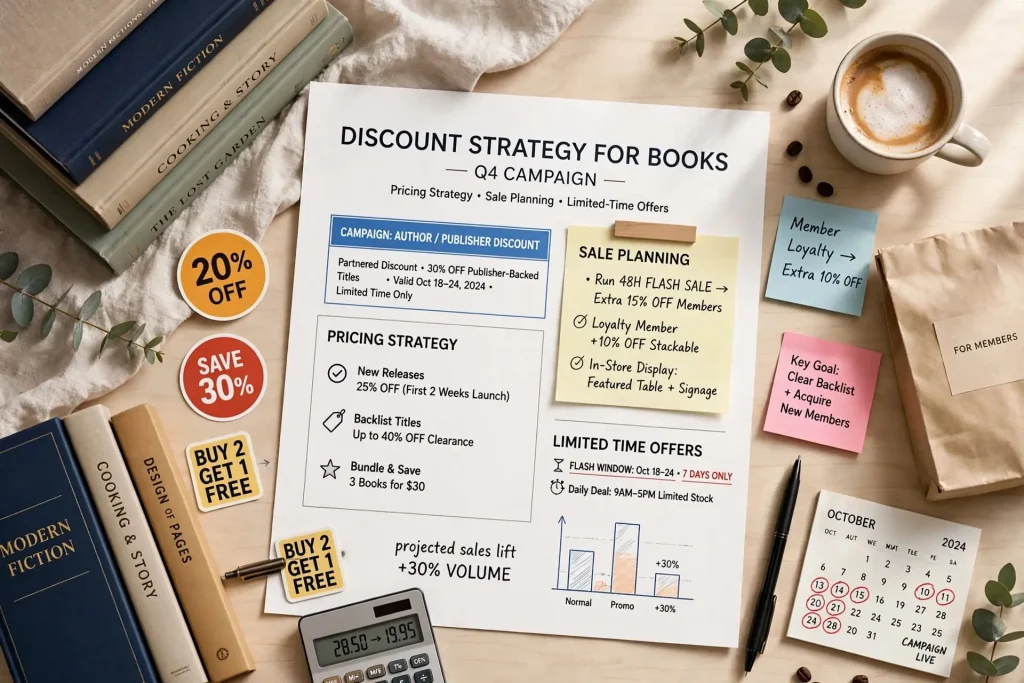
Most authors approach book discounts reactively. Sales slow down, they panic-discount. Promotional sites accept submissions, they discount to qualify. Other authors discount, they discount in response. The discounting accumulates without strategic framework, often producing weaker results than planned discount strategy would. The book discount strategy that actually drives sustainable sales involves specific decisions about when to discount, how deeply, on what platforms, and how to maintain pricing dignity across years. Authors who develop systematic discount strategy tend to extract more value from each promotional cycle than authors who discount reactively.
This post walks through when discounts actually serve sales strategy, how to structure discount campaigns, and how to avoid the patterns that turn discounting from sales driver into sales drag.
Why Discounts Work When They Work
Specific mechanisms make discounting effective in certain situations.
Price sensitivity in the audience. Most book buyers respond to price changes. Lower prices produce more purchases from the same browsing traffic.
Urgency creation. Limited-time discounts create urgency that drives concentrated purchase activity. Permanent low prices don’t create the same urgency.
Marketing efficiency. Discounted books make marketing more efficient. The same advertising spend produces more sales when prices are lower.
Algorithm signaling. Concentrated sales velocity during discounts signals to platform algorithms. The signal can produce continued algorithmic visibility after the discount ends.
Series read-through driving. Discounted first-in-series books drive readers into series. The series read-through revenue often exceeds the discount loss.
Audience building through discounted entry. New readers entering through discounted purchases can become long-term audience. The lifetime value can justify discount-driven entry.
These mechanisms work when applied strategically. Random discounting without strategic purpose often fails to achieve any of these benefits while damaging perceived value.
When Discounts Actually Drive Sales
Specific situations make discounting strategically valuable.
Series first-book promotion. Discounting first-in-series books to $0.99 or free can drive series read-through that significantly exceeds the discount cost.
Launch coordination. Discounts during launch windows can drive concentrated sales velocity that produces algorithmic ranking boosts.
Promotional placement requirements. Major promotional sites (BookBub, ENT, others) require discounted prices for placement consideration.
New book promotion via backlist discount. Discounting backlist titles can drive readers into the catalog who then buy new releases at full price.
Seasonal promotion alignment. Holiday-themed books, beach reads, back-to-school content can benefit from season-aligned discounts.
Anniversary and milestone promotions. Book anniversaries, milestone sales numbers, or other significant moments can support promotional discounts.
Cross-promotion arrangements. Coordinated promotions with other authors. Both authors discount and mail each other’s lists.
Sales velocity recovery. Books that have lost ranking can sometimes be revived through promotional discount campaigns.
Each of these situations provides specific strategic rationale for discounting. The discount serves identifiable purpose rather than just reducing prices for unclear reasons.
When Discounts Hurt More Than Help
Other situations make discounting counterproductive.
Reactive panic discounting. Discounting because sales feel slow without strategic framework usually produces inferior results.
Permanent low pricing. Books at permanently discounted prices lose the urgency mechanism that makes discounts work. Permanent low price is just low price.
Discounting strong-conversion books. Books that convert well at full price might lose revenue when discounted. The conversion strength means the discount loss isn’t justified.
Discounting without promotional support. Discounted books without marketing activity to drive traffic often see modest sales lift that doesn’t justify the discount.
Random discount timing. Discounts at random times when no specific strategic purpose exists waste the promotional opportunity.
Premium positioning books. Books positioned as premium offerings lose positioning value when discounted. The discount damages future pricing.
Books with weak conversion fundamentals. Books with weak covers, descriptions, or other conversion factors don’t benefit from discounting. The fundamental issues need addressing first.
Books in non-price-sensitive genres. Business books, certain literary fiction, and other genres see less price sensitivity. Discounts produce smaller effects.
Recognizing when not to discount matters as much as knowing when to discount.
Discount Depth Decisions
How deeply to discount affects results.
The 99-cent positioning. The deepest standard discount level. Drives maximum impulse purchases but at minimal royalty.
The $1.99 middle position. Some discount, some royalty preservation. Less impulse purchasing than $0.99 but better per-sale revenue.
The $2.99 royalty threshold. Above this maintains 70% royalty. Below requires accepting 35% royalty rate.
Modest discounts from regular price. $4.99 book discounted to $3.99. Less promotional impact but maintains positioning.
Free promotions. Limited-duration free pricing through KDP Select. Drives massive volume but no direct revenue.
Each depth choice serves different strategic purposes. Match the depth to the goal of the specific promotion.
Discount Timing Strategy
When to schedule discounts affects their effectiveness.
Pre-planned promotional calendars. Mapping promotional cycles in advance produces better results than reactive scheduling.
Quarterly promotional cycles. Many authors run major promotional pushes quarterly. The cadence allows time for inventory rebuilding between cycles.
Major promotional placement timing. Schedule discount cycles around major promotional placement bookings. BookBub Featured Deals especially worth planning around.
Seasonal timing. Holiday-themed books benefit from holiday timing. Beach reads from summer. Match content to season.
Launch coordination. New book launches can coordinate with backlist discounts that drive readers to the new release.
Year-end and new year periods. Specific promotional windows produce different results than mid-year promotions.
Competitor discount monitoring. Awareness of when major competitors discount affects when your own discounts maximize impact.
The timing decisions matter as much as the depth and duration decisions. Strategic timing produces better results than random scheduling.
Platform Specific Discount Approaches
Different platforms support different discount approaches.
KDP Select promotional tools. Free promotion days and Kindle Countdown Deals. Specific tools available to enrolled books.
Wide distribution discount handling. Authors distributing wide need to coordinate discounts across platforms. Aggregators help with this.
Direct sales promotions. Authors with direct sales can offer specific promotions that retail platforms don’t allow.
Library platform considerations. Library promotional opportunities exist that retail-focused authors miss.
International discount considerations. Different markets may benefit from different discount approaches.
Each platform’s specific tools and conventions affect optimal discount strategy. Authors should understand platform-specific options rather than applying single approach universally.
The Psychology of Book Discounting
Discount psychology affects how readers respond to promotional pricing.
The bargain trigger. Some readers actively seek bargain books. Discount-targeting promotional sites cater to this audience.
The fear of missing out. Limited-duration discounts create FOMO that drives purchase decisions.
The perceived value relationship. Significantly discounted books may signal low perceived value. The relationship between price and quality assumptions affects buyer reactions.
The frequent discounter problem. Authors who frequently discount train readers to wait for sales. The training reduces full-price purchases.
The premium positioning damage. Frequent discounting damages premium positioning that supports higher full prices.
The discount fatigue effect. Readers exposed to many discounts can become desensitized to promotional pricing.
The psychology suggests strategic discount use rather than constant discount availability. Discounts should feel like opportunities rather than expected default.
Maintaining Pricing Dignity
Strategic discounting preserves long-term pricing power.
Predictable discount patterns. Discounts at predictable intervals (quarterly, semi-annually) allow regular promotional cycles without training readers to constantly wait for sales.
Limited-duration discounts. Discounts that end on specific dates create urgency without training expectation of always-available low pricing.
Strategic discount depth. Modest discounts maintain positioning better than dramatic discounts. Match depth to specific promotional purpose.
Selective discount applications. Some books in catalog discounted while others maintain full pricing. The selectivity maintains overall pricing structure.
Discount with promotional value. Discounts tied to specific events or purposes feel intentional rather than desperate.
Recovery to full price. Returning to full pricing after discount cycles maintains the price structure that supports full-price sales.
Authors who maintain pricing dignity through strategic discounting tend to sustain higher average revenue per book than authors who constantly discount.
Common Discount Strategy Mistakes
Several patterns weaken discount strategy outcomes.
Discounting without promotional support. Discounts without marketing activity produce modest sales lift.
Random timing. Discounts at random times without strategic purpose.
Perma-free or perma-99-cent without strategy. Permanent low pricing loses urgency mechanism.
Discounting strong sellers. Books selling well at full price don’t usually benefit from discount.
Premium book discounting. Books with premium positioning lose value when discounted.
Discounting weak fundamental books. Books with weak covers or descriptions don’t benefit from discounting. Fix fundamentals first.
No data tracking. Discount campaigns without performance tracking can’t be optimized.
Discount expectation training. Regular discount patterns that train readers to wait for sales rather than buying at full price.
Wide distribution discount complexity. Authors distributing wide who don’t manage discount coordination across platforms.
Discount-only strategy. Authors who rely entirely on discounts to drive sales rather than building sustainable full-price audience.
Discount Strategy Within Bigger Picture Thinking
Discounts work as part of broader marketing strategy rather than as primary strategy themselves. Authors who treat discounts as one tool among many in their promotional kit tend to use them effectively. Authors who treat discounts as primary sales driver often produce career patterns of dependence on constant promotional activity to maintain any sales velocity. The dependence isn’t sustainable across the long term and damages overall pricing power across the catalog.
The strategic frame matters. Discounts can drive specific outcomes (series read-through, audience acquisition, algorithm boost) when applied strategically. They can damage outcomes (positioning, full-price expectation, sustainability) when applied randomly. The framework that produces sustainable results involves clear knowledge of which outcome each discount campaign serves, careful timing of campaigns to specific strategic moments, appropriate depth matching specific goals, and disciplined return to full pricing between campaigns. Authors who apply this kind of discipline tend to build careers where discounts serve as periodic accelerators of underlying sustainable sales. Authors without the discipline often find that discounts become the only thing driving sales, leaving them on a treadmill of promotional activity that produces revenue without building sustainable business. The choice between these patterns typically determines if discounting becomes a valuable tool or destructive habit in your publishing career.


