
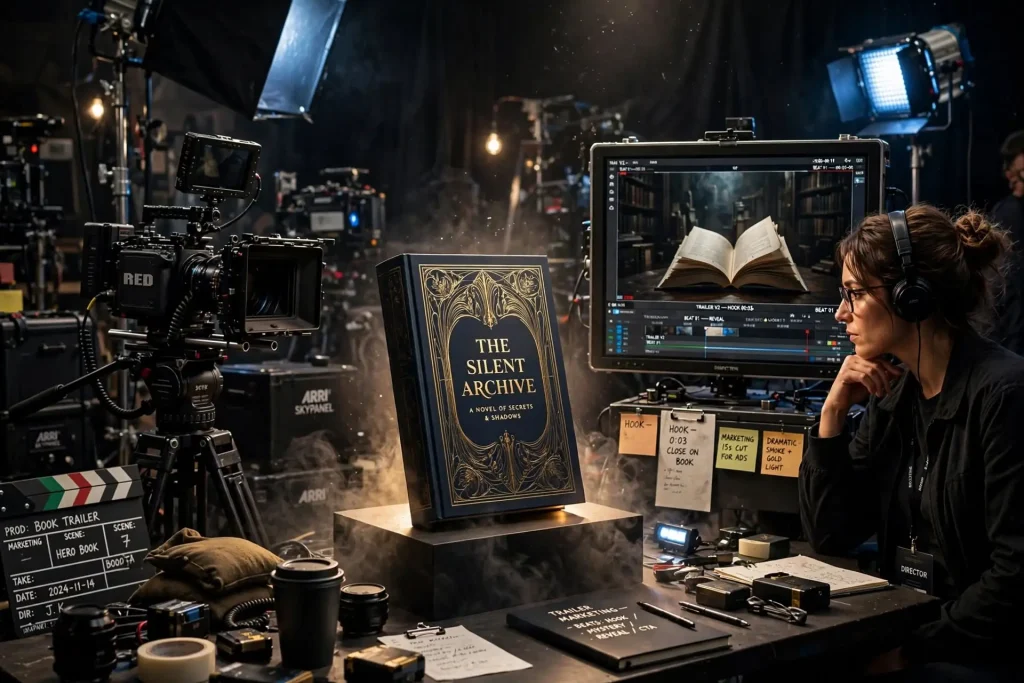
Book trailers have a mixed reputation among indie authors. Some authors spend thousands on professional video production and see modest returns. Others put together simple trailers in an afternoon and drive significant sales. The difference isn’t the production budget. It’s knowing what book trailers actually do, where they work in the marketing mix, and how to produce videos that match modern audience expectations on TikTok, Instagram Reels, and YouTube Shorts. The book trailer marketing question that matters in 2026 is how to create short-form video that fits the platforms where readers actually discover books, not how to make Hollywood-style trailers that nobody watches.
This post walks through how book trailers work in current social media reality, what production approaches actually produce results, and how to distribute videos for maximum sales impact.
What Book Trailers Actually Do
Book trailers serve specific functions in the marketing mix.
Top of funnel awareness. Short video content reaches readers who scroll past static images. The motion, sound, and storytelling capture attention that traditional book covers can’t.
Genre signaling. Trailers communicate genre instantly through visual style, music choice, pacing, and tone. Readers in the target genre recognize the signals and engage. Readers outside the genre scroll past efficiently.
Emotional connection. Video can establish emotional connection to characters, themes, or premises faster than written description. Readers who feel the emotional hook from a trailer convert to interested readers at higher rates.
Algorithm fuel. Video content gets favored treatment on most social platforms. Posts with video reach more people than posts with static images alone. Book trailers feed the algorithms that drive organic reach.
Ad creative. Video ads typically outperform static image ads on Facebook, Instagram, and TikTok. Book trailers serve as the foundation for paid advertising campaigns.
Authors who treat trailers as just promotional content miss most of these functions. Authors who design trailers to work across these multiple purposes get more value from each production investment.
Short Form Video Reality in 2026
The video world has shifted significantly from the era of long-form book trailers.
TikTok dominates short-form discovery. The platform’s 15 to 60 second videos drive massive book discovery, particularly in romance, fantasy, YA, and certain thriller subgenres. BookTok influences sales at scale that traditional marketing channels can’t match.
Instagram Reels parallels TikTok format. Same short-form video length and style. Different audience overlap but similar discovery dynamics.
YouTube Shorts extends short-form video to YouTube’s audience. Up to 60 seconds. Similar format expectations to TikTok and Reels.
Traditional long-form YouTube book trailers (60 to 180 seconds) still exist but reach smaller audiences. They serve specific purposes like website embeds and ad creative but rarely drive significant organic discovery on YouTube alone.
The implication for trailer production. Most book trailer effort in 2026 should target 15 to 60 second video for vertical (9:16 aspect ratio) viewing on phones. The Hollywood-style horizontal trailer that worked in 2015 doesn’t fit current discovery patterns.
What Production Approach Actually Works
Several production approaches produce effective book trailers at different budget levels.
DIY mobile production. Modern phones produce video quality good enough for social media. Apps like CapCut, InShot, or Adobe Express handle editing. Music libraries like Epidemic Sound provide licensed tracks. Total cost can run under $50 if you already have the phone.
Quality matters more than budget. Authors who match the production style of successful trailers in their genre often produce results comparable to higher-budget productions.
Mid-budget freelance production. Services like Fiverr offer trailer production at $50 to $500 per video. Quality varies significantly. Look for portfolios showing successful trailers in your genre.
Higher-budget specialized production. Companies that specifically produce book trailers run $500 to $5,000+ per project. The investment makes sense for major launches or premium positioning.
AI-assisted production. Tools like Runway, Pika Labs, and others generate video from text prompts or still images. The technology is advancing quickly. For some trailer styles, AI tools produce acceptable results at minimal cost.
The choice between approaches depends on your specific goals. For social media discovery, simpler DIY production often outperforms higher-budget productions because it matches the platform aesthetic better.
Designing Trailers for Discovery
The trailers that drive discovery follow specific patterns that match how social media users actually consume content.
The opening 3 seconds matter most. Most social media users scroll past videos that don’t grab attention within 2 to 4 seconds. The hook needs to land immediately.
Hook patterns that work include compelling questions or statements that stop the scroll, emotional moments that connect viscerally, visual surprises that defy expectation, and quick promises of value or entertainment.
Captions are essential. Most social media users watch video with sound off. Trailers without captions lose 60% to 80% of viewers immediately. Burned-in captions or readable text overlays serve the silent viewing context.
Vertical orientation for mobile. Phones hold vertically dominate social media viewing. 9:16 aspect ratio fills the phone screen properly. 16:9 horizontal video appears small with significant black bars on phones.
Music that signals genre. Music choice tells viewers immediately what kind of book this is. Romance trailers use different music than thriller trailers, which use different music than literary fiction trailers.
Pacing that matches platform. TikTok and Reels reward fast pacing. Long static shots lose viewers. Quick cuts, motion, and visual changes maintain attention.
Strong call to action. The end of the trailer should tell viewers what to do next. “Available now” with the book title and author name. Strong CTAs in 5 to 10 second trailers convert at meaningful rates.
Trailer Content That Actually Works
Several content approaches produce effective book trailers across genres.
Aesthetic mood pieces. Visual collages that establish atmosphere and tone without explaining plot. Strong for literary fiction, romance, and certain fantasy subgenres.
Character introduction trailers. Show specific characters with brief identifying text. Strong for character-driven fiction.
World-building trailers. Visual introduction to the setting or world of the book. Strong for fantasy, sci-fi, and historical fiction.
Premise trailers. Quick text-based explanation of the book’s central question or hook. Works across many genres when the hook is strong.
Quote trailers. Visual treatment of striking lines from the book. Strong for literary fiction and certain commercial fiction.
Behind-the-scenes trailers. Author talking about writing the book, inspiration, or process. Strong for nonfiction and for fiction with personal angle.
Reader reaction trailers. Featuring genuine reader reactions to the book. Strong social proof for books with established readership.
The choice between approaches depends on genre conventions and what fits the book’s specific selling points.
Music & Sound Selection
Music choice often determines if a trailer succeeds or fails.
Licensed music sources for indie authors. Epidemic Sound, Artlist, and Storyblocks offer subscription access to licensed music. Costs run $15 to $25 per month. Music can be used commercially without per-track licensing fees.
YouTube and TikTok music libraries. These platforms provide some free music for use in videos on their platforms. The licensing typically allows use only on that specific platform.
Stock music libraries. Sites like AudioJungle offer pay-per-track licensing. Useful for one-off trailers without subscription commitment.
Avoid copyrighted music without license. Using popular songs without proper licensing causes problems. Videos get muted or removed. Accounts can get penalized.
Music selection criteria. The music should match genre expectations. The pacing should match the visual edit. The mood should connect to the book’s emotional tone. The intensity should build appropriately across the trailer’s duration.
For short trailers (15 to 30 seconds), simpler music with clear structure works better than involved layered compositions.
Visual Elements That Strengthen Trailers
Several visual elements consistently improve book trailer effectiveness.
Book cover prominently displayed. The cover should appear clearly at least once, usually near the end. Viewers need to be able to recognize the book if they see it again later.
Author name visible. The author’s name should appear clearly so viewers can search for the book or author later.
Genre-appropriate imagery. Stock footage, original photography, illustration, or animation all work when they match genre conventions. Mismatch between genre expectations and visual style confuses viewers.
Typography that signals genre. Text overlays use fonts and styles that fit the book’s genre. Romance trailers use different typography than thrillers.
Color palette consistent with cover. The trailer’s color treatment should connect to the book cover’s palette. The visual continuity helps the trailer reinforce cover recognition.
Movement that maintains interest. Static images with simple motion (Ken Burns effect, zoom in/out) outperform completely static visuals. Full video footage usually outperforms still images when budget allows.
Avoid visual clutter. Too many elements competing for attention reduces effectiveness. Simple, clear visual treatment usually beats busy montages.
Distribution Strategy
Where and how you distribute the trailer affects how much value it produces.
TikTok and Reels for organic discovery. Post the trailer to TikTok and Instagram Reels as native content. Use relevant hashtags. The platforms favor native uploads over linked content.
YouTube for evergreen visibility. Upload the trailer to YouTube where it can be discovered through search over time. Optimize the title, description, and tags for relevant searches.
Website embed. Place the trailer on your book’s landing page and author website. The video improves engagement with the page and provides preview content for visitors.
Email marketing. Include the trailer (or a link to it) in launch announcements and other promotional emails. Subscribers engage more with video content than static images.
Paid advertising. Use the trailer as creative in Facebook, Instagram, and TikTok ad campaigns. Video ads typically outperform static image ads significantly.
Press kit inclusion. Provide the trailer to podcasts, bloggers, and media contacts as part of your media kit. They may share it through their channels.
Multiple distribution channels working together produce more total value than any single channel alone.
Common Book Trailer Mistakes
Several patterns regularly produce trailers that fail to deliver results.
Treating trailers like Hollywood movie trailers. Most book audiences don’t expect cinematic productions. Simpler social-media-style trailers often outperform expensive Hollywood-style productions.
Too long. Trailers over 60 seconds lose most viewers before the end. Cut ruthlessly for length on social platforms.
Wrong aspect ratio for the platform. Horizontal trailers don’t work well on TikTok or Reels. Vertical (9:16) is essential for mobile-first platforms.
Missing captions. Most viewers watch without sound. Trailers without captions lose those viewers.
Generic stock footage that doesn’t fit. Mismatch between stock footage and the book’s actual content or genre damages credibility.
Music license problems. Using copyrighted music without proper licensing causes platform issues. Stick to licensed sources.
No clear call to action. Trailers that don’t tell viewers what to do next miss conversion opportunities.
Posting once and forgetting. A single trailer post produces limited reach. Repurposing the trailer across multiple posts, formats, and platforms multiplies the value.
Skipping testing. Authors who post one trailer without testing alternatives miss learning what works for their audience. Test different opening hooks, music choices, and visual styles.
Treating Video as Ongoing Marketing Asset
The book trailer you produce isn’t a single-use asset. It continues working for the book across years if treated as ongoing infrastructure. The trailer that ran during launch week can run again 60 days later as part of a promotional cycle. It can serve as ad creative for months or years of paid advertising. It can appear on the book’s landing page indefinitely, supporting conversion for every visitor.
Authors who treat book trailers as launch-only content produce one trailer and never use it again after launch week ends. Authors who treat trailers as multi-use marketing assets get years of value from each production investment. The same trailer that drove 5,000 launch-day video views can drive 50,000 cumulative views over two years of continued use across ads, social posts, email marketing, and landing pages. The work to produce the trailer well happens once. The returns continue accumulating for as long as the book stays in catalog and the trailer continues being used. That math justifies higher production quality and more thoughtful planning than authors who think of trailers as disposable launch-week content typically apply.


