
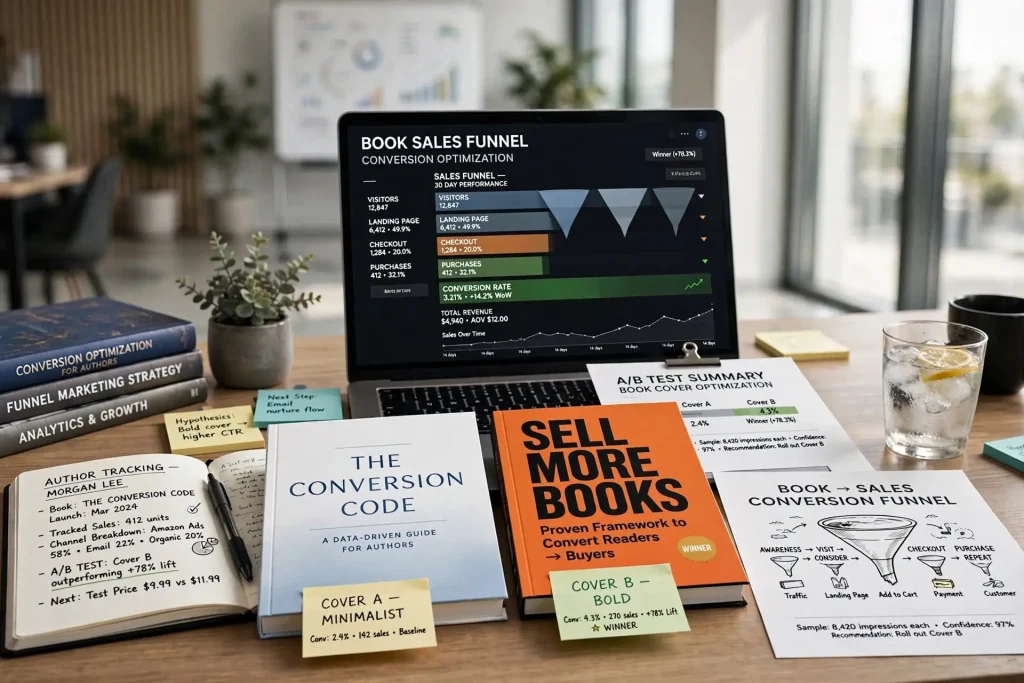
Most authors focus exclusively on driving traffic. More social media reach. More email subscribers. More ad clicks. The traffic is real but the actual sales numbers don’t match what the traffic should produce. The book conversion rate that authors actually achieve often runs significantly below what better optimization would produce. Doubling traffic produces twice the sales only if the conversion rate stays constant. Doubling the conversion rate produces the same effect with half the traffic and effort. Authors who learn conversion optimization tend to extract significantly more from their existing audience than authors who keep focusing only on traffic growth.
This post walks through where conversion actually happens for book sales, the specific elements that affect conversion, and how to systematically improve conversion rates rather than just driving more traffic.
Where Conversion Actually Happens for Books
Book sales involve several distinct conversion points where readers decide to take the next action.
The listing page conversion. Readers land on your Amazon or retailer listing and either buy or leave. This is where most book conversion happens.
The landing page conversion. For authors driving traffic from ads or email to dedicated landing pages, the landing page either converts visitors to retailer clicks or loses them.
The email signup conversion. Visitors to your website either join your email list or leave. The signup conversion determines if anonymous traffic becomes addressable audience.
The email-to-sale conversion. Email subscribers either convert to buyers when you send promotional emails or don’t. The percentage that converts varies dramatically by list quality and message strength.
The ad-to-click conversion. Ad creative either gets people to click through or doesn’t. The click-through rate affects ad efficiency significantly.
Each conversion point can be optimized separately. Authors who improve conversion at multiple points produce compound improvements that single-point optimization can’t match.
Listing Page Optimization
The Amazon (or other retailer) listing page is where most conversion happens for books.
Cover optimization. The cover does enormous work in the conversion decision. Strong covers convert at much higher rates than weak ones. Investment in cover design typically produces the highest ROI of any conversion improvement.
Title and subtitle clarity. Readers should know quickly what the book is about. Vague titles damage conversion. Clear titles with strong subtitles improve it.
Description structure. The first paragraph above the “Read more” fold matters most. Strong opening hooks convert readers to keep reading. Weak openings lose them immediately.
Description content. After the hook, the description should sell the experience or transformation the book provides. Specific details outperform generic language.
Description formatting. Bold tags, italics, and paragraph breaks make descriptions scannable. Walls of text convert worse than properly formatted descriptions.
Review profile. Strong review profiles dramatically affect conversion. Books with 100+ reviews at 4.5+ stars convert at 2x to 3x the rate of similar books with weak review profiles.
Editorial reviews section. Quoted reviews from credible sources signal quality. Even one strong editorial review can affect conversion.
Look inside content. The opening pages visible through Amazon’s preview affect conversion for readers who explore beyond the listing.
Price visibility. The listed price affects conversion. Pricing that matches genre conventions converts better than pricing significantly above or below.
Each element compounds with the others. A book with strong cover, clear title, compelling description, and good reviews converts much better than the same book with any of these weakened.
Description Conversion Mechanics
The book description specifically deserves focused attention because authors typically have full control over it.
Strong opening hook. The first sentence should grab attention. Generic openings (“This book is about…”) lose readers. Specific evocative openings keep them reading.
Conflict or stakes establishment. For fiction, the conflict should be visible quickly. For nonfiction, the specific problem the book solves should be clear.
Specific details. Generic language doesn’t convert. Specific details about characters, situations, or content engage readers in concrete ways.
Genre signaling through language. Romance descriptions sound different from thriller descriptions sound different from business book descriptions. The language signals genre as much as the cover.
Reader benefit clarity. Nonfiction descriptions especially need to tell readers what they’ll gain. Specific benefits outperform vague promises.
Social proof integration. References to awards, bestseller status, or notable endorsements support conversion. Avoid empty claims, but include verified credentials.
Strong close with implicit call to action. Descriptions should end in ways that create urgency or anticipation. The reader should feel motivated to buy rather than walk away.
Test descriptions over time. Different opening hooks, different lengths, different structures. The data reveals what works for your specific book.
Cover Optimization for Conversion
Beyond initial cover design, cover optimization is an ongoing consideration.
Test alternative covers periodically. Major books sometimes get cover refreshes that improve conversion. The test costs the design fees and the brief disruption but can produce sustained conversion improvement.
Track conversion data. Note the conversion rate before and after any cover changes. The data reveals if changes helped or hurt.
Watch for genre evolution. Cover conventions shift over years. Covers from 2018 may not perform as well in 2026 as updated covers would. Periodic refresh keeps pace with genre evolution.
A/B testing for covers. Some authors test alternative covers in paid advertising to identify which performs better before committing to a permanent cover change.
Subgenre-specific optimization. Books that fit multiple subgenres might benefit from cover treatments that better align with the higher-converting subgenre.
The cover does so much work in conversion that ongoing attention to it usually pays back significantly more than ongoing attention to other elements.
Pricing Conversion Effects
Pricing significantly affects conversion rates.
Genre-appropriate pricing. Books priced significantly above or below genre conventions convert worse. The mismatch signals quality concerns or value problems.
Promotional pricing periods. Limited-time pricing creates urgency that drives concentrated conversion. Permanently discounted books lose the urgency effect.
Price points that work for specific tiers. $0.99, $2.99, $4.99, and $9.99 are psychological price points that often outperform similar nearby prices.
Series first-book discounting. First books in series at $0.99 typically convert at higher rates than the same books at $3.99. The series read-through value justifies the lower initial conversion price.
Pricing as quality signal. Premium pricing signals quality for some genres. Discount pricing signals quality concerns. The pricing decision affects perceived value.
Test pricing over time. Move books between price points and track conversion changes. Patterns emerge that inform better pricing decisions.
Email Funnel Conversion
Email marketing has its own conversion mechanics distinct from listing page conversion.
Subject line optimization. The percentage of subscribers who open emails directly affects every subsequent metric. Strong subject lines produce 30%+ open rates. Weak ones produce 15% or less.
Sender name and identity. Emails from a person convert better than emails from a company. Personal names with photos build connection.
Email length calibration. Different content works at different lengths. Test long versus short for your specific list.
Call to action clarity. Each email should have one primary action you want subscribers to take. Multiple competing CTAs reduce conversion.
Personalization elements. Subscriber names, segmented content, dynamic personalization all support conversion improvement.
Sequence design. Welcome sequences for new subscribers, launch sequences for new books, ongoing nurture sequences. Each sequence has its own conversion dynamics.
Test email approaches systematically. The patterns that work for your specific audience reveal themselves through testing.
Common Conversion Mistakes
Several patterns regularly weaken conversion across the various touchpoints.
Focusing only on traffic. Authors who drive massive traffic without optimizing conversion leave significant sales unclaimed.
Generic descriptions. Listings that could describe any book convert poorly. Specificity matters.
Weak covers driving good traffic. Strong marketing campaigns wasted on weak covers produce poor conversion regardless of traffic quality.
Inconsistent messaging. Ads promising one experience while listings deliver different messaging confuse readers and damage conversion.
No conversion tracking. Authors who don’t measure conversion can’t optimize it. Basic tracking reveals where opportunities exist.
Treating conversion as fixed. Conversion rates change over time. Periodic testing and optimization produces ongoing improvement rather than stagnation.
Skipping mobile optimization. Most traffic comes from mobile devices. Listings and landing pages that work on desktop but fail on mobile lose significant conversion.
Long landing pages that hide the offer. Landing pages with too much content before the call to action lose readers before they reach the conversion point.
Conversion Work That Pays Across Every Reader
The compound math of conversion improvement makes it one of the highest-leverage activities in book marketing. A book that converts at 3% on listing page views earns half as much as the same book converting at 6% from the same traffic. Doubling the conversion rate doubles the sales without any change in marketing spend or audience reach. The improvement continues for as long as the book stays in catalog, which can be a decade or more for evergreen titles.
Authors who treat conversion optimization as serious ongoing work tend to extract significantly more from their existing audiences and traffic sources than authors who focus only on driving more traffic. The work involves attention to many small details rather than dramatic single changes. Cover refresh. Description improvement. Email sequence optimization. Landing page testing. Each individual improvement might affect conversion by 5% to 20%. The cumulative effect across years of optimization can be 2x to 5x improvement over baseline. That kind of improvement compounds dramatically when applied across a growing catalog of books, each benefiting from the optimization patterns the author has learned. The investment in conversion thinking pays back across every reader who encounters every book for as long as the books remain in catalog.


