
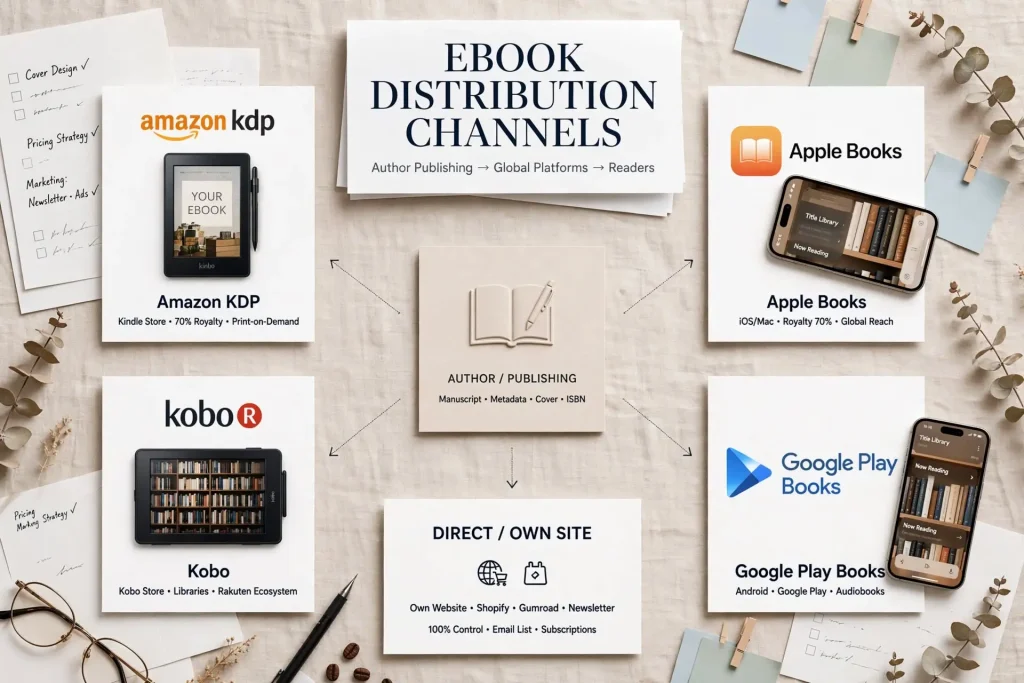
Most authors think about ebook distribution as a binary choice between Amazon-exclusive and “wide.” The reality of ebook distribution involves a much more specific set of channels, each with its own dynamics, audience, and operational considerations. Authors who treat distribution as binary often miss meaningful opportunities on channels that would serve their books well. The ebook distribution decisions that produce sustainable sales involve channel-specific knowledge rather than ideological positions about exclusivity versus wide. Authors who learn the channels can make informed decisions about which to engage and which to skip based on their specific situations.
This post walks through the major ebook distribution channels, what each offers, and how to think about building distribution strategy from channel-specific options rather than from broad strategic positions.
The Distribution Channel Map
Several specific channels make up the ebook distribution map.
Amazon KDP. The dominant US ebook platform. Most authors start here and many never expand beyond.
Apple Books. Significant market share, particularly in iOS-heavy markets and certain demographics.
Kobo. Strong international presence with active promotional opportunities.
Google Play Books. Integrated with broader Google search infrastructure.
Barnes and Noble Press. Smaller share but still meaningful for some books.
Aggregators. Draft2Digital and PublishDrive distribute to multiple platforms through single uploads.
Library platforms. OverDrive and Hoopla reach library readers through library systems.
Direct sales. Author websites selling books directly to readers.
International specialty platforms. Tolino in Germany, Storytel, and others serve specific markets.
Subscription platforms. Kindle Unlimited, Scribd, and others operate subscription models.
Each channel has specific operational requirements and revenue dynamics. Authors should know what each offers before deciding which to engage.
Amazon KDP
Amazon KDP remains the dominant ebook channel for most authors.
The market share reality. Amazon captures the majority of US ebook sales. Most authors generate most of their ebook revenue here regardless of other distribution.
The exclusivity choice. KDP Select enrollment requires Amazon exclusivity but enables Kindle Unlimited participation and specific promotional tools.
The royalty structure. 70% royalty for books priced $2.99 to $9.99 in major markets. 35% royalty for other price points.
The promotional tools. Kindle Countdown Deals, free promotion days (for KDP Select books), Amazon Advertising platform.
The algorithm dynamics. Amazon’s algorithms favor books with strong sales velocity. The algorithmic visibility affects ongoing sales significantly.
The Kindle Unlimited consideration. KU enrollment can generate significant revenue in certain genres (romance, certain fantasy, certain thrillers) but limits other distribution.
The operational simplicity. Single platform with mature tools and straightforward operations.
Amazon-only strategies work for some authors. Authors in KU-dominant genres particularly benefit. Other authors leave significant revenue on the table by staying Amazon-only.
Apple Books
Apple Books reaches readers Amazon often doesn’t.
The audience characteristics. Apple Books readers skew toward Apple device users, often higher-income demographics, particular preferences in fiction and nonfiction.
The market share. Smaller than Amazon overall but meaningful in specific genres and markets.
The promotional opportunities. Apple has its own promotional placements that featured books can access.
The royalty structure. 70% royalty across price points.
The upload process. Apple Books requires specific upload procedures. Mac-based upload tools work most cleanly.
The metadata requirements. Apple has specific metadata expectations that differ from Amazon.
The international strength. Apple Books has strong presence in certain international markets where Apple devices dominate.
Authors distributing wide often see Apple Books as their second-largest revenue source after Amazon. The platform deserves attention rather than treatment as afterthought.
Kobo Writing Life
Kobo offers specific opportunities for authors who engage it.
The international presence. Strong in Canada, UK, Australia, and several European markets.
The promotional system. Kobo Writing Life provides promotional opportunities including merchandising, daily deals, and platform-wide sales.
The metadata flexibility. Kobo allows specific metadata customization that supports international markets.
The pricing flexibility. Kobo allows pricing strategies that differ by market.
The royalty structure. 70% royalty on books priced appropriately. 45% on lower-priced books.
The audience characteristics. Kobo readers tend to be heavy ebook consumers with specific genre preferences.
The active engagement opportunity. Authors who actively engage Kobo’s promotional opportunities often see significant Kobo revenue. Authors who upload and ignore typically see minimal Kobo sales.
For authors with international audiences or in genres where Kobo readers concentrate, the platform deserves active engagement rather than passive distribution.
Google Play Books
Google Play Books has specific characteristics worth knowing.
The Google search integration. Books on Google Play can appear in Google search results, providing discovery beyond the book platform.
The audience characteristics. Android users particularly. Different demographic patterns than Apple Books.
The royalty structure. 70% royalty for most books with specific conditions.
The promotional system. Less mature than Amazon or Apple but exists.
The upload process. Specific Google Play Books interface for direct uploads or distribution through aggregators.
The metadata requirements. Google has specific metadata expectations.
The growing market. Google Play Books market share has been growing relative to other platforms.
For authors with technical, business, or other content that benefits from Google search visibility, the platform offers specific advantages.
Barnes & Noble Press
Barnes and Noble Press serves specific reader populations.
The Nook reader audience. Readers using Nook devices and apps. Smaller market than major platforms but still meaningful.
The royalty structure. Specific royalty rates that should be checked against current platform terms.
The promotional opportunities. Some promotional capabilities exist.
The upload process. Direct upload through Barnes and Noble Press interface.
The audience characteristics. Tends toward specific reader demographics that overlap less with other platforms than initially might be expected.
For authors with audiences that include Nook users, the platform deserves at least basic distribution attention.
Direct Sales Through Your Site
Direct sales offer specific advantages beyond retail platforms.
The higher royalty. Direct sales can pay 90%+ royalty after payment processing costs. Significantly higher than retail platforms.
The customer relationship. Direct sales let you collect customer email and build direct relationships.
The platform independence. Direct sales don’t depend on retail platforms for sales infrastructure.
The setup requirements. Direct sales require website infrastructure, payment processing, file delivery systems.
The marketing requirements. Direct sales depend on your own marketing rather than retail platform visibility.
The operational complexity. Sales tax, returns, customer service all become your responsibility.
The customer base building. Direct sales build owned audience that other distribution doesn’t.
Authors building serious direct sales operations often see them grow into significant revenue sources over years. The investment in setup pays back across years of subsequent direct revenue.
Aggregators (Draft2Digital & PublishDrive)
Aggregators simplify distribution to multiple platforms.
The Draft2Digital approach. Single upload distributes to multiple platforms (Apple, Kobo, Barnes and Noble, others). Takes percentage of sales as service fee.
The PublishDrive approach. Similar but with different platform reach and different pricing model.
The advantages. Operational simplicity through single upload point. Some smaller platforms only accessible through aggregators.
The disadvantages. Royalty reduction through aggregator percentage. Slower update propagation than direct uploads.
The hybrid approach. Direct uploads to major platforms (Apple, Kobo) while using aggregators for smaller platforms.
The reporting consolidation. Aggregators provide consolidated sales reporting across multiple platforms.
The metadata sync. Updates through aggregators propagate to all distributed platforms.
For authors wanting wide distribution without operational overhead, aggregators provide reasonable solution. The royalty reduction is the trade-off for simplicity.
Library Channels
Library distribution generates meaningful revenue for some authors.
The OverDrive distribution. Library platform reaching readers through library systems. Specific royalty model based on library purchases.
The Hoopla distribution. Alternative library platform with different model.
The library audience. Library readers often differ from retail readers in genres and preferences.
The royalty model. Library sales typically pay specific royalties per library purchase or per checkout.
The distribution access. Library distribution requires either direct relationships with library platforms or distribution through aggregators that include library channels.
The exclusivity implications. Amazon KDP Select exclusivity prevents library distribution. Wide distribution authors can reach libraries.
The audience growth value. Library readers can become retail buyers later. The audience development matters beyond direct library revenue.
For authors with library-appropriate content, library distribution deserves serious consideration as revenue source and audience builder.
International Channels
International distribution opportunities exist beyond major US platforms.
The Tolino platform. Strong German market presence. Access through aggregators or specific arrangements.
The Storytel platform. Strong Scandinavian and certain other European markets.
The 24Symbols and similar. Subscription platforms with specific market reach.
The translation considerations. International markets often benefit from translated editions. Translation investment creates new revenue source.
The cultural localization. Some markets benefit from market-specific descriptions, covers, or pricing.
The platform-specific tools. Different international platforms have different promotional opportunities.
The growth opportunity. International ebook markets continue growing. Early presence in growing markets builds long-term position.
Authors with international audience appeal benefit from international distribution attention. Generic global distribution captures less revenue than market-specific engagement.
Subscription Channels
Subscription platforms operate differently from purchase platforms.
Kindle Unlimited. Amazon’s subscription service. Pays per page read. Requires KDP Select exclusivity.
Scribd. General reading subscription. Different revenue model than KU.
Other subscription services. Various smaller subscription platforms exist with different models.
The revenue model differences. Per-page-read versus per-borrow versus per-subscription-share. Each affects total revenue differently.
The audience characteristics. Subscription readers tend to consume more books than retail readers. The volume can compensate for lower per-book revenue.
The strategy implications. Subscription enrollment is strategic decision affecting other distribution options.
The income predictability. Subscription revenue can provide more predictable monthly income than retail sales.
For authors in genres where subscription audiences concentrate (romance, certain fantasy, certain mystery), subscription channels can generate significant revenue. For other genres, subscription may not produce meaningful results.
Channel Choices That Serve Your Catalog
The ebook distribution decisions that produce sustainable results involve channel-specific knowledge rather than ideological commitments to exclusivity or wide. Different channels serve different books, different genres, and different audience profiles differently. Authors who learn channel specifics tend to make better distribution decisions than authors operating from broad strategic positions without channel-level knowledge.
The work to build channel knowledge isn’t extreme. Reading channel documentation. Joining author communities discussing specific channels. Watching how successful authors in your genre handle distribution. Testing channels with at least basic distribution before deciding to skip them. The investment in channel knowledge pays back across years of subsequent distribution decisions. Authors who understand channel specifics typically build distribution strategies that capture more reach than authors operating without that knowledge. The right channel mix for your specific situation depends on your genre, audience, business strategy, and operational capacity. The mix that works for someone else may not work for you. The honest evaluation of which channels serve your catalog produces better outcomes than copying successful authors whose situations differ from yours. Channel decisions deserve regular review as your catalog grows and your audience develops. The channel mix that worked at one career stage may not be optimal at another. Authors who treat distribution as ongoing strategic discipline rather than one-time setup tend to maintain reach that matches their evolving needs.


