
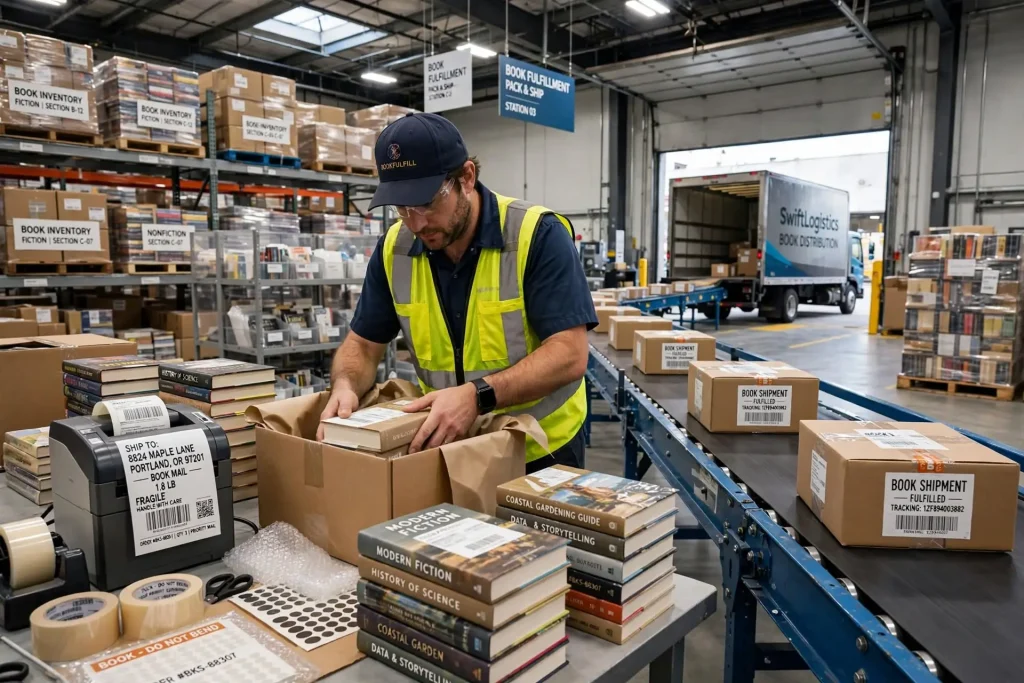
Most authors think of book shipping as something that happens after the sale, handled by the retailer, with no author involvement. For typical POD print sales through Amazon and IngramSpark, that’s roughly accurate. But once you start selling direct, ordering bulk copies for events, or handling international shipping for your own audience, the book shipping process becomes something you have to manage. The logistics affect costs, timing, customer experience, and ultimately if the operations side of your author business runs smoothly or eats your time.
This post walks through how book shipping actually works across the main scenarios authors encounter, what each scenario costs, and how to handle the logistics without making them a full-time job.
Why Book Shipping Has Its Own Logistics
Books have specific shipping characteristics that affect how they move.
Books are heavy relative to size. A 300-page paperback weighs roughly 12 to 16 ounces. A hardcover weighs 24 to 30 ounces. Weight drives shipping costs significantly.
Books need protection during shipping. Damaged corners, bent covers, and wet pages all reduce perceived quality and can generate refund requests. Proper packaging matters more than the contents would suggest.
Books are usually low margin per unit. The shipping cost can easily exceed the per-book profit margin if not handled carefully.
Books often ship internationally. Authors with global audiences regularly handle shipments to different countries, each with its own customs requirements and shipping options.
These characteristics mean book shipping decisions matter more than authors typically expect. Bad shipping decisions can eat profitability quickly.
Print on Demand Shipping
POD shipping is the simplest scenario because the platforms handle everything.
Amazon KDP Print orders ship through Amazon’s logistics network. The book gets printed at Amazon’s print facility, packaged, and shipped to the customer. Standard shipping takes 5 to 7 business days in the US. Prime members typically receive Prime shipping speeds even on POD books.
IngramSpark orders ship through Ingram’s print and distribution network. The book gets printed at Ingram’s facility, packaged, and shipped through the retailer that placed the order (Barnes & Noble online, independent bookstores, Amazon when not using KDP Print). Customer delivery typically takes 7 to 14 days.
Authors don’t see or handle any of this. The platforms handle printing, packaging, and shipping entirely. Author involvement ends when the book is published and made available.
The shipping cost gets included in the retailer’s pricing to the customer. For Amazon Prime members, shipping appears free. For non-Prime customers, shipping fees apply at the retailer’s standard rates.
Authors receive only the royalty portion. The shipping costs and printing costs come out before royalty calculation, which is why POD print royalties run lower than authors typically expect.
Bulk Order Shipping for Direct Sales
When authors buy bulk copies for direct sales, events, or other purposes, the shipping equation changes significantly.
KDP Print author copies ship from the same print facility but at author cost. Author copy pricing is the print cost only (no profit margin). Shipping costs are added on top.
Standard shipping for KDP author copies takes 5 to 10 business days domestically. Expedited shipping is available at higher cost.
Bulk pricing tiers reduce the per-copy cost for larger orders. Orders of 25, 50, 100, or more copies often qualify for volume pricing.
IngramSpark author copies work similarly. Print cost plus shipping. Volume discounts available for larger orders.
For most authors, ordering 25 to 100 copies for event use makes sense periodically. The bulk shipping cost per copy is significantly lower than ordering individual copies as needed.
Direct Sales Shipping Operations
Authors selling directly to readers (through their website, at events, or through other direct channels) handle shipping themselves.
The simplest direct sales setup involves the author shipping each order personally. Books in your inventory, packaging materials in your workspace, postage purchased online or at the post office, packages dropped at the post office or picked up.
This works for low-volume direct sales. The math falls apart at higher volume because the time investment exceeds the per-book profit.
Fulfillment services (third-party warehouses that store inventory and ship orders on your behalf) make sense once direct sales reach meaningful volume. Services like ShipBob, ShipMonk, and others handle the operational chain. Costs typically run $2 to $5 per shipment plus storage fees.
The breakeven point for fulfillment services varies by margin and order volume. Most authors should plan to handle direct sales themselves until volume reaches 100+ shipments per month.
Packaging materials matter. Padded mailers protect books better than basic envelopes. Bubble wrap inside the mailer prevents corner damage. Investment in proper packaging reduces complaints significantly.
International Shipping Considerations
International shipping adds complexity that domestic shipping doesn’t have.
Customs declarations are required for international shipments. The shipping form documents what’s in the package, its declared value, and the sender/recipient information. Books typically have favorable customs treatment but the declarations still need to be accurate.
Shipping costs scale dramatically for international destinations. A book costing $4 to ship domestically might cost $12 to $25 to ship internationally.
Delivery times vary widely. International shipments can take 1 to 6 weeks depending on destination, shipping service, and customs processing.
Tracking gets less reliable internationally. Tracking numbers work within originating country but often lose visibility once the package enters the destination country’s mail system.
Customs duties and taxes may apply on arrival. The recipient often pays these directly to the carrier or customs office. Authors shipping internationally should warn buyers about this possibility.
For most authors, the math on international direct sales is challenging. Shipping costs often exceed per-book profit. Authors with significant international audiences typically route those buyers to the retailers in their countries (Amazon UK, Amazon DE, etc.) rather than handling direct international shipping.
Shipping Cost Calculations
Knowing the actual shipping math helps authors price books and plan operations.
US domestic media mail rates. USPS Media Mail offers reduced rates for books. A typical book ships for $3 to $5 in media mail. Slower than first class (5 to 10 business days) but significantly cheaper.
US domestic priority mail rates. USPS Priority Mail offers faster delivery (2 to 3 business days) at higher cost. A typical book ships for $7 to $12 in priority mail.
US domestic ground shipping. UPS or FedEx ground service for books typically costs $7 to $15 depending on weight and distance.
International rates. USPS international first class for books starts around $14 to $20 to Canada and Mexico, $20 to $35 to most other destinations. Higher-priority international services cost significantly more.
These rates change periodically. Always verify current pricing through the carrier before quoting shipping to customers.
Packaging adds cost. Padded mailers run $0.50 to $1.50 each. Bubble wrap adds modest cost. Labels and printing add a few cents.
Total shipping cost per book typically runs $4 to $8 domestically and $15 to $30 internationally including packaging.
Lost or Damaged Shipments
Even with proper packaging, some shipments arrive damaged or get lost in transit.
Damaged shipments. Books with bent covers, water damage, or worse arrive looking unprofessional. The recipient typically expects replacement. Authors should plan for 1% to 3% damage rate on shipped books.
Lost shipments. Books that never arrive at the destination address. Tracking helps determine if the package was delivered or actually lost. Authors should plan for 0.5% to 1% lost shipment rate.
Insurance options exist but rarely make economic sense for individual book shipments. The cost of insurance often exceeds the cost of just replacing the occasional lost book.
Replacement policy matters. Most authors who handle direct sales replace lost or damaged books at their own cost. Building this into pricing prevents the replacements from eating into margins.
Tracking for accountability. Always use tracked shipping for direct sales. Untracked shipments make it impossible to resolve disputes about delivery.
Shipping Speed & Customer Expectations
Customer expectations around shipping speed have shifted significantly in recent years.
Amazon Prime conditioning. Many customers expect 2-day shipping as standard. Books that take 5 to 7 days feel slow even at standard shipping speeds.
Standard shipping for direct sales. Most authors realistically deliver in 5 to 10 business days from order to delivery. Setting expectations clearly at the time of purchase prevents complaints.
Shipping speed selection. Some authors offer multiple shipping options (standard, expedited) at different prices. Letting buyers pick prevents complaints from those who needed faster shipping.
Communication during shipping. Confirmation emails, tracking information, and delivery confirmation all reduce customer anxiety during the shipping wait. Automation tools handle these communications without ongoing author work.
Holiday season shipping. November and December produce shipping bottlenecks in carrier networks. Authors selling direct during the holidays should set realistic delivery expectations and order shipments earlier than typical.
Logistics as Part of the Author Business
Shipping isn’t the most glamorous part of being an author, but the logistics affect customer experience, profit margins, and operational time investment significantly. Authors who think carefully about their shipping operations early tend to make better decisions about which sales channels to develop and which to leave to the retailers.
For most indie authors, the math favors letting platforms handle the shipping chain. POD print through KDP and IngramSpark eliminates the operational burden of book shipping while providing reasonable customer delivery times. Direct sales make sense for specific situations (signed copies, events, premium pricing) but rarely as a primary distribution channel given the operational time investment required. The authors who scale direct sales successfully typically do so by either keeping volume modest enough to handle personally or by using fulfillment services once volume justifies the cost. Either approach works when the decision is made deliberately rather than defaulting into one or the other without thinking through the trade-offs.


