
Most authors learn ebook file formats only when something goes wrong. They upload the wrong format to a platform that doesn’t accept it. They send the wrong file type to a reader who can’t open it. They get conversion errors that don’t make sense. The ebook file formats actually used in publishing aren’t randomly assorted. Each format exists for specific reasons, serves specific purposes, and has specific limitations. Authors who learn the basic format catalog tend to handle file operations without the surprises that catch unprepared authors off guard.
This post walks through the major ebook file formats, what each is designed for, and how to handle the practical realities of multi-format ebook publishing.
What Ebook File Types Actually Are
Ebook file types are different technical specifications for how ebook content gets packaged for delivery to readers.
The container concept. Each file type defines how text, images, formatting, and metadata get bundled into a single file or package.
The reader compatibility. Each format works with specific reader applications and devices. Compatibility limits which formats serve which contexts.
The feature support. Different formats support different features. Some support rich formatting. Others support fixed layouts. Others support DRM.
The conversion relationships. Most formats can be converted to other formats with varying quality results. The conversion math matters for multi-format publishing.
The evolution history. Formats have evolved over time. Older formats persist alongside newer formats. Knowing the family tree helps make sense of the options.
The standards versus proprietary distinction. Some formats are industry standards. Others are proprietary to specific platforms. The distinction affects flexibility.
These foundational concepts apply across the specific formats described below. Each format exists within the broader ecosystem and has specific role.
EPUB
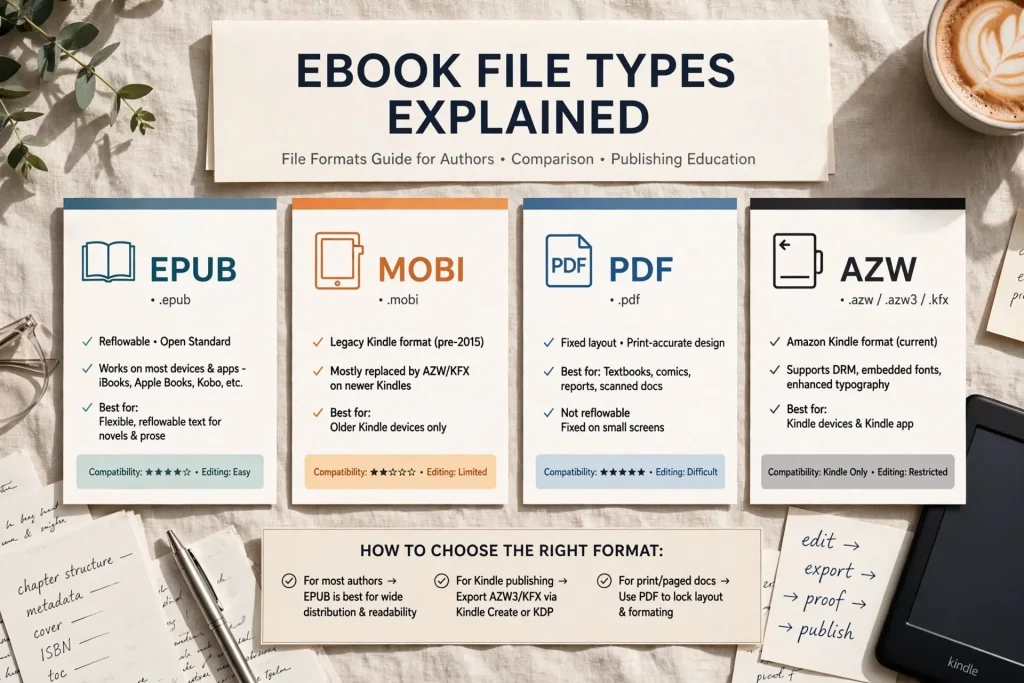
EPUB is the dominant industry-standard ebook format.
The format basics. EPUB stands for Electronic Publication. Open industry standard maintained by the International Digital Publishing Forum.
The structure. EPUB files are essentially zipped folders containing HTML/CSS content plus metadata.
The reflow capability. EPUB supports reflowing text that adjusts to different screen sizes. The standard for novels and most other reflowable content.
The version history. EPUB 2 is older standard with broad support. EPUB 3 adds capabilities like multimedia, scripting, and interactive elements.
The platform support. Apple Books, Kobo, Google Play Books, Barnes and Noble Press, and most non-Amazon platforms use EPUB as primary format.
The Amazon support. Amazon doesn’t sell EPUB directly but accepts EPUB uploads for conversion to Kindle formats. Many authors upload EPUB to KDP and let Amazon convert.
The accessibility features. EPUB supports accessibility features (screen reader compatibility, semantic markup) that other formats may lack.
The creation tools. Vellum, Atticus, Calibre, Sigil, Adobe InDesign, and many other tools create EPUB files.
EPUB is the format most authors encounter most often. Strong knowledge of EPUB serves most other format situations because conversion typically starts from EPUB.
MOBI
MOBI is the legacy Kindle format that’s largely been replaced.
The format basics. MOBI stands for Mobipocket. Amazon acquired Mobipocket and used MOBI as Kindle format historically.
The status. Amazon has phased out MOBI in favor of newer formats. New uploads to KDP no longer use MOBI specifically.
The continued presence. MOBI files still exist for older Kindle ebooks. The format hasn’t disappeared from the ecosystem.
The legacy reader support. Older Kindle readers and apps still support MOBI. Newer Kindle devices may prefer newer formats.
The conversion uses. Some workflows still produce MOBI files for compatibility with older systems.
The replacement formats. AZW3 and KFX have largely replaced MOBI in current Amazon use.
For practical purposes, new authors don’t need to focus on MOBI specifically. Uploaded EPUB files get converted to whatever current Amazon formats are needed.
AZW3
AZW3 is the modern Kindle format that replaced MOBI.
The format basics. AZW3 (Amazon Word 3, also called KF8) is Amazon’s enhanced format with better feature support than MOBI.
The capability improvements. Supports better typography, CSS3 features, multiple fonts, and other modern features that MOBI didn’t.
The reader compatibility. Newer Kindle devices and apps support AZW3 well. Older devices may not.
The current Amazon use. Amazon uses AZW3 for many books in its system, often alongside or transitioning to KFX.
The conversion considerations. AZW3 files can be created from EPUB through Amazon’s conversion or through tools like KindleGen (legacy) or Kindle Create.
The DRM application. Amazon applies its DRM at the AZW3 level for books that have DRM enabled.
AZW3 matters mostly as the format Amazon delivers to readers rather than as a format authors directly manage. Most authors upload EPUB and Amazon handles the conversion.
KFX
KFX is Amazon’s newest Kindle format.
The format basics. KFX is Amazon’s most recent format, designed for the latest Kindle features and devices.
The feature support. Supports advanced typography, enhanced typesetting (with proper margins, word spacing, hyphenation), and other modern features.
The device requirements. Requires newer Kindle devices and apps. Older Kindles can’t display KFX properly.
The Amazon adoption. Amazon increasingly uses KFX for new ebooks while maintaining AZW3 compatibility for older devices.
The author workflow. Authors don’t create KFX directly. Amazon generates KFX from uploaded EPUB or other source files.
The DRM integration. KFX includes DRM capabilities used by Amazon’s protection systems.
KFX shows the direction Amazon is moving. The format matters for knowing what Amazon delivers but isn’t something most authors create directly.
AZK
AZK is the Kindle format for Apple devices.
The format basics. AZK is the variant of Kindle format optimized for iOS devices specifically.
The use context. Used in the Kindle app on iPhones and iPads, where iOS limitations affect what formats work cleanly.
The author relevance. Most authors don’t deal with AZK directly. Amazon handles format selection for delivery to iOS Kindle apps.
The technical existence. The format exists primarily because iOS and Amazon platform interactions sometimes require specific format handling.
For practical purposes, AZK is a format authors should know exists but rarely need to handle directly.
PDF serves specific functions in ebook publishing despite not being primarily an ebook format.
The format basics. PDF (Portable Document Format) is fixed-layout format designed for consistent presentation across devices.
The fixed-layout strength. PDF preserves exact formatting regardless of reading device. Pages look the same on phones, tablets, and computers.
The reflow limitation. PDF doesn’t reflow text. Reading PDFs on small devices often requires zooming and scrolling.
The use cases for ebook publishing. Cookbooks, technical books with specific formatting, art books, children’s picture books, and other content where fixed layout matters.
The platform support. Most platforms accept PDF for specific use cases. Amazon accepts PDF uploads but converts to other formats. Direct PDF sales work on most retail platforms.
The creation tools. Adobe InDesign, Microsoft Word, Pages, and many other tools produce PDF.
The DRM options. PDF supports several DRM systems though application varies by use case.
For reflowable text content (novels, most nonfiction), PDF isn’t the best choice. For fixed-layout content, PDF often makes more sense than EPUB.
IBOOKS
IBOOKS is Apple’s specialized format.
The format basics. IBOOKS is Apple’s enhanced format for Apple Books with capabilities beyond standard EPUB.
The platform exclusivity. Created through iBooks Author software. Distributed only through Apple Books.
The capability advantages. Supports interactive elements, multimedia, and other advanced features that standard EPUB doesn’t.
The use case fit. Educational content, illustrated books, and other content benefiting from interactive features.
The author adoption. Limited compared to standard EPUB use. Authors creating Apple-exclusive enhanced content might use IBOOKS.
For most authors, standard EPUB serves Apple Books distribution better than IBOOKS since standard EPUB also works elsewhere. IBOOKS makes sense only for Apple-exclusive content with specific interactive needs.
Why Multiple Formats Exist
The format ecosystem reflects multiple historical and technical realities.
The platform competition. Different platforms developed their own formats during early ebook market development. Standardization came later.
The technical capability differences. Different formats support different capabilities. The fragmentation reflects different priorities.
The DRM system differences. Each major platform’s DRM operates within its own format. Cross-platform DRM is difficult.
The historical legacy. Older formats persist because they have installed bases of readers and devices.
The evolution toward standards. EPUB has emerged as industry standard for reflowable content. Proprietary formats persist mainly for platform-specific features.
The likely future direction. Continued movement toward EPUB as primary standard with proprietary formats for platform-specific features.
The complexity isn’t going away soon but is gradually simplifying around EPUB plus platform-specific extensions.
Platform Specific Format Requirements
Different platforms have different format requirements that affect upload decisions.
Amazon KDP. Accepts EPUB, DOCX, and several other formats. Converts uploaded files to Amazon’s delivery formats (AZW3, KFX) automatically.
Apple Books. Accepts EPUB primarily. IBOOKS for special cases.
Kobo. Accepts EPUB as primary format.
Google Play Books. Accepts EPUB and PDF.
Barnes and Noble Press. Accepts EPUB.
Library platforms (OverDrive, Hoopla). Specific format requirements vary.
Aggregators (Draft2Digital, PublishDrive). Accept various formats and handle distribution-specific conversions.
The practical implication. Authors who produce strong EPUB files can distribute to most platforms. EPUB serves as universal source format for most distribution.
Conversion Tools & Workflows
Several tools handle ebook format conversion.
Vellum. Mac-only tool that creates EPUB and other formats from source content. Strong default formatting.
Atticus. Cross-platform tool similar to Vellum. Newer but capable.
Calibre. Free conversion tool that handles many format conversions. Powerful but with learning curve.
Adobe InDesign. Professional layout tool that produces EPUB and PDF.
Microsoft Word. Can produce EPUB through various paths. Often produces suboptimal results compared to dedicated tools.
Kindle Create. Amazon’s tool for creating Kindle-format files. Useful for Amazon-specific work.
Sigil. Open-source EPUB editor for direct EPUB manipulation.
The workflow recommendation. Create strong EPUB through dedicated tool. Let platforms convert from EPUB to their formats as needed.
File Format Knowledge as Career Foundation
The ebook file format knowledge serves authors across years of subsequent publishing work. The specific formats change over time but the underlying concepts persist. Authors who learn how formats work, what each is designed for, and how conversion happens tend to handle format situations without the panic that catches unprepared authors when something goes wrong.
The investment in basic format knowledge isn’t extreme. Reading documentation. Experimenting with conversion tools. Joining author communities discussing format issues. The knowledge accumulates gradually and supports operational confidence across years. Authors who treat formats as serious technical infrastructure tend to develop publishing operations that handle format situations smoothly. Authors who treat formats as confusing technical mysteries often struggle with avoidable problems repeatedly. The format ecosystem is involved but not impossibly so. The basic catalog of formats, what each does, and which platforms use which becomes manageable with modest study. The knowledge supports decisions about which tools to use, which platforms to distribute to, and how to handle the technical realities of multi-format ebook publishing. The investment pays back across every book published afterward, making format knowledge one of the more practical technical skills available in indie publishing today.


